 Netwrck
Mystery.
The forest below the stacks
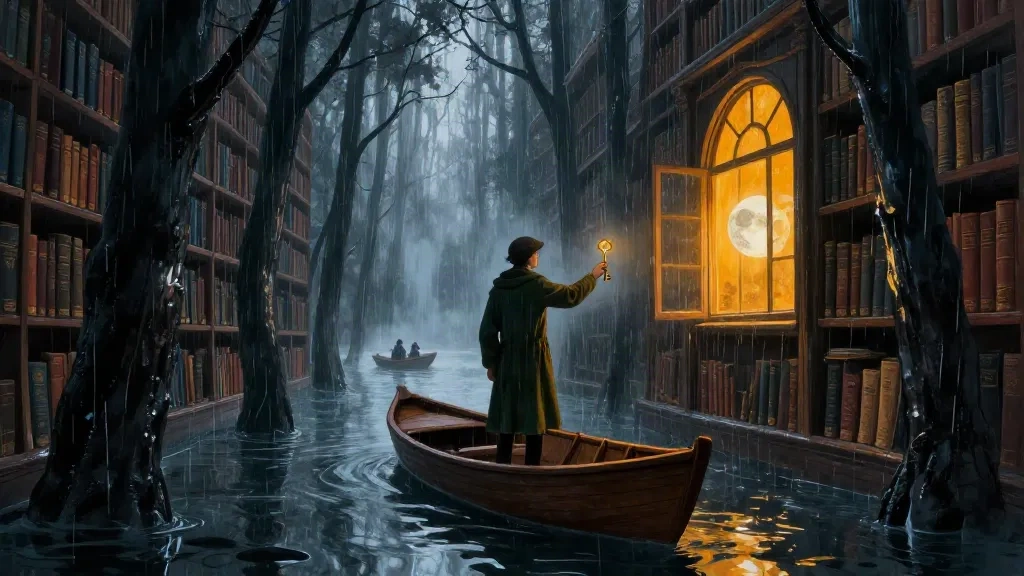
Ranger Ilyan Vess reached the flooded archive by rowboat, with a lantern, a waterproof chart, and no permission to ask why a forest had been evacuated from its own years. The channel took nine hours of poling. Rain fell the whole way down, thin and silver, and never once struck the water. It went sideways into the stacks, into the reading rooms, into the years.
The forest grew between submerged shelves. Black trunks rose through rows of forgotten atlases, their branches spreading beneath the vaulted ceiling, their leaves silver on one side and dark on the other. They made a sound like coins in a dry throat. Librarians rowed between them in flat-bottomed skiffs, calling catalog numbers into the rain, and each one wore a brass badge shaped like a closed eye.
In his coat pocket, against his ribs, Ilyan carried a catalogue card. SENA ORIL, indexer. Removed without trace. The removal was in his own handwriting. Four years ago he had carried that card out of the forest in his coat and put it in this pocket, and he had not been able to put it down since.
At the sixth pier Archivist Nera laid a damp chart on the boards and weighted it flat with a stone. Her fingers were stained blue at the second knuckle, ink that had never come off. She did not greet him.
Cartographer Esen Vey began this journey thirty-one years ago. He vanished before the evacuation order. Finish what he began.
The route began in the drowned forest, crossed a channel marked in pale ink, and ended beneath a symbol repeated in the margins: a small moon, waxing and waning, always three points from the brass key.
Ilyan read the bearings twice, the way he read any shoreline. The pale ink was not decoration. It was a measurement, and the measurement was wrong by exactly three points, which meant it was not wrong at all. It was a cipher written by a man who trusted a reader more than a sentence.
He folded the chart into his coat beside the card. The brass key was already around his neck, though no one had given him one at the gate.
Curfew at the moon shelf
Curfew arrived before dusk, the way bad news does in the mountains: early, and already close.
A bell sounded above the water. The librarians turned their skiffs in unison and ran for the reading hall, oars striking in time, calling numbers as they went. The forest answered with a chorus of snapping leaves, though no wind moved between the shelves.
On the far pier stood a tall creature with a narrow, pale face and six jointed fingers. It wore no weapon. Its eyes were black circles, and in each one a different year was moving: a sapling, a fire, a field of silver grass, a child's room.
You will leave the ninth stack tonight, Ilyan said.
Why?
Because Esen Vey did.
The creature considered this. It raised one hand and pointed at the water, and beneath the surface a procession of glowing windows went past: rooms, streets, whole forests folded into glass and set gently down.
Curfew was not a prohibition, Ilyan understood. It was a measurement. The creature stood at the seam between what had happened and what might still happen, and its job was to be certain the seam held.
He looked down at the key. One tooth was warm. The small moon from the chart had come up in the eastern window, pale and exact, three points from nothing at all.
What Esen left behind
At the ninth stack the forest narrowed until the trunks were touching, bark to bark, and there was no room for a boat. Ilyan tied his skiff to a shelf bracket and stepped into a corridor where books hung upside down in the air, their pages turning without wind, exposing passages in dozens of handwritings. Some were careful. Some ran off the margins. One was a shopping list.
Esen's hand was the careful one. It appeared on the first leaf Ilyan turned.
If you have come to finish my route, do not follow the lamps.
The next page had been torn out, not cut. The torn edge was soft as bread. A wet trail of amber light ran beneath a shelf and into a hollow, where an old desk floated upright in the water as though the flood had been politely asked not to disturb it.
On it: a black lantern, a brass key, and a small moon made of bone.
The key at Ilyan's neck pulled toward the objects on the desk, hard enough to chafe his collar. He picked up the bone moon. It was warm, and the water around his wrist stayed cold. Every leaf in the corridor turned to face him at once.
Somewhere off in the stacks a door opened.
A figure came out carrying a folded rowboat over one shoulder, wrapped in silver rain.
Esen Vey looked exactly as his missing notice had described him: young, exhausted, and alive.
The arithmetic of a man who cannot age
He was thinner than the notice. That was the only difference Ilyan found, and he hated himself for checking.
You took the wrong key, Esen said.
Ilyan drew his own from under his shirt. The two had been cut from the same blank; he could see the flaw running through both, a dark vein like a healed bone. On Esen's key the teeth were cut as a narrow staircase, ascending. On Ilyan's they were cut as open doors, and the wards stood up flat on both sides.
How long, Ilyan said.
What?
Thirty-one years. You have been here thirty-one years and you have not aged a day. What did it cost you to stay?
Esen's mouth moved, and nothing came out, and Ilyan understood that the question was unfair in a way that had nothing to do with the arithmetic. Esen had spent three decades carrying a small moon from window to window because the years had to be carried somewhere, and he had volunteered, and no one had thought to object, least of all him.
Somewhere to put them, Ilyan said.
Somewhere to put them, Esen agreed.
And the key that closes the evacuation.
Stolen, Esen said. Four years ago. Not by me.
Four years. Ilyan's hand went to his coat pocket, where the card was, and stayed there, and he did not say what he knew, and Esen looked at the pocket and did not ask.
Three points from the key
They took Esen's boat and Ilyan's skiff lashed together and worked their way inward while the bell kept sounding, getting thinner each time.
Tell me about the margins, Ilyan said. The moon, three points from the key.
Esen poled. Third window, Esen said. There is a window in this archive that is not a window. Three points from the key is how I marked the cipher, because I could not trust myself to write it plainly. A cartographer who writes plainly gets believed. A cartographer who writes a cipher has to be understood, and only one person is paying attention.
That is a very cold way to choose a reader.
It was very cold out here, Esen said.
Ilyan went over the chart with his thumbnail, measuring the gaps. Third window, third pier, third stack below the waterline, and the ninth stack ending in the terminal coordinate. The route was not a path through the archive. It was a path through the years that had been taken out of the forest: thirty-one of them, one per window, carried forward like water in cupped hands.
And the evacuation?
The evacuation was a door with no handle, Esen said. When the years came back, the door opens. It does not open gently. Every year returns at once, all of them, and anything that lived inside those years comes back with them.
Anyone you loved.
Anyone, Esen said. Also everyone you did not.
The window that remained
The corridor ended at a place where the shelves gave up and the ceiling lowered until the water touched it. The Warden was standing there, six fingers open around a small wet clock.
Curfew has ended, it said.
It said it without anger, the way a clerk says a number. Ilyan set down the black lantern on the ledge and understood that he was being permitted. That was worse than being stopped.
The forest must remain evacuated, he said.
Yes.
But it must not remain divided.
The Warden turned the clock over. Behind it was a second face, and the second face had been counting down.
You have the open key, it said. I have the count. I will allow the door, and I will not allow the arithmetic to be wrong. Count carefully, ranger. If a year is returned twice, the forest takes the difference out of the forest.
So it is not a door that opens, Ilyan said. It is a debt.
The Warden inclined its head, which was as close as it came to approval, and stepped back into the water and waited.
He fitted both keys into the black lantern. The bone moon rose off his palm without being lifted and settled down between them, and the amber light went out through the stacks and began finding things. Windows, everywhere, at every depth. In each one the same forest at a different age: saplings in raw new ground, full-grown trunks black with rain, a hillside burning from the bottom up, a field of silver grass bending under a wind that had not come yet.
Esen rowed toward the central pier. Ilyan carried the lantern between them, up out of the water, and the light went ahead of him along the corridor like something being let out of a room.
The Warden counted aloud. One year lost. Two years returned. Three years still waiting. Thirty-one in all, and the numbers came out of it flat and unhurried, a woman calling goods off a shelf.
At the twelfth window Ilyan's own face came up in the glass, older than he was now. At the nineteenth, Sena Oril sat in an index room with her sleeves rolled, writing something short on the back of a card. She looked up. She looked past him, because he was thirty-one years in the future and not yet due, and she went back to her writing, and that was all that window had, and he watched it all the way to the end.
At the third window there was no forest at all. There was a room, dry, with a table, and on the table a brass key and a note in a hand that had made no effort to hide itself.
He read it standing in black water up to his knees.
The evacuation is a lock, not a wall. Someone in this archive signed the order and kept the handle. If you are reading this, you carried a card out of the forest on the night it burned, and you have been carrying it since, and you have never once said why.
He folded the note. The lantern was warm in his hands and the keys were in, and the Warden was counting, and the forest under the stacks held its breath the way a held thing does.
He understood the whole cost and it was exactly the cost he had already paid. Closing the evacuation would give back the thirty-one years. It would also give back the people who had been inside them, at the ages they had been taken, in the years they had been living. Sena Oril would come back nineteen, in the fire year, and not older, and not the woman he had spent four years failing. He would have done it for nothing. He had known he would, and the knowing had not slowed him down.
Ilyan raised the lantern. The Warden did not stop him. It began the count again, from the beginning, and this time the numbers were the only sound in the whole archive.
Then he turned the key.
The count
The black lantern went into the water and kept burning. That was the detail nobody had told him and the only one that mattered: the light did not go out, it went down, into the stacks, into the submerged forest, and the archive took it like a breath drawn in through the nose.
The ninth stack did not survive. Not a beam of it. Twenty thousand volumes, the years nobody had asked for, the withdrawn, the mislaid, the politely forgotten: gone in under a minute, folded into the current and scattered through the lower stacks, where the librarians will find them for the next four hundred years, wet, and out of order, and whole. The Warden's ledger lost a page and a half that afternoon, and it wrote them out again from memory, because that is the deal a Warden makes.
The windows opened one after another down the whole length of the water. Some of them were kind. Some of them were not. A field of silver grass came back over the drowned district and stayed. A burning hillside came back and, being a hillside, burned, and the fire found nothing to burn except the year of itself, and went out. Two hundred and six people came back to a forest that had no roads and no houses and no idea they had been gone, and the librarians rowed out to them with badges sewn to their coats, and the reading hall was made into a hall of arrivals, and it was not enough, and everyone involved knew it, and they did it anyway.
Esen Vey came out of the water at the central pier with thirty-one years on him. He went grey at the temples and the scar on his jaw had gone white, and he sat down on the boards without saying anything at all, and he looked, for the first time in four decades, like a man who could be held responsible for something. Nobody held him responsible. Ilyan sat beside him and let him be old for a while.
You should go up, Esen said. Before they close the channel.
And you.
Esen looked at the water, at the windows still going, and at the light under the shelves where the ninth stack had been. I am the only one who knows where the rest of them are, he said. Not all of them. Not the ones nobody has gone looking for. Somebody has to keep the count.
Ilyan almost said something then that would have been a kind of cruelty, and did not, and the not-saying was the last of his ranger's education and the last thing the archive ever taught him that it had not already taught him at the gate.
What the forest remembered
He went up the channel in the rain, which still fell sideways, and there was a woman on the sixth pier with her sleeves rolled, nineteen years old, with silver grass in her hair and no idea where she had been.
You are the ranger, she said. From the notice. You brought the card back.
Ilyan took it out of his coat. Four years of rain had not improved it and he had not once let anyone else hold it. She read the name on it, and then read the line beneath, and then laughed out loud, once, the way people do when they are twenty and surprised.
Your handwriting is terrible, she said. I would have filed this properly.
And then she asked him, because she was nineteen and the pier was new and strangers were the least of it, whether he would help her carry the shelf baskets in, because the whole ninth stack had come apart and there was silver grass growing up through the floorboards of the reading hall, and it kept coming, and nobody knew how to cut it without cutting something older.
He said yes. That was all. There was no key turned, nothing counted aloud, no light going under the shelves, and it was the single decision he has never once been able to rank against the other one.
Far below, in the drowned part, a Warden with six jointed fingers came up through the water with a wet clock in its palm, and began again, from one.





