 Netwrck
Weird Fiction.
The Last Address
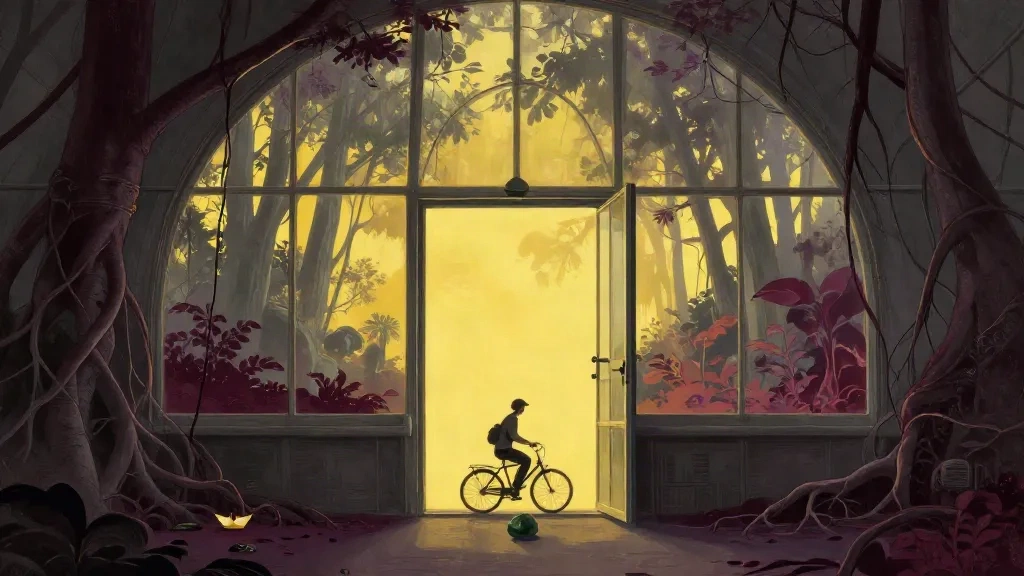
Mara carried one letter inside the paper hull of a tiny paper boat, and the boat inside a green stone no larger than a plum seed. Saffron sunlight poured through the orbital greenhouse’s stained panels. Beyond them, stars burned without weather. Inside, the air was deep plum with smoke, and the forest leaned through its roots, remembering seasons the seed had left behind.
Her bicycle had once belonged to a maintenance officer. It weighed almost nothing, though every letter in its panniers became heavier the closer it drew to its destination. The bicycle also passed through closed doors. This made it poor at leaving and exceptional at entering, a distinction Mara’s employers had neglected to explain when they licensed her.
She stopped at the address painted on a sealed quarantine door: Post Office, Forward Century.
No future correspondence was being accepted.
She took the paper boat from her coat, set it on the sill, and watched the green stone sink into the grain of painted metal. The stone was warm. Her map went blank.
Mara’s courier’s license had issued instructions for this situation, written in a hand that admired precision. At a discontinued address, she was to verify occupancy, return unopened mail to the depot, and report no less than every breath she discovered.
The door opened. No air escaped. On the other side waited a corridor filled with leaves.
The Forest Granted Entry
Oxide walls continued beneath the floor, but seams of root had split them. The bicycle rolled without pedals. Leaves lifted beneath its wheels, each underside printed with a postal code in silver veins.
“Your route has expired,” said a voice from a brass tube beside the corridor. “No one has your destination.”
“Then I have an undeliverable letter.”
“You have evidence of negligence.”
“That is nearly the same thing.”
At the end of the passage, a listening room opened around her. Hundreds of root-tubes rested in white cradles. Smoke-grey air trembled inside them. Faces had formed in the bark—not human faces exactly, but mouths holding themselves carefully shut.
A plaque above the console named the Treaty of Attentive Ground. Its first article allowed the land to hear every promise spoken upon it. The last article, added six centuries later, allowed human institutions to stop listening.
Mara attached the paper boat to the console. The green stone dropped from its paper hull and struck the floor. Every root-tube slammed silent.
Then the forest spoke.
Letters the Future Withheld
The voices arrived through the walls: deliveries confirmed; children described; apologies revised; last words accepted by the wrong people. Layer upon layer, the letters descended from later centuries into the roots. They were not lost. They had been gathered here because someone had concluded that a promise was unsafe once its recipient died.
“The land listens,” Mara said.
The brass tube answered, “The land is permitted to listen.”
“To what difference?”
“The legal difference is considerable.”
She understood then. The future had not stopped sending letters. It had stopped pretending that words without witnesses were harmless. A widow forgave her brother. A physician confessed a false diagnosis. A government announced a theft. A child promised to return home. The treaty kept every promise exactly as first spoken, including those its speakers wished to retract.
So the letters became dangerous cargo, and the couriers became unwilling archivists of the dead.
Mara looked at the address on the boat: Ivo, age nine, fourth greenhouse ring.
There had been no Ivo for ninety years. But the ink was fresh.
Delivery Requires Two Witnesses
The bicycle carried her downward through locked fire doors, past pumps, seed vaults, and chambers where extinct oaks grew as thin as wire. The paper boat raced ahead in the smoke, unable to stop.
“This letter was opened,” she called.
“No,” said the forest. “You were delayed.”
At the fourth greenhouse ring, the trees had grown around a boy sleeping in their roots. Saffron flowers burned above him. His hands were full of green leaves, and beneath his knees rested a green stone split cleanly in two.
Mara gave him the paper boat.
He opened it. Inside was one sentence, written in her own handwriting from a day she had not yet lived:
Do not let the treaty teach you silence.
The boy woke. Somewhere above them, valves opened, and the smoke-grey air rose into sunlight. The listening roots released thousands of sealed letters at once. They rose through the greenhouse like pale moths, each one seeking a name the future had learned to carry.
Mara stood beneath them with the broken stone warm in her palm. Delivery required two witnesses: the speaker and the land. Both, she thought, should be permitted a second draft.





