 Netwrck
Fantasy.
The River’s Other Bank
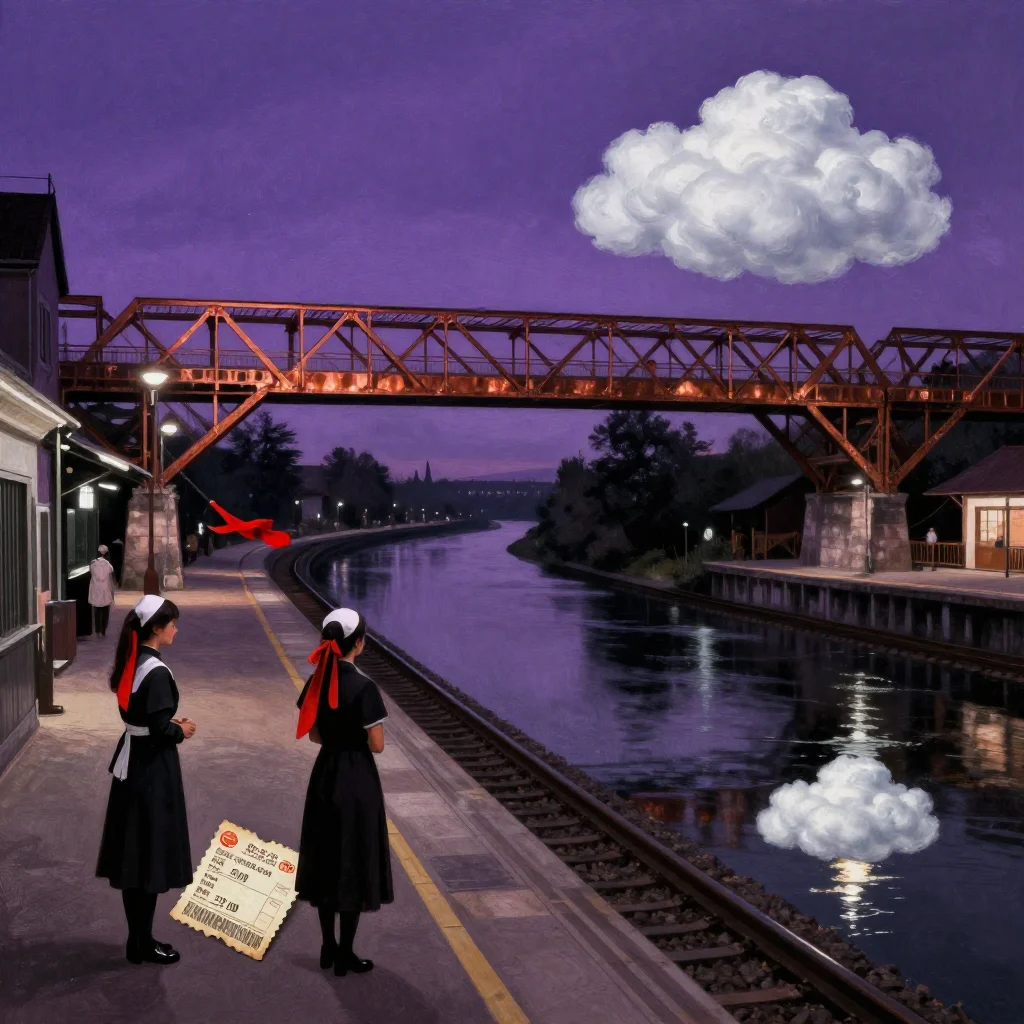
Violet dusk settled over Bellwether as Nurse Mara Venn locked the doors of the ferry house. Across the river, the town wore the same violet, though its windows burned cloud-white. Every night at midnight, the current reversed. The western bank became east, the east became west, and the people of Bellwether woke to find their houses facing unfamiliar roads.
That was not unusual. The strange part was what the houses did beforehand.
They grew quiet by degrees. Pictures leaned toward the walls. Kettles cooled in kitchens where three generations had argued over tea. Children slept with their shoes on. A house becoming homesick missed the rooms its family had filled with ordinary noise.
Mara treated them with foxglove honey, iron filings, and a careful question: what did you need to remember?
The answer was never a room. It was always a person.
On the evening the river turned, Mara crossed to the house where Tomas and Elian Vale had spent nine years refusing to speak. Tomas was leaving at dawn for the northern orchard. Elian had packed one case and left it beside the door. The red scarf Tomas knitted for his brother lay on the table, unfinished at one end. In his coat pocket, Elian carried a train ticket folded around an old apology.
Stationmaster Pell’s Ledger
At the platform, Stationmaster Pell was copying departures onto a green ledger. His ink smelled of oxidized copper. He did not look up when Mara approached.
“You have six hours to mend the house,” he said. “After the turn, the timetable begins again.”
“Timetables are printed in advance.”
Pell tapped the ledger. In its columns, names had migrated between destinations. Anselm Gale departed for a village that no longer existed. Oren Bly arrived from a platform marked in red ink as closed. The stationmaster’s face was calm, but his fingers had worn the paper thin.
“Every ending is a scheduling error,” he said. “A person leaves because the correct moment was entered in the wrong column.”
Mara watched the river below the embankment. Black water moved beneath copper lights, carrying a silver moon toward the wrong shore.
“Then correct this one,” she said. “Tomas and Elian have a ticket for the same train. It is not marked one-way.”
Pell’s pen stopped.
“People are not trains.”
“No,” Mara said. “Trains cannot come home by taking the wrong road.”
What the River Borrowed
She returned to the Vale house as the lamps dimmed. The walls had drawn inward. The red scarf had wound itself around the chair legs, and the unfinished knitting needles pointed toward the station.
Mara placed the ticket on the table. The paper was warm. She mixed foxglove honey with rainwater and drew a narrow line from the ticket to the scarf, asking the house to show its memory.
Violet light spread over the floorboards.
She saw Tomas and Elian beneath the old market lantern, arguing about a promise made during a thunderstorm. Tomas had said he would never leave Elian behind. Elian had said staying was not the same as choosing him. Both had meant: stay until I can learn how to choose.
The house had mistaken their fear for disagreement. It had packed itself around the silence and waited for one voice to vanish.
Down the lane, Pell rang the warning bell. The river began to groan. A minute before midnight, Mara heard a train whistle from both banks at once.
She took the red scarf and ticket and ran.
The Last Platform
Pell stood on the track, one hand raised to stop the invisible train. The scarf dragged through the wind around his wrist. The ticket trembled between Mara’s fingers.
“If I mark them together,” he said, “the river will have to keep them.”
“No,” Mara said. “It will only make another home sick.”
She handed him the ticket. He stared at the two names printed in one faded column.
Below them, the current turned.
Mara unwrapped the scarf from Pell’s hand and held one end toward the river. The wool glowed cloud-white in the moon. Then Tomas and Elian came running from opposite sides of the embankment, each following the scarf’s impossible brightness.
They stopped when they saw each other.
Tomas reached into his coat. He had brought the other knitting needle.
“I was going north because I was afraid you would ask me to stay,” he said.
Elian’s ticket slipped from his fingers. “I was going because I was afraid you would say yes.”
Mara stepped aside. Pell lowered his pen.
At midnight, the river changed direction beneath the rails. The train came from the west, where the houses had always belonged.
No one boarded. Tomas and Elian sat beneath the platform lamp and finished the scarf between them, one stitch at a time. Pell wrote nothing in the ledger. By dawn, the Vale house had opened every window, and the kettle was singing.
Mara returned home along the reversed bank. Behind her, the station lights shone on both shores. For the first time, she understood that some departures could be corrected—not by changing where the train went, but by teaching the people aboard to face one another.





