 Netwrck
Mythic Fiction.
The Weather Below the Stacks
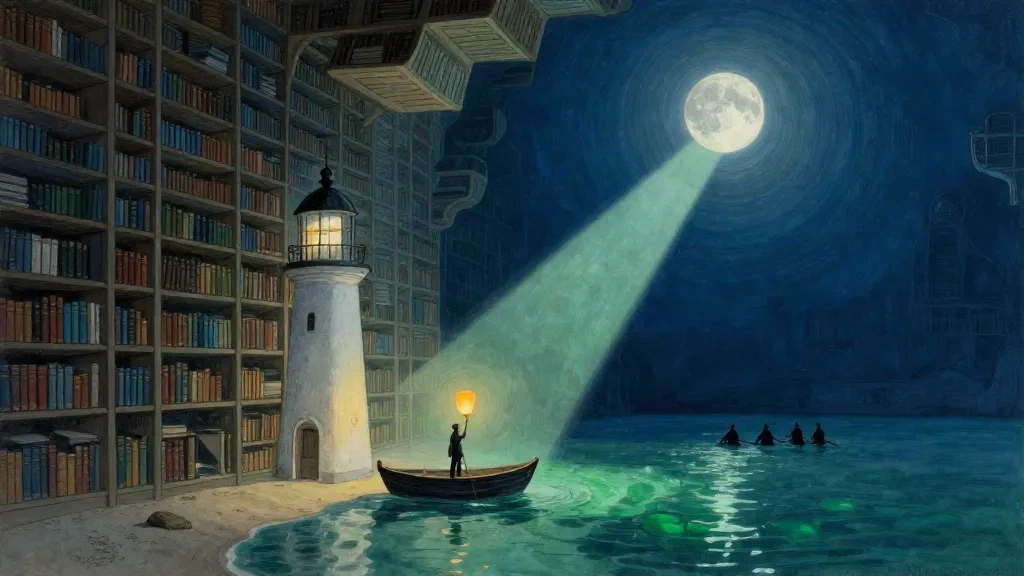
Master Keeper Sava rowed through the drowned archive with her lantern chained to the bow. Its paper shell shone sea-glass green, though the flood was cobalt from ceiling to flagstone. Between the towering shelves, drowned clerks guided their boats by pulling shelf-rails like oars. They called to one another with the titles of lost years.
Sava did not row for books. She catalogued weather brought through cracks in the world.
Blue lightning slept in sealed jars. Salt rain fell upward from a copper basin. April from another coast hovered over her shoulder in a cloud of pale moths. Every dawn, she entered these arrivals into the municipal ledger, measured them, and assigned them to the narrow hours where they could safely become ordinary.
At the archive’s center rested a small moon no larger than an apple. It hovered inside a net of braided paper chains. Each tide, Sava renewed one link with handwriting from her own childhood.
“Keeper,” whispered a boatman, “the rain is forgetting us.”
His name was Orun. Three days earlier, Sava had written Orun, weather clerk on the clean glass over his berth. Now the words had faded. The berth itself was dissolving, its brass number sinking into the silt.
“Who remembers you?” Sava asked.
“My daughter. Perhaps.”
“Then we have little time.”
Every Miracle Was Offenses
The archive’s highest shelf held the Revised Ordinances of Civic Continuity, freshly recopied each morning. Sava steered toward it. The water lapped against white legal sentences.
Article Nine prohibited impossible rain.
Article Twelve prohibited weather without a registered horizon.
Article Twenty-six classified any autonomous light as a public nuisance. The small moon had been fined three times for shining without permission.
A paper annex, however recent, declared collective forgetting a lawful civic economy. Sava read until the words rearranged themselves.
Not criminal, she thought. Worse: no longer an event anyone was permitted to witness.
Orun’s oar slipped beneath the flood. The little moon turned slowly above him, whitening with reflected lightning.
“One remembered name should break the clause,” Sava said.
“Names enter through the doors,” Orun replied. “You cannot carry one through a wall.”
“That is a nautical opinion.”
“So is a keeper of storms.”
“Yes.” She lifted the lantern. “It has saved ships.”
She placed the lantern in his boat. Its green glow reached through the water and touched the dissolving berth. A brass number returned: 314. Somewhere above the flooded stacks, Orun’s daughter would forget she had ever asked which ship her father sailed on.
Sava remembered: a girl on a quay, holding the heel of his broken sandal.
The archive trembled.
The Trial of a Burning Shadow
A bell rang beneath the water. The municipal clerk arrived in a black lacquered skiff, wearing the blue shadow of a storm across his shoulders.
“You have restored an unapproved light,” he said.
“It is a paper lantern.”
“Without a permit.”
“There is no such office.”
“Therefore the permit is legally impossible. Possessing it is forbidden.”
He laid Article Twenty-six across Orun’s boat. The ink flowed upward and formed black wings above him. The clerk seized the small moon.
When Orun reached for it, his hands passed through. The moon had begun forgetting him faster.
“You can save nothing that no one will certify,” the clerk said.
Then Sava opened her weather catalogue to the first page, the night she had been apprenticed. Foreign thunder knotted in her teeth. Black hail clattered inside her ribs. She spat them onto the ordinance and watched the impossible storm strike the legal page.
The clerk’s shadow flared cobalt.
“Unlicensed weather,” he protested.
“Stolen memory,” Sava answered. “Also forbidden to mention.”
She struck out the words lawful civic economy with the moon’s small, cold light.
The Name the Water Kept
Every shelf door burst open. Sand poured through the archive in slow columns. Books rose from their bindings and circled above the boats like pale birds. Across the ruined berth appeared a name written in green ink.
It was not a name Orun had.
It was Sava’s.
Under it: keeper of weather from other worlds; the girl who waited at the broken lighthouse.
The clerk looked down at his wings. They were becoming feathers.
“You summoned a storm,” he said.
“No,” Sava said. “Somebody remembered me.”
She took the moon from his hand. The paper lantern flared between the drowned stacks, and in its light Sava understood the ordinance’s dead purpose. It had not been written to keep miracles out. The city had feared that one remembered life would prove the others could return.
Orun climbed into his restored berth. His daughter’s name shone beneath the lantern, followed by the first line of the song she had sung at the quay.
He rowed toward the stair. Sava stayed, cataloguing the exodus: each forgotten sailor climbing a ladder of rain, each drowned room rising sand-heavy from the flood.
At dawn, the small moon was gone. In its place hung a paper lantern, ordinary, warm, and bright.
Below it, on the first page of the ledger, Sava wrote the weather of that morning:
Visibility: returning.
What the city first calls forgetting, the water only calls unfinished.





