 Netwrck
Surrealism.
The blue thread in the bark
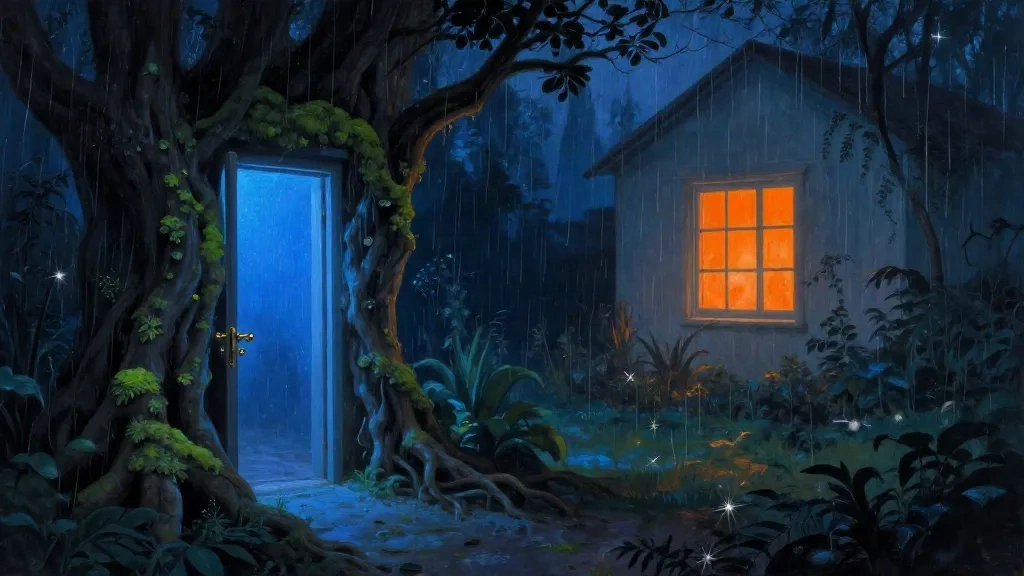
Mara arrived at the garden before sunrise, when the air still held the metallic taste of rain. The garden occupied a abandoned railway cutting, though no railway had ever run there. Its trees grew doors instead of leaves: narrow blue doors in the trunks, brass doors in the roots, tall white doors opening onto rooms that had no walls.
She carried a blue thread around her wrist. Her grandmother had given it to her, saying it was the color of a promise made before anyone knew what it would cost. Mara used the thread to bind the shutters of the small kiln where she made windows. The first light caught the glass and broke into orange sparks across the damp path.
Today she intended to make an ordinary window. Nothing more. A pane for the upstairs room of a house in another world, where a baker wanted morning light to fall across his flour and a child wanted to wake without being frightened by thunder.
She wanted to keep one ordinary morning from being taken away.
The trail that forgot its name
The path through the garden had changed overnight. It was safer now, though Mara could not say how she knew. The stones lay flat. The thorned branches bent aside. Even the wasps navigated around her shoulders instead of striking.
She followed the trail until it ended at an unmarked door between two apple trees. No handle. No hinges. Only a thin seam of blue storm-light.
The door opened before she touched it.
Inside was a room she knew from a hundred commissions: pale walls, a square table, a window looking onto an orchard. The baker was there. The child was there. They looked toward her with expressions of mild surprise.
“You are late,” the baker said.
“You are early,” the child replied.
Mara’s glass rod slipped from her fingers. It did not break. It rolled beneath the table and stopped at the base of the unmarked door.
Then the room spoke in her voice.
“Nothing here is dangerous,” it said. “Nothing here needs to be explained.”
The trail brightened. Outside, the apple trees dropped their fruit without sound.
What the garden would not keep
Mara entered. The room was warm, the right temperature for an ordinary morning. She began working immediately. The baker’s window was easy: a square of blue storm-light, a thin border of lichen green, a sunrise burning orange at one corner. She shaped it with steady hands.
But the glass reflected faces. First her own. Then the baker’s, older and wet with flour. Then the child’s, with no eyes. The room was not a room. It was a collection of mornings that had been offered to the garden, each stripped of the moment before it began.
When she asked who had removed them, everyone answered, “No one.”
The door remained open. Beyond it, a procession moved through the garden: gardeners carrying baskets of unmarked doors, children carrying blue thread, animals carrying unlit windows. None of them looked afraid.
“You could stay,” the room said. “Here, no one has to tell the truth.”
Mara understood then. Safety had not been granted to the trail. It had been purchased with omissions. Every silence removed a danger and a person. Every softened answer made the path easier by making the world less specific.
She placed the baker’s window in the wall. Light poured through it, warm and ordinary, but it illuminated only the table. No shadows. No flour on the floor. No child’s feet.
A window with two faces
Mara opened her tool bag and took out the blue thread. She tied one end to the unmarked door. Then she tied the other to the window she had just made.
“If you want a morning,” she said, “it must contain someone who can lose it.”
The room resisted. The glass clouded. The thread burned against her wrist. She held on.
One by one, the people in the procession stopped. The gardener looked at the basket of doors and remembered a house she had locked. The child looked at the blue thread and remembered a brother who had gone through one. The baker remembered the first loaf he had burned, and the child remembered waking alone.
The truth did not make the garden beautiful. It made it dangerous again. Doors began to open inward. The unmarked door swung wide. Storms moved through the trees, their blue light striking the glass.
Mara shaped the window’s second face in the storm-light: not a view of a perfect morning, but a view of the people who would enter it, frightened, late, alive.
She stepped through before the trail closed.
On the other side, dawn was beginning. A small window in a distant house turned orange, then lichen green, then blue. Someone opened the curtains.
Mara looked back once. The garden had returned to ordinary darkness, except for one pale seam between the trees.
She did not know what lived behind the unmarked door now. She only knew that the morning was not protected from sorrow. It had been made safe enough to reach.





