 Netwrck
Speculative Fiction.
The Note Under the Glass
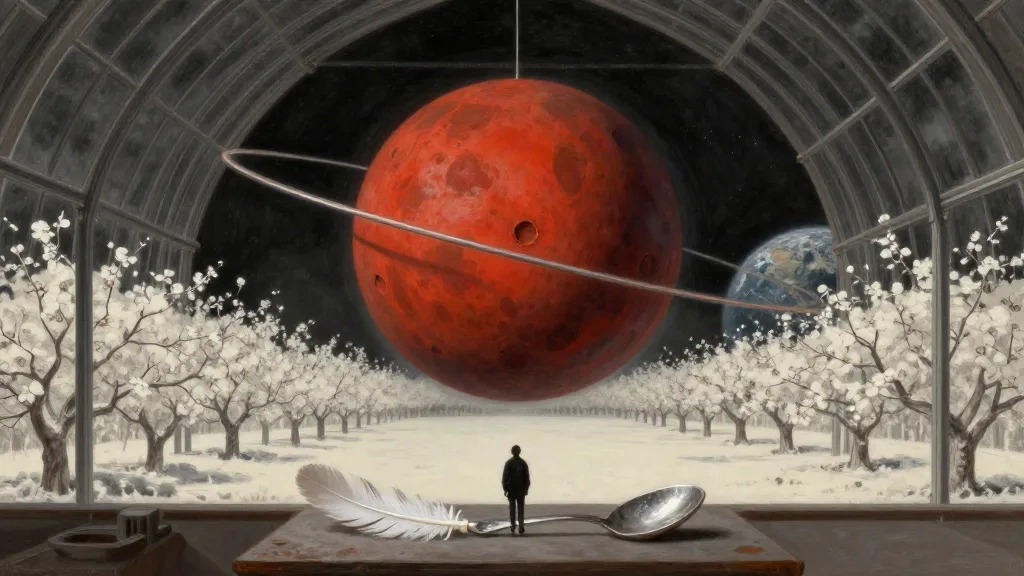
Mara Venn tuned the greenhouse strings beneath the seed’s oldest branch. The seed was the size of a clenched fist, rust red and veined with charcoal, suspended in a column of pale winter light. It remembered forests that had burned, drowned, or vanished beneath layers of human weather. Each rotation made its leaves whisper in a language almost music.
Mara heard a new note whenever someone spoke true.
The cook, Ondra, confessed that the ration fungus was failing. The note was a clear B, high and startling. An engineer named Pell admitted he had falsified the pressure alarms; the note became a low silver chord. Even the seed answered, though Mara suspected its memory had its own kind of honesty.
Her work was to turn those notes into something lasting. The colony’s council had promised a public record, but paper was already becoming scarce, and no archive could hold the warmth of a living voice. Mara designed an instrument with thirty-six glass reeds. Each reed would hold one truth-note, resonating until the membrane around it wore thin.
On the workbench waited a white feather and a silver spoon. The feather had arrived in the seed’s oldest sample case. The spoon belonged to the first gardener, who had fed the seed with diluted mineral water during the third orbital winter. Mara used the spoon to stir resin into the reed chambers. The feather served as a balance, its hollow shaft measuring the wind inside the instrument.
A Winter Without Morning
Then the greenhouse lights failed to rise.
Not darkness exactly. A pale winter light continued beyond the glass, flat and shadowless, refusing the programmed dawn. The first generation born under it grew tall in six months, then aged as if decades had passed between meals. Frost formed on pipes that should have carried heat from the reactor. The seed’s leaves hardened into rust-red plates.
The colonists stopped speaking plainly. Lies produced silence, and silence made the instrument useless. Mara heard only a thin A whenever the official reports promised that the light would return.
She hauled the instrument into the central orchard and began fitting its reeds into the seed’s root collar. The machine was meant to preserve selected truths, not every one. Each note required a memory to feed it. She gave it Ondra’s B, Pell’s low chord, and her own admission: she had come to the greenhouse because she could no longer tolerate a world where beautiful things vanished without leaving an echo.
The white feather drifted into the resin. The silver spoon bent under the cold, but its bowl held a bead of warm fluid. Mara realized the spoon was not merely a tool. It had carried the first gardener’s promise: Whatever wakes here will be given a chance.
The Engine of Remembering
She built the first engine around the seed. Copper filaments carried each note into the seed’s dormant tissues, where the lost forests surfaced as branching patterns of blue-green light. The seed remembered a rainstorm over cedar, the bitter roots of ironwood, a bird that had nested beneath a volcano.
Each restored memory warmed the chamber. The pale light withdrew by a fraction. The younger generation began sleeping instead of aging between meals. But Mara’s instrument was built to preserve truth, and the seed began returning a truth she had not given it: the greenhouse was not orbiting a star. It was orbiting the last living seed, and the seed was remembering the moment after the forests had ended.
That future belonged to no one alive. If she opened all the chambers, the seed would preserve a world the colony could never build. If she kept it silent, the present would consume itself.
On the final night, Mara spoke the only lie that mattered: “I built this to save us.”
No note sounded. The instrument waited. She replaced the lie with the exact shape of her intent. “I built this to survive me.”
The note that rose was neither high nor low. It passed through her teeth and into the seed, where a new root split the rust-red shell.
What Could Remain
By dawn, the pale light had warmed to ivory. Children who had never seen a sunrise stood among the branches, holding the white feather in one hand and the silver spoon in the other. The spoon carried a clear note whenever they admitted what they had lost.
Mara’s hands were thinner. Her hair had gone white. The instrument remained, but she no longer could distinguish its music from the seed’s.
Then a child touched the oldest reed and heard a note no one else could recognize. It sounded like a forest remembering rain.
Mara smiled. Something had survived the telling after all.





