 Netwrck
Historical Fantasy.
The last broadcast
Captain Ilya Vale had been in orbit for nineteen years, though the years disagreed among themselves. Mission control had stopped sending clocks. The station turned against the sun, carrying its commander through the dark like a splinter in a black sleeve. Below, Earth was a rumour repeated in crackling voices: blue oceans, crowded harbours, bread ovens burning at dawn.
Ilya had once corrected that rumour from orbit. He had named the streets, the rivers, the little theatres where people laughed too loudly. Then the signal narrowed to static, and the planet became a blue smear beneath the clouds. He refused the evacuation capsule. The ship’s physician called it stubbornness. Ilya called it duty.
On his console he kept one recording: his sister Mara, aged nine, speaking from the theatre in Vell. Her voice had survived only as background noise, buried beneath the emergency broadcast. “If you leave, leave the ending behind,” she said. The sentence had been cut off by static. For nineteen years, Ilya believed it was all the farewell he had.
Discarded endings
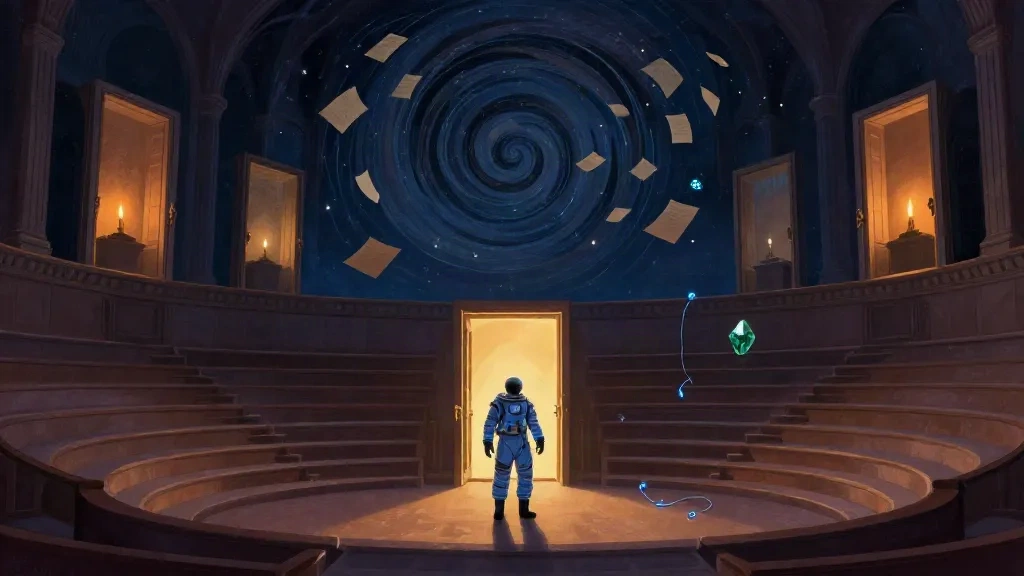
The station received a signal from a theatre called the Last Hour, where performances began with tomorrow’s discarded endings. Every night, actors staged the deaths, reconciliations, departures, and forgotten weddings that the future had rejected. Ilya watched through the porthole as a pale building assembled itself on the night side of the moon.
He landed without permission. The theatre smelled of dust, hot metal, and tobacco. Its walls were steel blue, its seats tobacco brown, and candlelight ran across them in wavering sheets. An usher led him through a corridor lined with doors. Behind one, a king wept. Behind another, a city sank without a sound.
Ilya found Mara’s voice in the projection room. It came from a damaged speaker, surrounded by the hiss of dead channels. “You are hearing the part nobody kept,” said the theatre’s archivist, a woman with a green stone hanging at her throat. “History likes the grand words. It discards the small ones.”
She gave him a spool of blue thread. “Tie it to the door you remember. Not the one you came through. Memories are good at pretending they are directions.”
The storm indoors
At midnight the storm arrived without weather. It moved through the walls, rearranging doors while the audience sat inside them. A woman in a mourning dress found herself behind a kitchen wall. An old actor opened his dressing-room door and saw the moon burning in a room full of strangers. The theatre groaned, and every candle leaned toward a different exit.
Ilya ran after Mara’s signal. It flickered from door to door, always one room ahead. He tied blue thread across the handles, but the storm rewrote the corridors as fast as he crossed them. The green stone grew warm in his pocket. At the final door he heard his sister clearly.
“You cannot take me home,” Mara said. “Earth has not been a rumour to everyone.”
He pushed open the door. Behind it was the Vell theatre, intact and empty, with Mara waiting in the third row. For one breath he believed the storm had opened a path through time. Then he saw her clothes: a coat cut in the old style, a copper button polished by his mother’s hand.
A voice in the wings
She was not Mara. She was the performance of Mara, assembled from the scraps the future had discarded. Ilya understood then why the voice had survived. History had used his sister as a doorway, a noise beneath the noise, a way for other voices to pass through.
“I came to take you home,” he said.
“Then finish the sentence,” she replied.
Outside, the storm tore the theatre apart. The archivist’s green stone split in two, but the blue thread held. Ilya stood at the threshold between the stage and the wings, holding the thread between the living memory of his sister and the empty future that had preserved her.
He spoke into the dark. “I came to take you home.”
The theatre went silent. The false Mara smiled. The real voice, faint but unmistakable, answered from somewhere beneath the floor.
“Ilya.”
At dawn, the station received a message from Earth in clear language. It contained no coordinates, only a child’s voice describing the theatre where her mother had once worked. Ilya left the spool of blue thread tied to the last door. The green stone remained in his palm, warm as a small, faithful star.
He had come for a voice. He returned with a way home.





