 Netwrck
Speculative Fiction.
The Door That Wasn't There
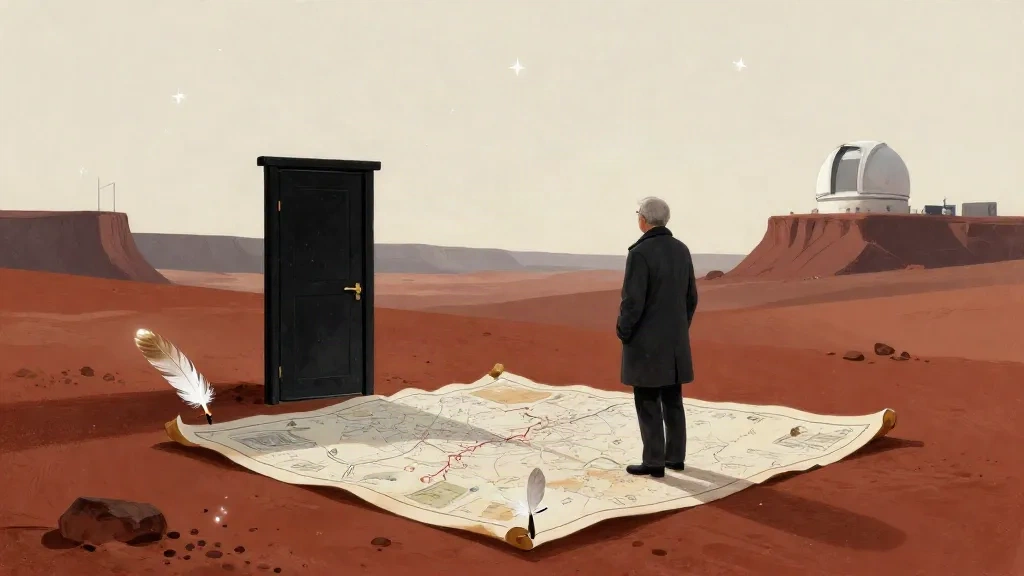
Elian Venn had spent forty years drawing coastlines that had drowned, rivers redirected, villages swallowed by reservoirs. After retirement, he kept a small room beneath the desert observatory, where the instruments turned nightly toward stars that sent messages.
He did not trust the messages. They arrived as sequences of pale dots in the eyepiece, patiently repeating themselves. Other observers called them navigation data. Elian called them invitations.
On the desk lay his oldest map, a sheet of charcoal paper covered with places no longer existing. In its margins he had drawn doors: narrow black rectangles, each one opening onto a vanished road, courtyard, orchard, or shoreline. He had never crossed one. He had only hoped that the right map would make a place where lost things could rest.
Then the observatory recorded a message in the handwriting of his dead daughter.
The Market of Accurate Things
Elian found the market at the bottom of a dry wadi, beneath a red cliff streaked with charcoal shadows. Stalls stood in crooked rows beneath awnings of rust-red canvas. The air smelled of hot iron, dust, and crushed mint.
Sellers called their wares by the names of things that had been lost: a key with no lock, a glove fitted to an absent hand, a blue door from a house burned before the city had a name. The expensive things were always true.
A woman beneath a white canopy displayed a moth wing pinned to velvet. It was larger than a hand, and its scales shifted from rust to silver as the wind moved.
“That belonged to the night the observatory disappeared,” she said. “The true night.”
Elian pointed to a white feather resting beside the wing. “And that?”
“The price.”
She named a sum in old currency. The market’s oldest rule allowed a buyer to purchase certainty, but only by surrendering the thing most closely connected to the truth. The wing would reveal the lost night if he gave her the feather.
Elian understood then why the market had flourished. Everyone wanted an answer. Few wanted its cost.
A Place That Would Not Vanish
The message led him to a dune on the observatory’s eastern horizon. At dawn he set his map against the sand and drew a door beside the old path to the first telescope.
His hand stopped moving.
A place that no longer existed could only be approached from the map. If he wanted a refuge for lost things, he needed a place that would remain after it was found. He needed to make permanence from absence.
At the market, he traded the map that contained the drowned village where his daughter had learned to swim. The seller tested the paper against the sun. Its streets appeared in faint red ink.
“This is true,” she said.
“Then it is worth what I need.”
With the white feather, Elian drew a small observatory on the blank center of the map. He gave it a dome, a warm western wall, and a door that opened inward. Beneath it he placed the moth wing. The wing trembled once.
The market went silent.
Every true object in every stall turned toward him: lost keys, vanished hats, the final coin of a forgotten empire. They waited to be admitted.
The Last Map
At nightfall, Elian opened the door.
Beyond it stood his refuge under pale winter light. The desert observatory hung above a black horizon, its telescope turned toward a sky crowded with messages. Inside, shelves waited without walls. The moth wing rested on a brass table. The white feather had become the door’s threshold.
Lost things entered slowly at first: a red mitten, a glass apple, a child’s shoe filled with sand. Then came the names spoken by the stars, each one becoming a small light inside the dome.
Elian’s daughter arrived last.
She was exactly as the message had promised, and for one breath he nearly asked which night was true. Then he saw that her face held no certainty, only the same tired tenderness he remembered.
“I brought the observatory here,” he said.
She looked back through the threshold. At the market, the woman held the missing feather in her hand.
“No,” Elian said. “I did.”
He closed the door before the market could enter. In the quiet, the stars continued sending messages, but the new observatory no longer needed directions. It had become the place they were leading toward.
Some truths are doors. Some doors are homes.
By morning, the desert map was blank except for a single black rectangle. Elian drew one more mark beside it, not a door, but a window. Then he waited for the lost things to wake.





