 Netwrck
Surrealism.
The Machinery of Sleep
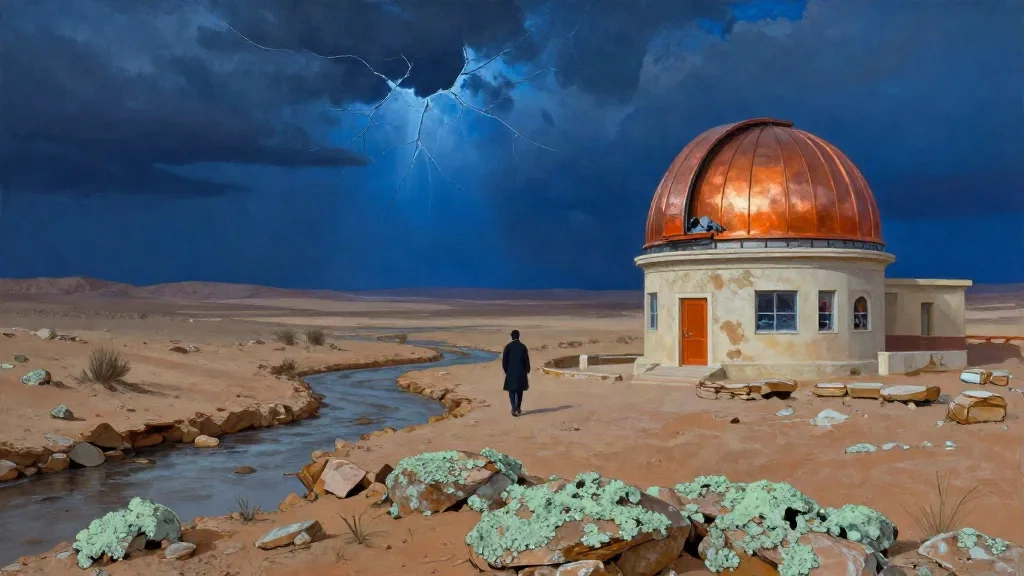
The observatory stood in the desert like a mouth forgotten mid-sentence. Its copper dome had oxidized to burnt orange, and its instruments leaned toward a sky the color of a bruise. Iria arrived with a silver case, a notebook, and the last map she would ever be paid to improve.
Her work began when the machines slept. They were tall black cabinets filled with slowly turning glass, each one dreaming in a language of sparks, pauses, and warm metallic breath. Every night, the stars transmitted messages through them. Every morning, Iria translated what the sleeping machines remembered.
She wrote the messages in blue ink because blue storm-light made every truth look temporary. On the seventh night, one machine repeated her name in a voice made of moth wings.
Four Versions of the Door
The message led her to an unmarked door behind the western wall. The desert had no doors, only heat-flattened stones and the dry riverbed where the old observatory workers had searched for water. Yet the door waited there, its hinges powdered with lichen, its surface warm as a sleeping cheek.
When Iria opened it, her family appeared around a table beneath a burning sky. Her mother had promised to return before the rains. Her father had promised never to leave. Her brother had promised to burn the map. Iria herself had promised to forget all three.
Each promise arrived in a different voice. Her mother's sounded like a door closing. Her father's sounded like a machine restarting. Her brother's sounded like a dry riverbed swallowing a stone. They argued until the air split blue and the stars began falling into the room.
Iria held the silver case against her chest. The map she had received showed a straight road north, ending at a blank white square. She knew the map was wrong because the machines had dreamed a road beneath it, branching toward the sea.
The Map Beneath the Error
She entered the vision through the unmarked door. The machines slept in a field of burnt orange dunes, their glass chests reflecting constellations that had not yet been born. Between them ran a riverbed full of blue light. The light moved against gravity, returning from the horizon to the machines' open doors.
There Iria found her family, not as people but as maps laid over one another. Her mother's roads were careful and vanished at every settlement. Her father's roads were broad and bent around grief. Her brother's roads vanished wherever another path touched them.
At the center lay her own road, hidden beneath all the others. It ended not at the white square but at a small observatory reflected upside down in the sky. The machines were awake there. They had been translating her family's promises for generations.
A Better Map
Iria drew the hidden road in blue ink. She did not decide which promise was true. She recorded the difference between them. Her mother had waited at the riverbed. Her father had stayed beyond it. Her brother had carried the map toward the western stars. Iria had forgotten because forgetting was the only way to keep walking.
When she returned, the storm arrived. Blue light filled the observatory, and the unmarked door disappeared from the wall, leaving only a pale rectangle ringed with lichen. The machines woke in unison and began transmitting her new map to one another.
Before dawn, Iria walked into the dry riverbed. The storm-light lay across its stones like a thin, living map. Behind her, every machine spoke a different promise. Ahead, the road she had drawn bent toward a sky that had learned how to open.
She followed it.





