 Netwrck
Romance.
The last fixed star
Mara Vale arrived at the observatory with a folding bed, six pencils sharpened to needles, and a brass compass that no longer pointed north. The desert had erased every fixed landmark she trusted. Roads became pale scars between dunes. Towns vanished beneath the moving grains, their names remaining only in the margins of maps she had drawn decades ago.
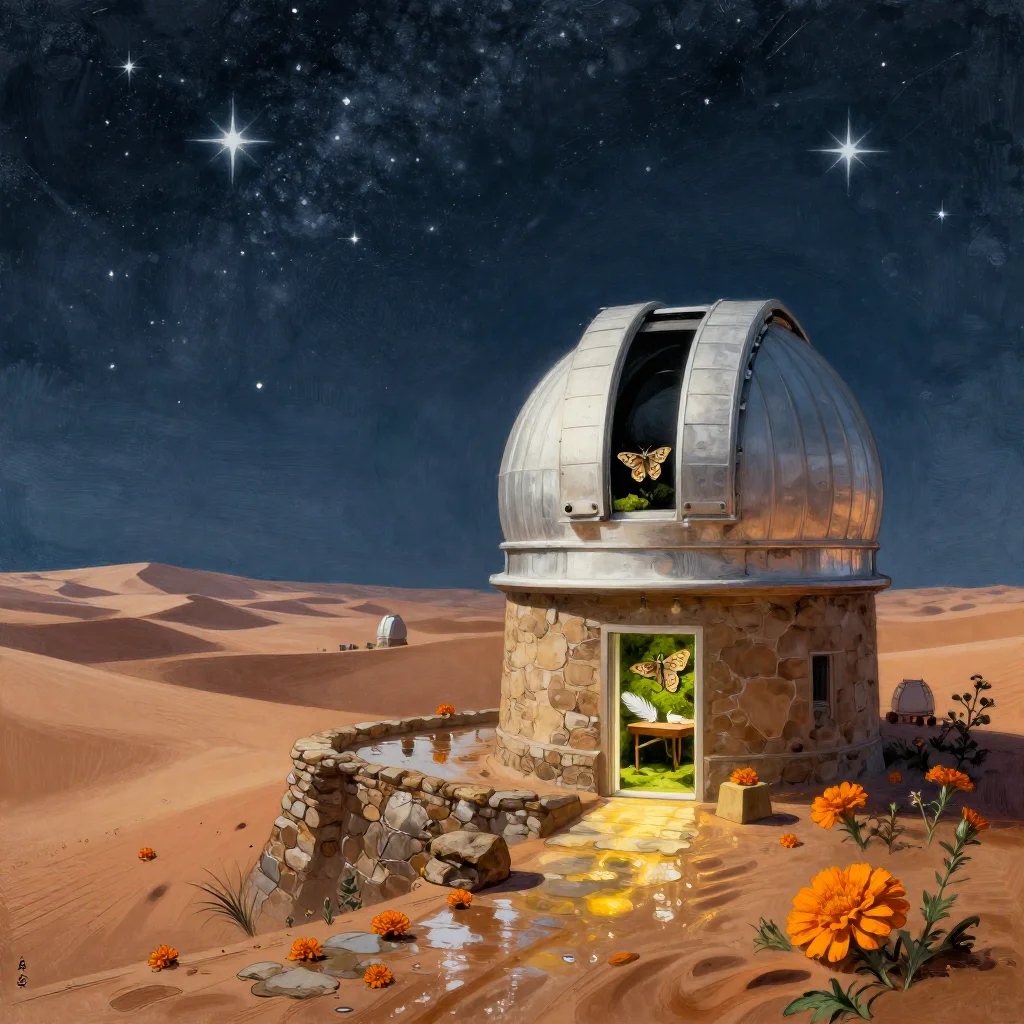
The observatory stood on a low ridge of wet stone, its copper dome green with moss where underground water kept the metal cool. Above it, the sky held more stars than Mara had ever seen. They did not shine so much as pulse. Each one carried a message, though the messages arrived without words: a brass key turning, rain beginning on a roof, someone laughing in a room that no longer existed.
Her first map covered the eastern wall. On it she marked the observatory, the dry wells, the ridge, and the narrow road leading south. Then she drew a door beside the blankest part of the horizon.
“A door to where?” asked Idris Vale, the astronomer who had hired her.
“Somewhere lost.”
He stood behind her, one hand resting on the dome’s copper rail. They had known each other for three months, long enough for silence to become familiar, not long enough for trust. Idris watched the stars without pretending they were harmless. He had lost a sister to the desert, and his letters to her continued to arrive from the sky.
The market of expensive truths
On the seventh night, a market appeared in the valley below. It had no tents, only rugs spread over the stones and stalls made from the shadows of walls. Mara went down with an empty jar and a list of things she could not replace.
At the first stall, a woman sold the exact weight of a missing year. At the second, a boy offered the last thing his mother said before she left. Every object had a price measured in memories. The cheapest was a forgotten tune. The most expensive was a true map.
“Maps of vanished places,” the seller said. He was old, with a white feather tucked behind one ear. “You draw the door. I give you what is behind it.”
The map was stitched from scraps of vellum, its roads crowded into a shape Mara recognized. Every curve belonged to somewhere demolished, drowned, renamed, or buried. At its center was the observatory, and beside it a door she had drawn that morning.
“You want to make a place for lost things,” the seller said. “This will show you where they can rest.”
“What is the price?”
He placed one hand over the observatory.
“The truth of why you are here.”
Mara understood the bargain. The truth was simple and unacceptable: she had come to the desert to keep herself from returning to the house where she and Elian had once believed a shared life would be enough. He had left before the walls were finished. She had finished them anyway, door after door, until the house became a place no one could enter.
She declined the map. The seller laughed without surprise.
“Then come back when you are ready to be found.”
A door made of absence
Mara returned to the observatory and found Idris beneath the telescope, repairing its western motor. A moth had flown into the mechanism. Its wing was the color of old paper, fragile and luminous under the lamp. He had saved it in a glass matchbox.
“For the collection,” he said, though there was no collection. “Or for the map.”
Mara took the matchbox. On her chart, she drew a small room beyond the door: a shelter with stone walls, a roof patched in green moss, and cots for every lost thing that still had a shape. She drew a basin of water. A shelf for keys. A low table where names could be spoken aloud.
Idris watched over her shoulder. His breath made the vellum ripple.
“You are making a sanctuary.”
“A place to rest.”
“Lost things do not always rest.”
“Then they can stay until they learn how.”
That night the brightest star opened like a small marigold flame. Its message arrived in the observatory’s copper dome: an address, a time, and the sound of Elian’s voice saying her name.
He was alive.
He was asking her to come to him in the city.
Mara held the moth wing between her fingers. It trembled against her skin, carrying the dust of places that had vanished. For one breath she considered abandoning the door. The sanctuary could wait. Lost things had waited longer.
Then Idris placed the white feather from the market beside her compass.
“A door without a keeper is only a mark on the ground,” he said. “If you leave, I will keep it open. But I will not pretend it is the same as standing inside it with you.”
His honesty hurt because it left room for her to answer honestly.
I want you to stay, she wrote across the map’s margin. I want to know whether we can build something from what survived.
He read it and smiled. The smile changed him. The observatory changed around them. Below the ridge, the market vanished, leaving only wet stone and a flash of marigold light moving through the dunes.
The room beyond the door
At dawn, Mara opened the door she had drawn.
It did not open into the desert. It opened into a room filled with unfinished things: the red scarf Elian had left on her workbench, her mother’s chipped bowl, a bicycle missing one wheel, a jar of sealed letters, and thousands of small objects with no owners. Moss softened the floor. Rain ticked against a roof beyond the walls.
At the center stood a table.
On it lay the true map, cut from the market’s vellum. Someone had drawn a second observatory inside it, and beside that a road leading toward the distant city. The road passed through places that no longer existed, yet it was solid beneath her boots.
Idris took her hand. His palm was warm and calloused from telescope repairs. In his other hand he carried the glass matchbox.
“We can begin with the moth,” he said.
Mara opened the box. The wing lifted in the air, no longer trembling. It flew once around the sanctuary, found the white feather near the door, and settled beside it.
Outside, the stars began to fade into day. The desert wind moved across the ridge, carrying grit against the open door. Mara did not close it. She drew another room on the map, then another, until the sanctuary reached toward every absence.
Somewhere beyond them, Elian waited in a city full of living noise. But the road on the true map was open. For the first time, leaving did not mean losing the place she had made.
She looked at Idris, then at the two small objects resting together on the table.
“Welcome home,” he said.
Mara left the door open. This time, it was not an ending. It was a direction.





