 Netwrck
Romance.
The Country on Her Hand
At midnight, after the observatory lamps went dark, Mara Vale found a country on the back of her hand.
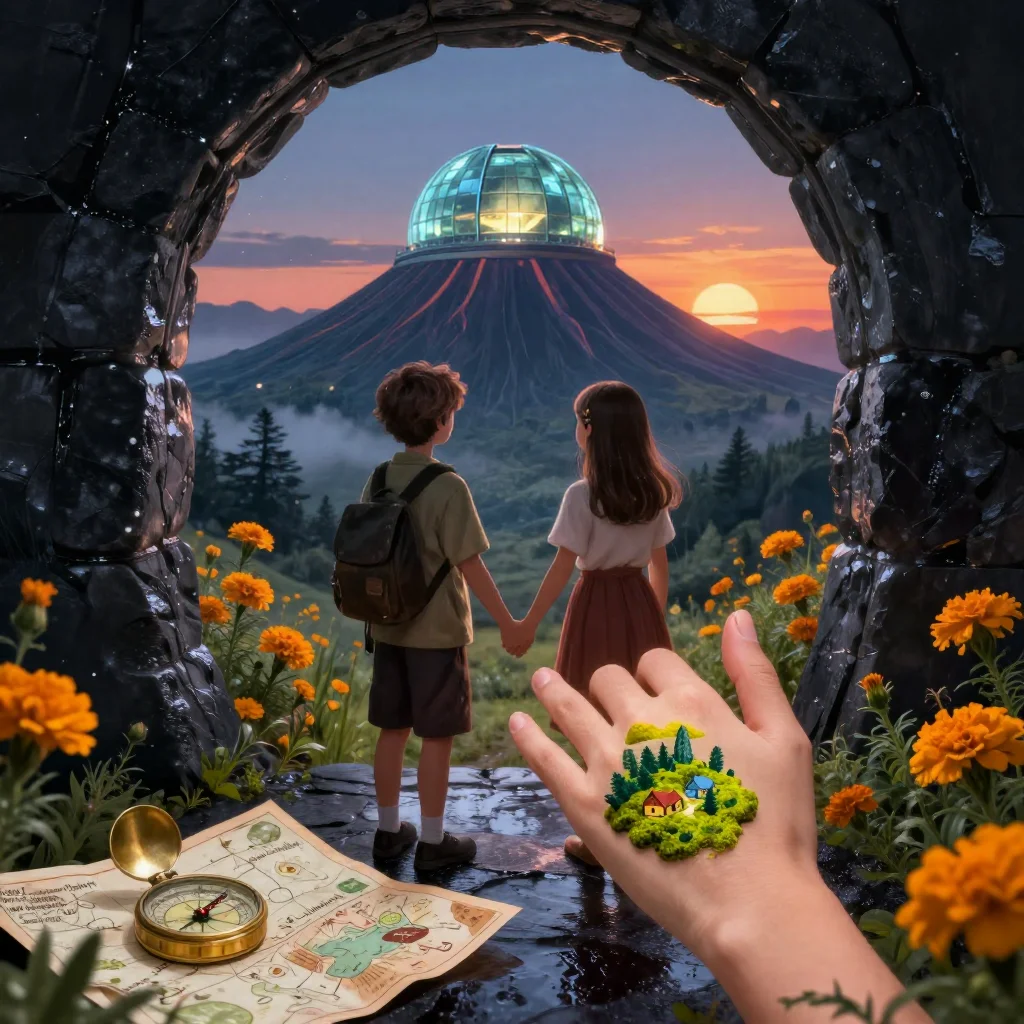
It lay beneath the skin between her thumb and wrist, no larger than a grain of rice. Moss-green forests crossed one another in delicate ridges. A black river curved around a single marigold star. Its borders shifted when she held her breath.
She was a cartographer’s apprentice, expected to polish brass instruments and number the stars in the chief cartographer’s atlas. Instead, she copied coastlines that appeared in the ash after thunderstorms. She knew that a map was not a place. She had not known it could become one.
That night, a song drifted through the volcanic stone.
Mara knew it before she could name it. Her mother had hummed it while braiding wheat-colored ribbons into Mara’s hair. The melody climbed the observatory walls, slipped through the brass windows, and stopped one breath before its final note.
The silence hurt behind her ribs.
On her desk lay the old brass compass her mother had left her and a folded map marked only with a marigold circle. Both had arrived that morning, tucked beneath the mountain’s registration ledger. No one admitted placing them there.
The Rival at the Vent
At dawn, Mara climbed to the western vent where the observatory’s oldest instruments leaned against wet stone. Tomas Ardent was waiting there.
He was the son of the chief cartographer, broad-shouldered and sunburned, with a silver thread around his left wrist. He had been her rival since they were children, always arriving first at a difficult survey, always knowing which trail would hold.
“You heard it too,” he said.
“Heard what?”
“The song.” His hand closed over his compass. “My father says its last note was removed from the world. He wants it restored.”
Mara looked toward the black opening in the mountain. Warm air breathed from it, carrying the smell of sulfur and rain.
“Why does he want it?”
“Because the country is waking.” Tomas’s gaze dropped to her hand. In the green valleys, a road had appeared. It led toward the center of the tiny land. “He says the note is a lock. He says without it, everything inside will come out.”
That was not the reason she wanted it. She had no interest in waking mountains or opening borders. She wanted the song finished because her mother had died before the last melody could be completed.
“You want it for power,” she said.
“I want it for proof.” He met her eyes. “Your mother left this observatory. If the song has a missing piece, I want to know who took it.”
Below the Sleeping Mountain
They descended by a stairway cut into the caldera. The brass compass turned toward the marigold star on Mara’s hand. The folded map unfolded itself in her fingers, its creases smoothing as they walked.
At the bottom stood a chamber filled with glass instruments. Each held a note of the unfinished song. A blue bowl hummed when Tomas touched it. A black stone trembled when Mara placed her palm over it. In the center, an empty brass cradle waited for something that was not there.
On the wall, someone had scratched two sets of initials: M.V. beside T.A.
Her mother’s initials. Tomas’s.
“They found this place together,” Mara said.
Tomas studied the cradle. “My father has hidden more than maps.”
Then the chamber answered him.
The song began again, louder now. It rose through the stone and gathered beneath Mara’s skin. The country on her hand blazed marigold. At its center, a tiny door opened.
Beyond it stood her mother, young as Mara remembered her, holding a golden note between two fingers.
“You came together,” her mother said. “You must leave separately.”
What the Song Needed
Mara reached for the note. The tiny country convulsed, and the chamber cracked along its walls.
Tomas caught her arm. “If you take it, the door may close forever.”
“If I don’t, no one can finish it.”
Her mother shook her head. “The final note was never hidden. It was given away. Love is not possession. It is the choice to let another person arrive.”
Mara looked at Tomas. He had followed her into the mountain for his own desperate reason, yet he had trusted her with the map, the compass, and the truth. She let go of the golden note.
It crossed the space between them and entered his hand.
Tomas played it.
No trumpet or string. The note sounded from the compass, the glass, the wet stone, and the small country beneath Mara’s skin. Her mother smiled as the melody found its way home.
When the light faded, the chamber was ordinary again. The folded map showed only mountains. The brass compass pointed north.
On Mara’s hand, the country remained, but its borders had opened. No longer a place to enter, it was a road between two people.
At the surface, Tomas offered his hand. She placed hers in it.
The compass swung once toward the marigold sunrise, then settled. Some directions are chosen only after the song is finished.





