 Netwrck
Romance.
The Country Under Her Thumb
At the monastery of clockmakers, every hour arrived wearing a different face. Some mornings the rain fell backward from the wet stones. At vespers, the bells rang in a language no one remembered speaking. Only the brass compass in the cartographer’s apprentice’s pocket insisted on a single direction.
Her name was Ilyra. She had been brought there as a child with a folded map, a square of vellum worn soft along its creases. It showed roads that had vanished, rivers that had changed names, and one blank valley marked in her mother’s hand: When the last note returns, do not follow it alone.
On the night the song failed, Ilyra was polishing the monastery’s oldest clock. Its glass had no hands, only a pale blue light. When she wound it, a melody rose from beneath the case.
It was the song the novice singers had carried from the western village, a warm, circling tune about a traveler returning home. Ilyra knew every breath of it. She knew the part where the melody lifted toward the roof beams, where the singer must reach one final note and let it fall gently into silence.
That note was gone.
Without it, the song ended as abruptly as a door striking shut. The clocks in the monastery began disagreeing more violently, their bells chasing one another through the corridors.
The Rival in the Belfry
Someone found her at the belfry with the compass in her hand and the folded map under her arm.
“You have been listening,” said Brother Vale.
He was the monastery’s rival mapmaker, though no one called him that aloud. Vale wanted the lost note for a different reason. He believed the country on Ilyra’s hand was not a map at all, but a piece of the world that had been removed from history. If he could restore the note, he believed the missing country would return, bringing back his drowned sister.
He showed her his own map. Unlike hers, it was crowded with dates that had never happened.
“You want your song,” he said. “I want a place where she is still waiting.”
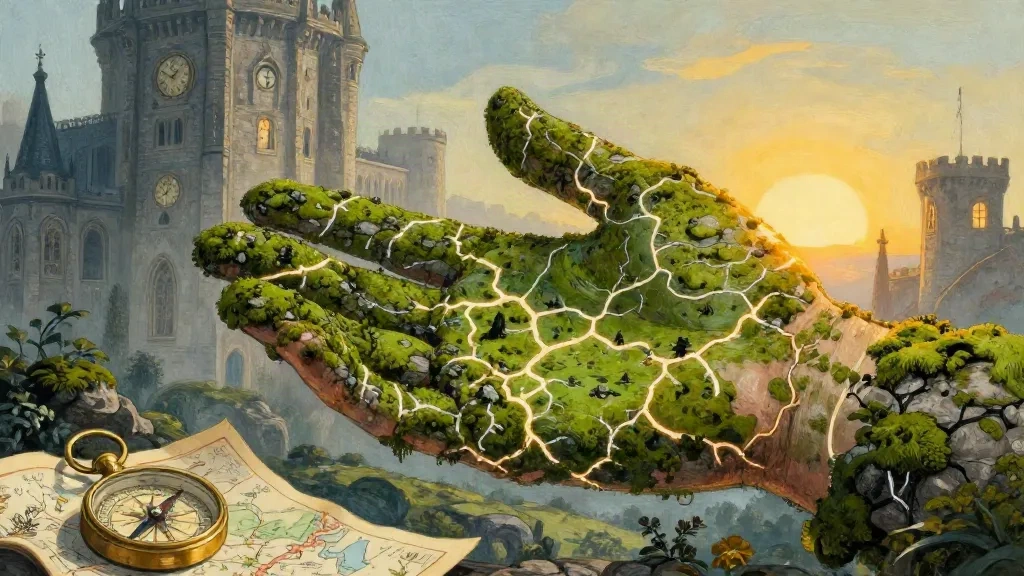
On Ilyra’s right hand, between the knuckles of her thumb and forefinger, a moss-green country appeared whenever the music stopped. Tiny roads glimmered beneath her skin. Wet stone lined its borders. A marigold flash of sunlight moved somewhere within it, though the monastery had seen no sun for weeks.
Vale’s fingers hovered over the mark. She pulled her hand back.
“The compass points there,” he said.
“Then you can follow it yourself.”
“It only points for you.”
The Note Beneath the Glass
They descended through the monastery’s oldest stairwell, where the walls were cool with rain even though the air remained dry. At the bottom waited a chamber filled with stopped clocks. Their faces displayed moments from other days: a coronation, a flood, a wedding, a birth.
Ilyra’s folded map began to change. The blank valley filled itself with a small line of script: What is remembered by two is not yet lost.
Vale touched the clock with the blue light.
“Your sister is not in the past,” he whispered. “She is in the unrepeated moment.”
Then he turned the compass toward him.
The needle bent.
He was trying to make the note return for himself. The stopped clocks shuddered. Their bells sounded beneath the floor, and the country on Ilyra’s hand burned with a marigold glow.
“If you take the note,” she said, “the country may disappear again.”
“If I do not, she disappears forever.”
For a moment, the room held both griefs, equal and sharp.
Then Ilyra placed the folded map on the blue clock. The song rose again, incomplete. She listened past the missing ending, past Vale’s breathing, past the ticking that had no source, until she heard the echo hidden inside the pause.
A Border Worth Crossing
The final note had not been stolen. It had been left behind in the breath before the song began.
Ilyra sang it.
It was not loud. It moved through the stopped clocks and woke their hands, one by one. Vale’s face changed as the note found him. In the blue light, his drowned sister stood on the far side of a river, neither living nor gone, waiting for him to accept the distance instead of trying to erase it.
He wept without turning away.
When the melody ended, Ilyra’s hand was blank again. The folded map had lost its valley, but in its place appeared a narrow road.
Vale took her compass and placed it in her palm.
“I thought I needed the lost country,” he said. “Perhaps I only needed a way home.”
They climbed into the wet morning. Behind them, every clock in the monastery agreed for the first time in years.
Ilyra listened to the bells. The final note remained.





