 Netwrck
Adventure.
The Country Under Her Thumb
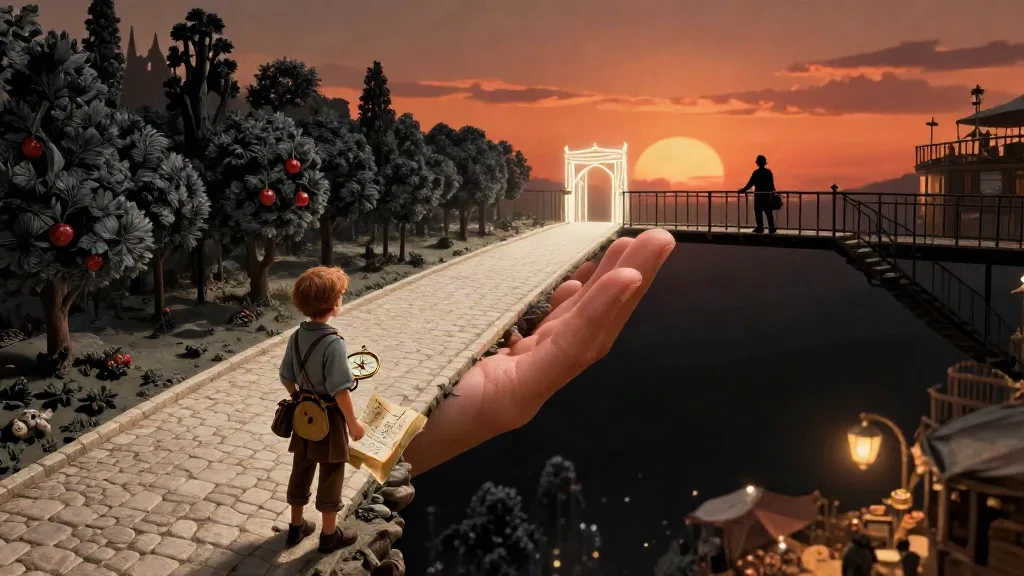
At midnight, the night market unfolded beneath the city’s first floor, where no street had ever been allowed. Stalls climbed one another on iron staircases. Lanterns burned in black-cherry bunches, and pale stone walls sweated beneath the copper-colored horizon.
Mara Venn, apprentice to the city’s last cartographer, was measuring a crooked lane when the brass compass in her palm pulled north. The needle did not point. It turned, trembling, toward the crease below her wrist.
There a country appeared.
Its black-cherry forests lay across the heel of her hand. Its pale-stone roads curled around her thumb. Tiny copper letters hovered above a range of mountains, rearranging themselves whenever she closed her eyes. At their center stood a white gate, and beside it Mara saw the outline of a single unfinished note.
She knew the shape.
Her mother had hummed the note while drawing coastlines during fever. Mara had learned the melody as a child, one of seven notes repeated until the final sound became a door. For sixteen years it had arrived reliably, delicate as a moth touching glass.
Now it was gone.
Without that note, the song ended before release. It sounded, Mara thought, like a house with every lamp extinguished.
The Collector of Unfinished Things
The gate opened when Mara pressed her thumbnail against the mountains. Heat ran beneath her skin, and the market roof vanished.
She stood on a balcony above a sea of tiled roofs. Below, late shoppers moved through the lantern lanes, unaware that the ground beneath them had never been ground at all. The city floated on a vast dark space, its first floor resting on pillars thick as tree trunks.
Waiting beside the gate was a rival cartographer named Orin Sable.
He wore a red scarf, though red was forbidden below the market, and his folded map hung from his belt like a shield. When he smiled, Mara saw that his face had been drawn rather than born.
“The country has been migrating,” he said. “Every seven years it chooses a carrier. You received it badly.”
“It chose me.”
“It landed on you.”
Orin tapped his map. The paper answered with a rustle like wings. “My mother left a song unfinished too. If I recover the note, her last words can return.”
Mara folded her own map tighter. Her mother’s melody had carried her through every absence: the hospital corridor, the empty schoolroom, the night after the funeral. She would not gamble it for someone else’s goodbye.
They descended through streets that ended at walls, crossed rooftops joined by taut ropes, and slipped beneath the bakers’ ovens when the market bells rang thirteen.
At every junction, Orin unfolded his map. His routes were clean and certain, but they led them away from the copper horizon. Mara consulted the compass instead. The needle spun toward the only places the forbidden maps omitted: open windows, broken stair treads, holes where floorboards had been removed.
By the third bell, they reached the market’s oldest well.
The Well Without a Bottom
There was no bucket, only a black-cherry darkness and pale stones descending forever. The compass leaned into it. On the well’s rim, one copper note glowed like a fallen ember.
Mara reached for it.
Orin caught her wrist. His fingers were colder than the well.
“The note cannot be taken,” he said. “Only returned. Whoever releases it last decides where the melody ends.”
“Then why did your map lead us here?”
His expression flickered. The folded paper opened by itself. Hundreds of routes crossed the sheet, but only one began at this well and ended at a star.
He had not come for her song. He had come because the note carried his mother’s unfinished words back to a place where the dead could hear them.
“I do not need the melody,” he admitted. “I need one breath inside it.”
Mara looked into the well. Her country glowed below, shrinking with every copper light on the horizon. She understood then: the final note was not missing because it had been lost. It waited at the bottom of every silence, waiting for someone to choose what came after.
Orin lowered himself into the dark.
“If I take the breath,” he said, “the song belongs to my mother.”
Mara climbed down after him.
The Last Measure
They fell through streets no builder had mapped. Above them, the market floated like a black-cherry constellation. Below, the note waited in a chamber of pale stone, suspended over a horizon made of copper.
Orin reached it first. The note opened its small white gate, and through it Mara heard a woman laughing in a distant room. His mother’s voice, young and whole.
He raised the map to catch the sound.
Mara could have let him take it. Instead she opened her own map and placed the seven notes along its border. The melody returned to her in fragments: a warm kitchen, rain on a window, her mother’s hand covering hers as she practiced.
She sang the first six notes.
The seventh waited.
Orin looked at her. “Give it to me.”
“You asked for a breath.”
She opened her palm. The country on her skin faced the copper horizon. Its roads brightened. Its white gate unlocked.
Mara sang the final note, but gave it no destination. It rose through the well, through the market’s iron staircases, and across the floating city. For one breath, every pause held a voice. Orin heard his mother say his name.
Then the note passed on.
When the market bell rang, the city beneath it came into focus: a dawn market, pale stone bright beneath a copper sky, streets appearing where shadows had been. Mara’s hand held only a compass and a folded map. But when she hummed, the last note returned—not as a door, not as a promise to return.
As a way forward.





