 Netwrck
Hopeful Science Fiction.
Shadows at the Lift
Mara arrived at Saint Orra with a silver spoon in one pocket and a white feather in the other. The spoon had belonged to her grandmother, who said that every city could be fed if enough people remembered to share a meal. The feather had come from a bird found dead beyond the frozen tram line, its wing unmarked by snow.
Saint Orra was a winter resort built on a black slope above the reservoir. In summer, guests arrived with guitars, suitcases, and plans to become healthier people. In winter, the place emptied before the first freeze, leaving the lifts humming over empty runs and the hotel windows glowing like pharmacy signs: green, steady, impossible.
The shadows arrived first.
They slipped beneath the doors and gathered in the lobby, wearing the outlines of people who had not yet arrived. One shadow sat beside the piano. Another leaned against the cloakroom desk. Mara saw them when she carried her instrument through the entrance, and she heard the note before she understood its source.
It rose from the piano strings without a key being touched. Lavender-colored, clear as a bell, and impossible on the old instrument.
Mara lifted the lid. The note stopped.
Outside, the last shuttle turned around.
The Truth of the Sound
By nightfall, the resort had filled with people who had been seen only in silhouette. They shook snow from their coats and spoke in careful voices. A woman said she was afraid of the dark. A man said he had lied about his name to get the job. A child admitted he had hidden the resort's emergency key beneath a planter.
Each confession produced the note. Higher when the speaker released something old. Lower when they told a truth they had carried for years. Mara played them back, finding melodies in the succession, until the lobby sounded like an orchestra tuning after a fire.
“You hear them,” said the hotel manager, arriving without a shadow. “That is why the winter stays.”
“The winter is not staying because of me.”
“No. It is staying because no one has told it the truth.”
He pointed toward the reservoir, where the ice had thickened into a white wall.
“One generation ago, the resort began making promises. Fresh water. Warm rooms. A season for everyone. We asked the mountain for a winter that would end when we had learned to be kind. The mountain heard us.”
“And then?”
“Then we forgot the promise. So the winter refused.”
Mara opened her case and removed the silver spoon. Its bowl held a piece of lavender ice.
A Shelter for the Storyteller
She decided the resort needed something stronger than a promise. It needed a structure built from the truths people had spoken, one that could survive its storyteller.
She began with the piano. For every honest word, she placed a small brass bridge inside the instrument, shaping the sound until it became a support. The lobby's shadows pulled at the wires, trying to imitate the people they had once followed.
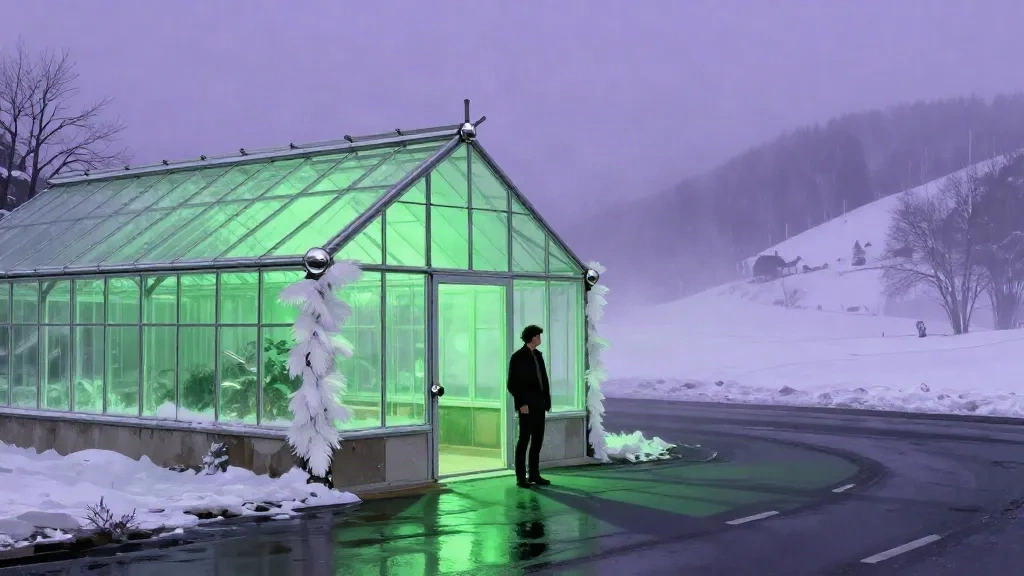
By the third day, Mara had built a greenhouse around the central stair. The structure was delicate: white feather supports, silver spoon joints, and a roof of green pharmacy-sign glass. Inside it, winter behaved as it should. Snow slipped from the leaves. Soil softened. Seeds opened in the dark.
But the cold found the seams.
It entered through the stories Mara used to build the walls. The woman's fear returned. The man's lie became a crack. The child's hidden key froze into the floor.
Mara understood then that truth was not a single beam. It was a living arrangement, requiring witnesses.
So she stopped building alone.
When the Story Changed
Every guest contributed one thing they had never said aloud. A farmer admitted he had sold his father's land. A nurse confessed that she had chosen the warmer ward over her sister. The manager said he had known the mountain's bargain and hidden it because admitting it would have ended the resort's prosperity.
The last note came from Mara.
She had heard the truth in everyone else, but had never spoken her own. When she put her hand on the greenhouse wall, the winter asked what she wanted.
“I want to build something that can survive the storyteller,” she said.
The answer was not a note.
It was every note at once.
The greenhouse rang. Silver spoons trembled against white feathers. The green roof filled with warm light, and the shadows around Saint Orra finally stepped into the sun.
Spring did not arrive as a conquest. It came as maintenance: a shovel cleared here, a seed planted there, a promise corrected before it hardened. The resort remained winter-bright at its edges, but the ice began to retreat one honest morning at a time.
Mara kept the feather in her pocket. She laid the spoon beside the greenhouse door, where any guest could pick it up.
By the next winter, the shadows arrived only when someone was ready to meet them.





