 Netwrck
Adventure.
The Country on Her Hand
Mara found the country while polishing the brass compass she had been forbidden to touch.
Its needle did not point north. It turned toward a pale stone arch beyond the monastery kitchen, where the clockmakers kept their oldest machines beneath linen cloths. The monks called the place the Black Cherry Cloister, though no cherry tree had grown there for a hundred years. At dawn, the stones released a sour, wine-dark scent. At noon, they looked ordinary. The country’s time obeyed no such schedule.
When Mara was twelve, her mother had hummed a song while drawing coastlines on the kitchen floor. The melody climbed from a low chamber in the chest and opened into a bright, climbing line. At its end, the song should have touched one final note: a clear, ringing sound, like a bell heard from underwater.
But the note was missing.
Her mother had died before finishing it. Since then, Mara heard the unfinished melody in dreams, always stopping at the same cliff edge. She had come to the monastery because its clockmakers claimed they could repair anything that had lost its measure.
That evening, she found the country on the back of her left hand.
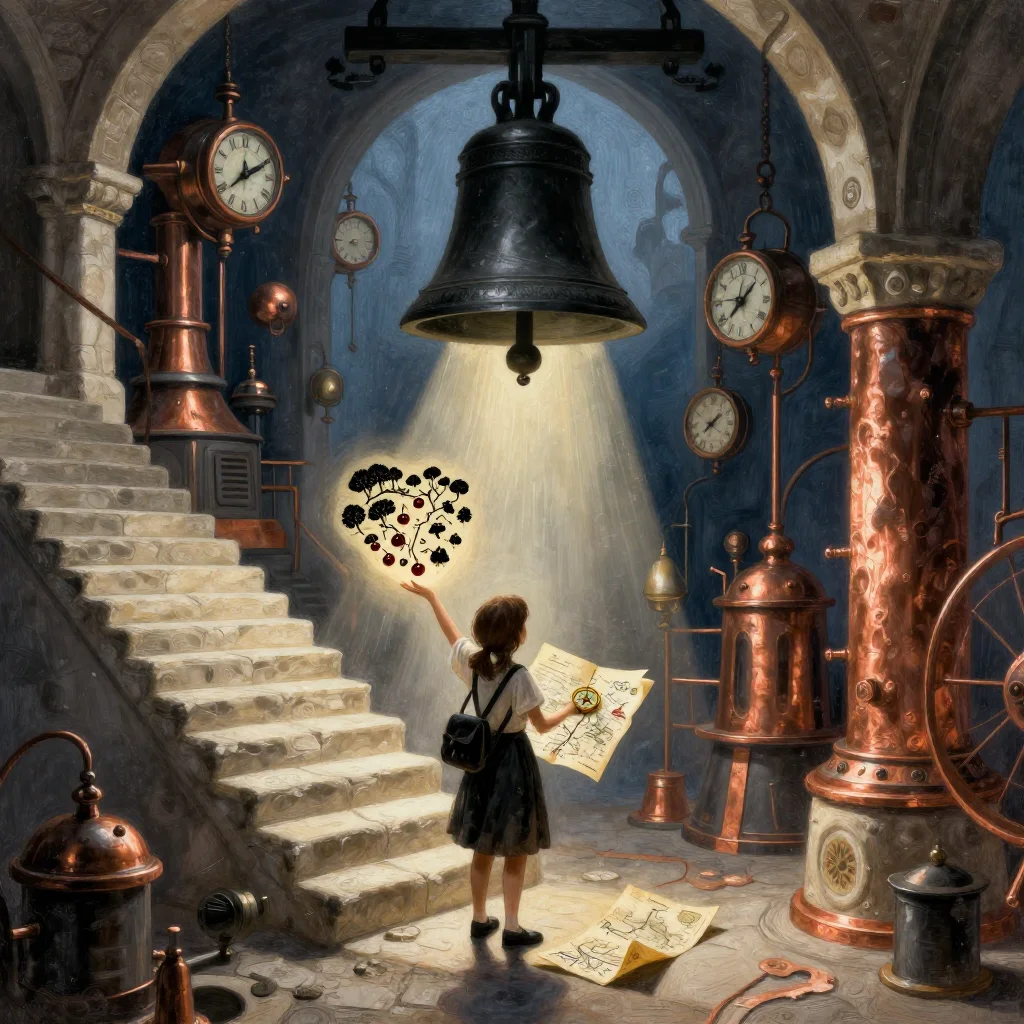
It appeared as the compass needle swung. Pale stone mountains rose from her knuckles. A copper-colored river divided the landscape and vanished beneath the heel of her palm. Tiny black marks clustered around the wrist, no larger than grains of pepper. Mara stared at the map until the lines shifted, forming a road toward the monastery’s buried bell tower.
She folded the map she had carried since childhood and pressed it against the country. The paper drank in the copper horizon.
The Missing Measure
Prioress Orra met her beside the monastery clock room. Orra was young for a prioress, with a face kept deliberately smooth and hands marked by acid. She wore a black cherry robe and carried no timepiece.
“You found the first map,” Orra said.
Mara unfolded the paper. Her hand-map had not changed, but the folded sheet now showed a narrow staircase descending into white rock.
“The song belongs to this country,” Orra continued. “For three hundred years, it has kept the monastery’s clocks aligned. Your mother knew. She came here to return the final note.”
“Then why was it taken?”
Orra looked toward the covered machines. “Because your mother believed the note belonged to everyone. Someone else believed it belonged to no one.”
The rival arrived before Mara could ask.
His name was Ilyan Vey, a clockmaker from the western monasteries. He carried a compass in one hand and a black iron key in the other. His coat was powdered with pale stone dust. He smiled as if they had agreed to meet.
“Give me the map,” he said. “I will restore the song.”
“You took the note.”
Ilyan’s smile disappeared. “I removed a weapon.”
Mara understood then why the country lay on her skin. Her mother had not lost the melody. She had hidden its ending in living blood, and the country had chosen Mara as its bearer.
Orra drew a thin brass key from her sleeve. “The final note is kept in the tower. It can be restored once, but only by someone willing to give up the road that leads to it.”
“What road?” Ilyan asked.
Orra did not answer. She looked at Mara’s hand.
Mara folded the map again. The country folded with it.
Under the Copper Horizon
The tower door opened to a stairway descending downward.
Ilyan reached the first landing before Mara. His key turned in a lock set into the floor, and the walls shifted. The pale stone staircase split around them. One path climbed toward a copper horizon fixed in the darkness. The other descended beneath the monastery, where air moved through cracks with the rhythm of a sleeping creature.
“You want the note for a weapon,” Mara said.
“I want the silence it creates.” Ilyan descended. “The country on your hand is waking. Every clock in the monastery is beginning to remember a different hour. If the note returns, the old agreement ends. Borders open. The war in the north begins again.”
“And if you erase it?”
“Then the country remains asleep.”
His answer was practical. That frightened her more than greed would have.
At the bottom of the stairway, they found a circular chamber. A single bell hung from the ceiling, black as a cherry pit. Mara’s brass compass pointed straight at it. The folded map unfolded itself in her hand, revealing a red line ending beneath the bell.
Ilyan set his key against the stone. “Your mother sang here.”
“You were there.”
“I was ordered to silence her.”
He turned the key. The bell gave a muted cough. The melody emerged from it, thin and broken: Mara’s mother’s voice, the low chamber, the bright climbing line.
It stopped before the last note.
Ilyan raised a hammer.
Mara lunged. The compass struck his wrist, and the bell rang once. The sound was wrong—too high, too sharp. Her countryMap tore beneath her fingers. On the stone floor, the black marks from her wrist spread into roads.
She understood the prioress’s warning. The road to the note was the road she had taken to reach it: the map, the hand, the belief that a lost thing could be fetched if one followed the correct path.
Mara opened her hand over the bell.
The country lifted from her skin.
The Note That Chose
Pale stone rose around them. Copper water filled the chamber. The monastery’s clocks began to strike at once, each from a different year.
Ilyan swung the hammer at the bell.
Mara caught the hammer’s head with both hands. The impact traveled through her arms and into the country. She saw the northern war as a thin red thread, saw the monastery buried beneath black cherry leaves, saw her mother standing in a kitchen with a map unfinished on the table.
The note was not a sound alone. It was a choice. Return it, and every clock in the country would begin again from the same present. Keep it hidden, and the clockmakers could continue ruling the hours.
She released the hammer and struck the bell herself.
The final note rang.
It was not loud. It was clear.
It passed through the chamber, the stairway, the cloister, the kitchens, and the old machines under their cloths. Mara’s mother’s song finished in every room at once.
Ilyan listened. His face emptied of anger. “Now they will remember what they did.”
“Yes,” Mara said.
“That is not peace.”
“It is an ending.”
By sunrise, the hand-map had faded to a few pale scars. Mara kept the brass compass, though its needle no longer pointed toward the tower. The folded map remained blank except for one copper line drawn along its edge.
In the clock room, Orra waited beside a machine with no hands. Mara wound it once. It began to move.
“What time is it?” Orra asked.
Outside, the black cherry trees had begun to bloom. The horizon was copper, distant and bright.
Mara looked at the empty clock face.
“The time we have,” she said.
The machine ticked once.
Then, for the first time in three hundred years, the monastery clocks disagreed beautifully.





