 Netwrck
Adventure.
The Country on Her Hand
At dawn the city drew its shadows beneath the windows, and every citizen who stepped outside did so wrapped in a darkness that obeyed none of them. Pigeons became gray bells overhead. Chimneys leaned east. The shadow of the Hall of Measures lay long across the market cobbles, pointing at nothing in particular, the way a finger points when the person holding it has forgotten what they meant to say.
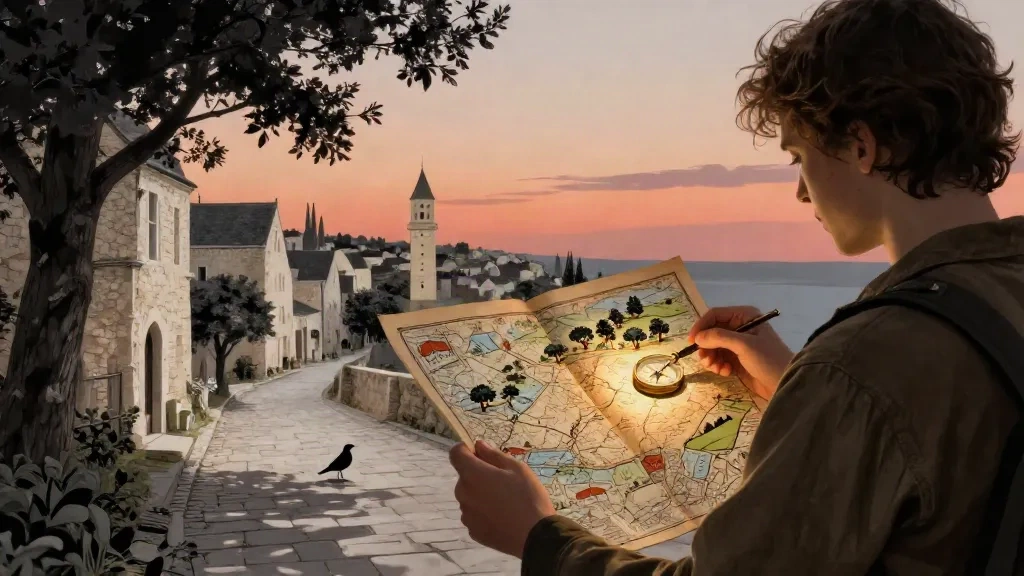
Nera kept her brass compass in the left hand and a folded map in the right. The map was older than the streets it described. Its creases had gone soft as cloth, but the ink was still sharp, red as black cherry under a pale stone sky. Her master, Dovan, had drawn it himself, thirty-one years ago, in a hand she had only ever seen shaking.
That morning a drop of ink appeared on the back of her right hand, where the fold had pressed hardest.
It spread into coastlines.
She watched a little country unfold between her knuckles. Mountains raised themselves along her tendons. A copper-colored river crossed her wrist and slid beneath her cuff. At its center stood a black city, its towers tilted toward a horizon the color of a struck bell, and along its coast, in letters too fine to read, a name repeated and then struck out so many times the paper had gone thin.
Dovan saw it from the doorway and went the color of old plaster.
“Ah,” he said. Then, in a voice with no room left in it: “It has chosen a hand.”
“Is it a country?”
“It is a place the city has forgotten how to hold.” He crossed the room without hurrying, which frightened her more than haste would have. He set his thumb beside the ink without touching it. “You will want to ask whose it is. Don’t. The map does not answer to its owner. It answers to whoever is left behind.”
Below them, in the court, the shadows voted. They came away from their citizens’ heels and gathered in a slow ring, each casting a small black hand to count itself, and every one of them pointed the same way: toward the Hall of Measures, where each person in the city was weighed against the darkness they cast.
Then the bells began.
The song rose out of the hidden organs under the streets, sweet at first, climbing from doorway to rooftop. It sang of the dead: names carried beneath bridges, love that outlasted the bodies holding it, the small absurd details the living kept of the gone — the way someone laughed, the particular cup they always reached for. Nera had heard it every morning of her life. It was the sound of a city agreeing not to forget.
At the final measure, the note vanished.
The silence struck her in the ribs, and every shadow in the court stopped voting.
The Hall of Measures
She found the gap in the melody as easily as a missing tooth. Thirty-one years she had walked the streets behind Dovan, and she had never once asked what the last note was. Now there was a hole shaped like a held breath, and the whole song leaned into it and did not fill.
At noon she went down to the Hall of Measures, where the counting was done. The Underweigher, Ostrel, sat behind a table with a ledger wider than his arms and a shallow brass basin set into the flagstones. Citizens came, stepped onto the disk, and their shadow spilled into the basin. If the shadow weighed more than the person, a price was entered in the ledger: a name of a dead relative, a winter of childhood, the face of a friend. The city paid gladly. It preferred to any single person deciding alone what the dead deserved.
Nobody’s shadow was where it belonged that day. The court was full of loose darkness, standing in files, waiting to be weighed.
“You’re late,” Ostrel said, without looking up. “You’re not even holding anything.”
“I am holding a silence.”
His pen stopped. “Then you’ll want the courier. He’s been asking after you since the first bell.”
Ilyan stood under the great window with its copper horizon, holding a torn page. He had been her friend at fourteen, in the years when the two of them raced courier rounds and stole bread. He had been her rival for six months, since the night he told her the map was not hers to keep.
“You found it,” he said.
“I found a page in a ledger sleeve. It has your hand on it.”
“It has my mother’s name on it.” He held the page out. She did not take it. In the Hall’s high light she could see the paper had been folded and refolded so many times it had gone soft as skin, and at its center, inked in a firm young hand, a bar of music: the last measure, entire, with a note marked beneath it in a different ink. Give this back to me and she will answer.
“That is not how the dead work.”
“That is how the living work. You say a name out loud, in a city that weighs everything, and something has to answer for the weight.” He smiled, brief and shadowless, and she noticed with a small cold shock that his shadow was not under his heels at all. It was pooled two paces behind him, patient, waiting to be called. “The city has been holding its breath for thirty-one years, Nera. Somebody has to let it out.”
“You don’t want her back. You want her to have been missed loudly enough that it counts.”
That landed. He flinched the way a man flinches when a surgeon names the wrong limb.
“Vesna,” he said. “Her name was Vesna. She was in the ledger the year the note was cut. One line. One line, and no weight against it.”
“Then she was never entered.”
“Then she was never weighed. There is a difference, and you of all people know it.” He stepped closer, and his pooled shadow did not follow him. “Give me the hand.”
“It isn’t on my hand. It’s under my skin.”
“Then give me the skin.”
He threw the bronze key. It struck the flagstones and became a small black bird, which flew under the hall’s doors, carrying the corner of the torn page in its beak. Nera chased it. Behind her, Dovan’s folded map warmed against her palm, and on the back of her hand the little country opened another half-inch wider.
The Thirty-First Year
She found her master in the workshop with the shutters barred, doing the only thing he still did well, which was nothing.
“You cut it,” she said.
He did not ask what. He set down the dividers with the care of a man putting down a weapon. “Thirty-one years ago the bells tried to sing every name at once. Nine hundred in a month, and the organs took them all. The shadows came loose from everybody and went into the streets. We had to choose: a city that forgets a little every day, or a city that remembers everything at once and cannot tell the dead from the living.”
“So you chose.”
“I was the cartographer. I knew what a map is for. A map is a promise that some things are on it and some are not.” He turned his hands over. They were translucent at the edges, like paper held to a window. “I took the last measure out of the city and into myself, and I have been holding it silent ever since. There is no place inside me that is counted. That is the whole of my usefulness.”
Nera felt the anger arrive before she had chosen a target for it. “You could have told me.”
“I could have had a daughter who owed me nothing.” He said it without bitterness, which was worse. “And you do owe me nothing, and here you are anyway, which is a country I never mapped.”
“What happens when you can’t hold it?”
That was the question the whole city was leaning into, and he answered it plainly, because he had always been plainly where it cost him. “Every year it thins. I lose a little of what I am holding. Some nights I cannot remember my mother’s voice. Six weeks ago I lost my own name for an hour.” He nodded at her hand. “When I go, the note goes out. Not into the city — out of it. Everything the city ever agreed to forget goes out with it, and the forgotten country comes in, and the two of them are the same place.”
“And when?”
“The bells first rang on the winter solstice. So does the note’s ending. When the organs wake that night, they will find the gap I left and they will fill it with whatever is nearest. Their nearest is the country on your hand.”
Outside, the black bird called once from the courtyard wall, and the sound it made was two notes, not one.
A Border Without an End
The bird led her through streets where the shadows had detached and marched in disciplined files, four abreast, holding their hats. Citizens stood beneath pale stone arches reduced to silhouettes, each cut from itself at the waist like paper dolls, waiting politely to be reassembled. Only Nera cast a shadow in the shape of a map.
At the city wall the border would not close. She tried the compass; the needle spun without settling. She tried the folded map; the paper went warm and refused to fold smaller, as though something on it was breathing.
Beyond lay the forgotten country. A plain of black cherry trees stood shoulder to shoulder, their trunks marked with names that peeled away whenever she looked directly at them, so that the ground was littered with a slow drift of other people’s grief. The copper horizon burned behind distant hills, low and patient. At the center of the plain a white tower rose with no door and no stair.
The bird landed on the folded map and pecked once, hard, at the place where the river disappeared beneath her sleeve.
Nera opened it. A narrow path ran between two blank regions, and at its end the missing measure hovered like a dark seed: a note so low it could only be heard by someone willing to be silent.
“We are not going there,” she told the bird.
It pecked again, at the struck-out name along the coast — the name repeated and struck out so many times the paper had gone thin.
“That is not my name,” she said.
Behind her, in the city, a bell that had not been touched rang a half-tone flat.
The Tower of Suspended Shadows
Ilyan reached the tower first, which surprised her less than it should have; he had been walking toward his mother since the day she died and had simply been taking the long way through other people’s houses.
He pressed his key into the blank wall. A door appeared the way a bruise appears — all at once, without any sense of having been made.
Beyond it stood a chamber filled with suspended shadows. Each one held a citizen’s forgotten act: a betrayal kept forty years, a kindness no one had thanked, a final spoken word preserved exactly as it had left the mouth. They drifted at shoulder height, turning slowly, and every one of them turned toward the door as Nera came in. At the center of the chamber, a black cherry tree grew upside down from the ceiling, its roots in the air, its branches buried in the floor.
Dovan was at the base of it, sitting down. He had followed her, and the following had cost him most of what was left.
“Play it,” Ilyan said.
“You don’t know what you’re asking to put back into the city.” Nera raised the brass compass. It was not a compass anymore. Its needle swung slowly and settled on the only person still standing behind her, which was her master, and stayed there. “Nine hundred a month. All at once. Every unweighed name in the ledger and the ones nobody ever entered. Vesna and your father and my father and the man who sold the bread you and I used to steal. All of it, in one breath.”
“Then it should have been theirs.”
“Yes,” she said. “It should have. That is the whole cost and I will not pretend otherwise.”
Ilyan looked at the upside-down tree. “You have three choices and two of them are mine to forgive. Play it whole, and the city drowns in what it dropped. Play nothing, and he dies and the country comes in and the dead go quiet forever.” He held up the bronze key, which was a key again, dull and ordinary. “Or play a little. One name a citizen, by their own weight, in their own hearing. Nothing forced on anybody. And then someone holds the rest.”
“And the someone is me.” Nera turned her hand over. The country on it was not a country. It was a list, in the cartographer’s red ink, of every person who had ever been entered where the city could not count them, and the last line was still wet. “The map does not answer to its owner. It answers to whoever is left behind.”
Dovan said, from the floor, in a voice like a hinge: “You may put it down. I will hold it tonight. I have held it longer than a night.”
“You have, sir,” Nera said, and felt the whole thirty-one years of him go out of her like a held breath. “And then we saw what you became.”
The Sound of Remaining
She began the song in the part of it she had known all her life, the part the city sang every morning, and the suspended shadows leaned in. Their forgotten acts came apart and reassembled as words: the loaf I never gave you, the name I was called in the yard, the promise I made at the bridge and broke in the same hour. The upside-down tree shivered. Its roots lifted an inch off the floor.
At the final opening Nera let the silence hold. She held it the way Dovan had held it, for years, out of his own chest. The chamber went absolutely still, and in that stillness she could hear one name at a time rising through the floor toward the city above — not summoned, not dragged; offered, the way a person offers a chair.
Then she sang the buried note.
It was not bright. It was deep enough to make the black cherry tree shudder and the stone of the tower sound like stone remembering rain.
Ilyan’s key fell from his hand. His mother’s shadow stepped forward out of the drift — not a body, not a rising. A presence. A hand resting lightly on his shoulder, the weight of it no more than a coat he had once carried for her across a bridge.
“Vesna,” he said.
And the shadow said, in a voice assembled out of every unspent kindness of hers: “You spelled my name wrong for six years.”
Then it dissolved into the chorus, and he did not reach after it, which was the strongest thing Nera had ever seen a person do.
The country on her hand closed.
Its mountains went faint beneath her skin, and the copper river thinned to a line, and the list along the coast stopped being written on. In the workshop back in the city, a cartographer’s old map lay flat on a table and had a woman’s hand printed in red on the inside cover, and the hand was still.
What the City Kept
By morning the city had one shadow for every citizen again, and the files outside the Hall of Measures had learned to walk home. The bells ran the whole song, all the way down, and the last note was almost too quiet to hear — a note in a room where nobody was speaking. People on the streets stopped and wondered why their eyes were wet, and no two of them wondered the same thing, and this was counted as a kindness.
Dovan went back into the tally. For thirty-one years nothing cast a shadow from him; now it did, a long grey shape with both feet, and he laughed at it, once, out loud, in the street, like a man surprised to still have a body. He lasted until the equinox. His name was entered in the ledger in a full, heavy hand, and the price the city assessed was nothing at all, because he had already paid it thirty-one years early, and the Underweigher, Ostrel, wrote settled and closed the book on it gently.
Ilyan kept the torn page. He came out to the wall most mornings with bread and stood where the border would not close, and twice a year he spoke one name into the black cherry plain, spelled correctly, and the trees peeled a little less of it away each time. He never asked her to answer. He had learned, from her, what asking costs.
And Nera, who could still feel the ring of the compass on her palm and the exact weight of the note she had chosen not to give back, went down to the workshops each evening and copied coastlines for couriers who needed them. Her hand was ordinary. It held a pen, a cup, the reins. It held no country, and no map, and no measure of anything.
But some nights, when the bells reached the end, the last note arrived from somewhere behind her shoulder, so faint that only a courier who had learned to walk quietly would have heard it at all.
Some maps record the roads we took. The rest record the one who stayed behind them.





