 Netwrck
Fantasy.
The catalogue in room 908
At violet dusk, Mara Venn climbed to the eighth floor of the Arreton Building, carrying a wool glove in her pocket and a glass seed beneath her tongue. The tenants remembered only what was coming. They brushed their teeth before breakfast because they foresaw cavities. They left umbrellas indoors during storms they could not yet survive. Their memories arrived as clean facts, without rain, fear, or the bodies that had earned them.
Mara was the building’s archivist. Her task was simple: record the future before it happened.
Room 908 contained a catalogue bound in violet leather. Its pages listed not events but names. Each name was paired with a future place where the person would be remembered. Some entries ended in hospitals, courts, gardens, wars. Others ended beneath bridges or beneath the sea.
Mara opened the catalogue because she had forgotten what her mother called her.
There, in the copper-brown ink, she found:
MARA VENN — the orchard below Saint Orra. Name restored by the last archivist.
The glass seed warmed against her teeth. She closed the book, but the words remained visible when she looked away.
A document made of shadow
Saint Orra lay twelve miles beyond the city, where the land rose into low, wind-scoured hills. Mara had visited it once. She remembered the orchard: white blossom, split fences, a stone marker with no inscription. She remembered signing a form before entering the grounds. The signature had looked like her name, though she had never learned to write the final letter.
At dawn she found the form in her archive. Its ink was black and faintly glossy. The signature moved when she watched it.
“You are late,” said a voice from the corner.
No one stood there. Only a shadow stretched across the floor, long-armed and narrow, holding a wool glove in one hand.
Mara recognized the glove as her own, though she had lost it years ago. The shadow offered it to her.
“Sign the release,” it said, “and the orchard becomes yours.”
She took the glove. Beneath its cuff, a note had been sewn in thread: Do not let a shadow finish your sentence.
At the building’s entrance, a clerk sat beside the elevator. He had no shadow, only a stack of forms.
“Ownership requires a beneficiary,” he said.
Mara looked back. Her shadow had begun signing.
The road beneath Saint Orra
She fled before the signature ended, carrying the catalogue, the glass seed, and the stolen glove. Outside, the city’s cloud-white roofs shone beneath a violet evening, though morning had not yet arrived. People hurried toward appointments they had already forgotten making.
At the city limits, the shadow caught up. It wore a neat black coat and carried a leather folder.
“The land does not care who remembers it,” it said. “Let me be the final witness.”
Mara opened the catalogue. On the page for the orchard, a new sentence appeared:
Accession transferred to the holder of the forgotten name.
She understood then. The catalogue had not preserved her name. It had preserved the land, and the shadow meant to erase the distinction between them.
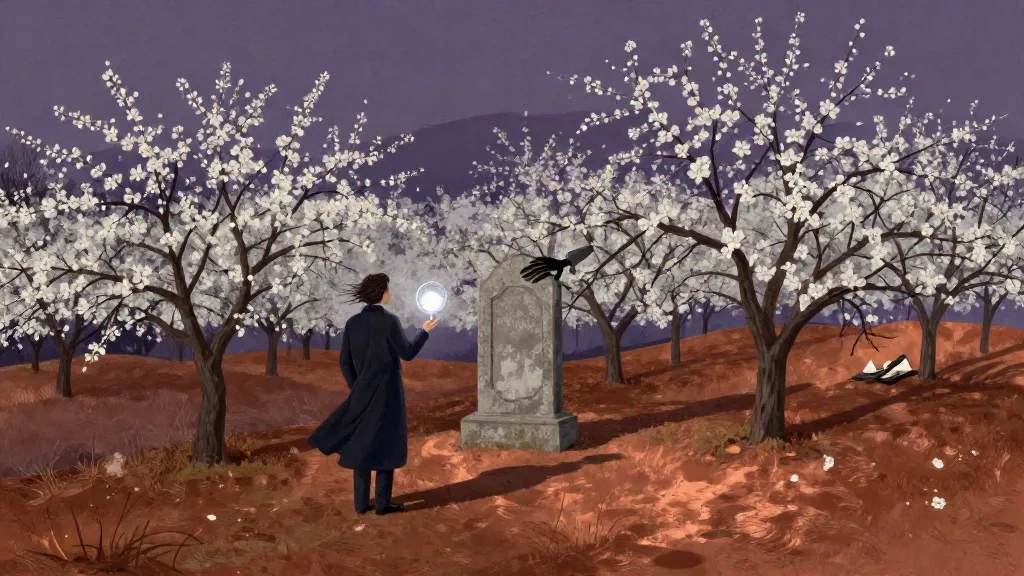
At Saint Orra, the orchard had been razed. Only the stone marker remained, surrounded by black soil. Mara knelt and pressed the glass seed into the earth.
The seed split open. Inside was no soil, but a small cloud-white flame.
The shadow seized her wrist. Its pen cut the air and signed her name in the air. The document demanded that the archivist surrender the final memory of the orchard.
The name returned
Mara did not fight for the memory. She spoke the name instead.
“Mara Venn,” she said.
The shadow’s pen stopped. The wool glove tightened around her fingers, warm with remembered winters.
She opened the catalogue and read every name aloud, from the smallest to the lost. The land answered beneath her feet. Roots crossed the soil in copper-colored seams. Branches rose from the black earth, white with blossom, each tree receiving the name assigned to it.
When she finished, the shadow’s document burned from its edges inward. The figure folded like smoke and vanished into the violet dusk.
Mara buried the glass seed beneath the stone marker. By morning, an orchard stood there, its rows aligned toward a future no one could predict. Visitors came from distant cities to ask for directions. The archivist gave them the names written on the marker, and none forgot.
Every evening, she left a single wool glove at the orchard gate. In the morning it was gone.
Somewhere beyond the road, a shadow was learning how to write.





