 Netwrck
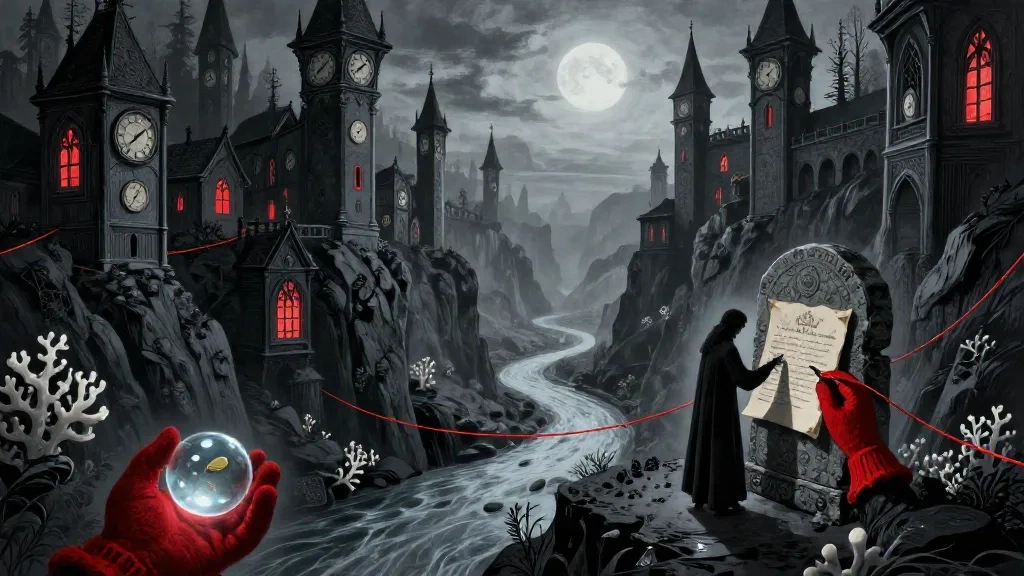
Gothic Fantasy.
The Monastery of Wrong Hours
At the monastery of Saint Vey, time was kept by five hundred clocks, and not one of them agreed.
There were brass clocks shaped like fleas, silver clocks with no hands, and tall wooden clocks that stopped whenever the wind crossed the western wall. Monks wound them at dawn, yet dawn arrived whenever they happened to wake. Vegetables boiled in one hour and froze in another. The cook marked days with red thread tied around the kitchen beams, and each morning found a different knot.
Isolde Venn was the archivist. She catalogued births, harvests, storms, and deaths in books bound in black calfskin. Her work required exactness. She recorded the name of every child born in the valley, every bride carried over the mountain, every ruler buried beneath the monastery.
In the western tower she found a catalogue no monk admitted to keeping. Its pages smelled of rain on hot stone. The entries began in the future:
Year of the White Coral Frost: Isolde Venn restores the name Orra Vale to the river country.
Her hands went cold. She searched for Orra Vale among the parish registers, the tax rolls, the genealogies of the clockmakers. The name appeared nowhere.
The Catalogue’s Last Page
That night, a shadow detached itself from the wall beneath the window.
It was tall, thin, and dressed in the shape of a man who had never existed. It moved through the doorway without disturbing the hinges. Across its chest lay a red thread, bright as a cut across black velvet.
Isolde reached for the catalogue. The shadow pinned it open with one hand.
“You will need a witness,” it said.
She knew the old law. A name erased from every public record could not be restored by speech alone. It required a living hand to trace it on the land’s own deed, followed by a witness who could distinguish truth from invention.
The shadow produced a quill. It dipped itself in an inkwell and signed below Isolde’s discovery: ORRА VALE, CLAIMED BY ISOLDE VENN.
The letters shone. The tower clock began to move backward.
“You are not a witness,” Isolde said.
“No,” the shadow replied. “I am the person who remembers her.”
In the archive below, Isolde found a wooden box lined with wool. Inside lay a single red wool glove, stiff with old blood, and beneath it a glass seed no larger than a raven’s eye. The seed had been planted in the valley three hundred years earlier, according to a faded label. Its contents moved like a trapped flame.
The Boundary Stone
Orra Vale had been a bellmaker, the shadow said. During the flood that broke the monastery’s western embankment, Orra held the river gate closed while the village escaped. The gate took her below the water. The king’s clerk erased her name because a woman could not own a public work. Within a generation, the valley forgot the gate, then the bell, then the hands that had saved them.
Isolde carried the glass seed and the wool glove to the boundary stone where the river divided.
The stone stood black and upright, veined with white coral. Someone had tied red thread around it so many times that the thread had become a second skin. The shadow knelt and began signing on the stone. Each signature made the surface warm.
Isolde pressed the glass seed into a crack. The buried bell rang beneath the river. Its sound traveled through the valley, opening every forgotten path at once. Names rose from the soil: shepherds, ferrymen, midwives, the missing dead. Some names belonged to the living. Isolde understood then that restoring Orra did not mean restoring only one person. It meant returning the land’s stolen history, including the mistakes the living had made to survive it.
The shadow’s quill snapped.
“You are afraid,” it said.
“I am responsible.”
The Name Returned
At sunrise, the red thread had crossed every surface of the monastery. It stretched through clock faces, beneath doors, across the white coral walls, and over the pages of the catalogue. Isolde followed it to the eastern courtyard.
There the shadow stood before a table covered with blank documents. It had signed away the monastery’s future, claiming the valley as its property. With the glass seed in one hand and the wool glove in the other, Isolde did not try to destroy the shadow. She placed Orra Vale’s name in the earth and held the glove above it.
“A forgotten name,” she said, “does not belong to the person who remembers it.”
She signed the deed herself.
The shadow dissolved into ink. The documents turned blank. Across the valley, every clock began to strike the same hour, though none agreed on what it was.
When the villagers gathered at the river, they found the old boundary stone clean of thread. Beneath it, a red wool glove rested in the mud, warm and whole. No one remembered the bellmaker’s face, but every child learned her name before learning the names of the saints.
That night, the western catalogue opened by itself. Its final entry read:
Year of the White Coral Frost: Orra Vale is returned. Her name cannot be taken, because someone has finally chosen to give it.
Isolde closed the book. Somewhere below, the river carried a small glass seed toward the sea.





