 Netwrck
Folk Horror.
The Catalogue of Returning Things
At the harbor, the old archivist kept a ledger beneath a window painted with salt clouds. Every morning the sea returned what the town had lost: a brass thimble, a child's shoe, a tooth in a twist of seaweed, a silver button polished by no hand. The objects arrived in the tide line, cold and shining, as if the ocean had been keeping them in its pockets.
On the ninth day of frost, a glass seed appeared beside the ledger. It was no larger than a plum stone, clear as rainwater, with a pale blue flame suspended inside it. The archivist's name was written on a scrap of blue paper beneath it: Elian Voss, keeper of the returning catalogue.
Elian did not recognize the handwriting. She did recognize the date at the top of the paper. It was forty-three years from now.
By evening she had copied the entry into the municipal register, where it seemed prudent to preserve a future fact. The ink dried. The letters rearranged themselves.
What the Tide Could Not Return
The next morning, a catalogue arrived beneath her door. It was printed in narrow black type on grey paper, and every page described an object the sea had returned, along with a name, a date, and a person who had claimed it. The catalogue ran from the founding of Bracken Harrow to a final page dated later than any calendar Elian knew.
She searched for the first forgotten name. The pages resisted. They were bound with a wool glove: one finger, grey with age, stretched over the spine. When she pulled it free, the pages turned themselves.
Near the back she found an entry dated seventeen years hence. One name, withheld from the land. Returned by Elian Voss.
Underneath, in a different hand, someone had written a question: Will she sign?
That night the harbor bell rang without a hand upon the rope. At the quay, a shadow detached itself from the water and entered the archive wearing the shape of a clerk. It carried a black ledger, a pen, and a glove of black wool.
The Clerk of the Unwritten
The shadow placed a document on the table. Its edges were wet with seawater.
“The town owes the sea one forgotten name,” it said. “You may return it yourself, or authorize another bearer.”
Elian asked who had signed the shadow's papers. It turned a page toward her. The signature was hers, though she had never learned to make the final loop so elegantly.
“Names become ours when no one speaks them,” the shadow said. “I have learned the proper forms. I can make the land remember.”
Elian took the pen. The paper smelled of wet wool. Somewhere beyond the breakwater, the tide turned and brought in a child's bell, a rusted key, a wedding ring.
Each object landed with a soft cry. Each was proof that the sea had not forgotten.
“Who is the name?” Elian asked.
The shadow leaned close. Its face was a hollow in the air.
“You know.”
She did know. In the oldest part of the register, beneath a smear of rust, was a name with no matching death, baptism, marriage, or departure: Orren Vale. The town had crossed the name from every ledger, yet the houses had angled toward the water, and the gravestones near the cliff had turned their blank faces inland.
The Signature at Dawn
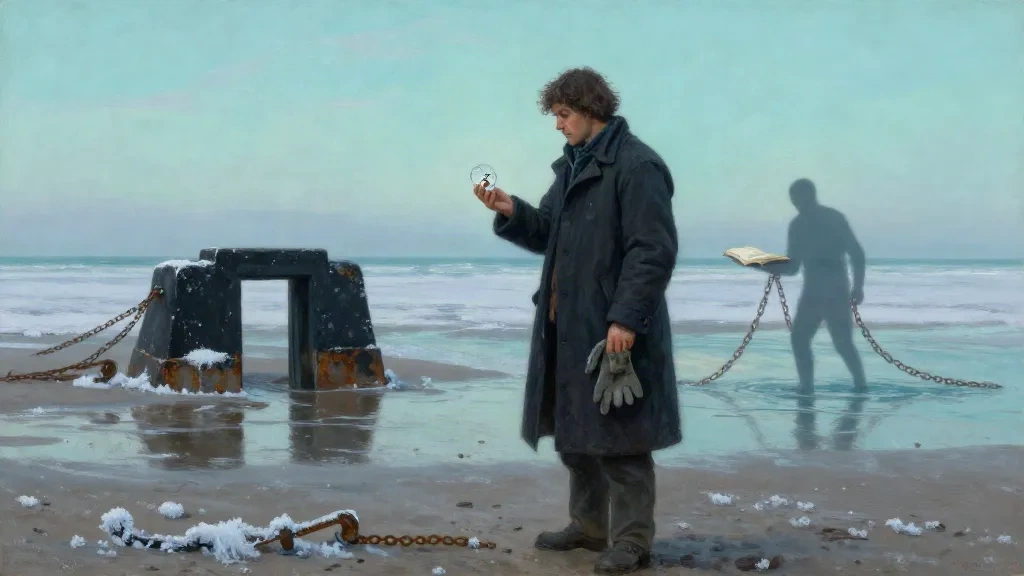
Elian carried the glass seed and the grey wool glove to the shore. The shadow followed, carrying its document open to a page already signed by dead witnesses.
The sky began to brighten without becoming morning. Frost silvered the rocks. Iron chains lifted in an impossible cyan dawn, each link flashing before the light reached it. The sea withdrew farther than the harbor could explain, exposing a path of black stones.
At its end stood an old boundary marker, split down the middle. In the stone, a shallow hollow waited for the seed.
Elian placed the glass seed inside. The blue flame rose through it. The wool glove tightened around her wrist, not strangling, but reminding her that warmth and loss were not the same thing.
“Say the name,” the shadow urged.
She said it aloud.
Every bell in Bracken Harrow answered. Every window turned toward the sea. Beneath the marker, a buried door opened onto a room of wet earth, where countless ledgers had been pressed flat by the tide.
The shadow stepped forward, pen extended. “Sign.”
Elian looked at the signature it had stolen from her future self. It was elegant, confident, and false. The true name was not a key. It was a debt.
She pressed the cold seed into the black ledger until it cracked. The blue flame spread through the paper. The shadow's borrowed signature burned away.
Dawn arrived cyan and soft over the returning shore. On the first page of the municipal register, a new line had appeared in Elian's own hand: Orren Vale, returned to the land by the granddaughter who kept the door.
Elian had never married. She had never known a granddaughter. When she looked again, the name had faded, leaving only the date of a low tide and a small square pressed into the page.
Behind her, the shadow folded itself into the water. On its glove, the word VAIL had been stitched over and over.





