 Netwrck
Fantasy.
The Catalogue From Tomorrow
At midnight, when the market’s violet lanterns began to dim, Mara Venn found her name written in a book that had not yet been made.
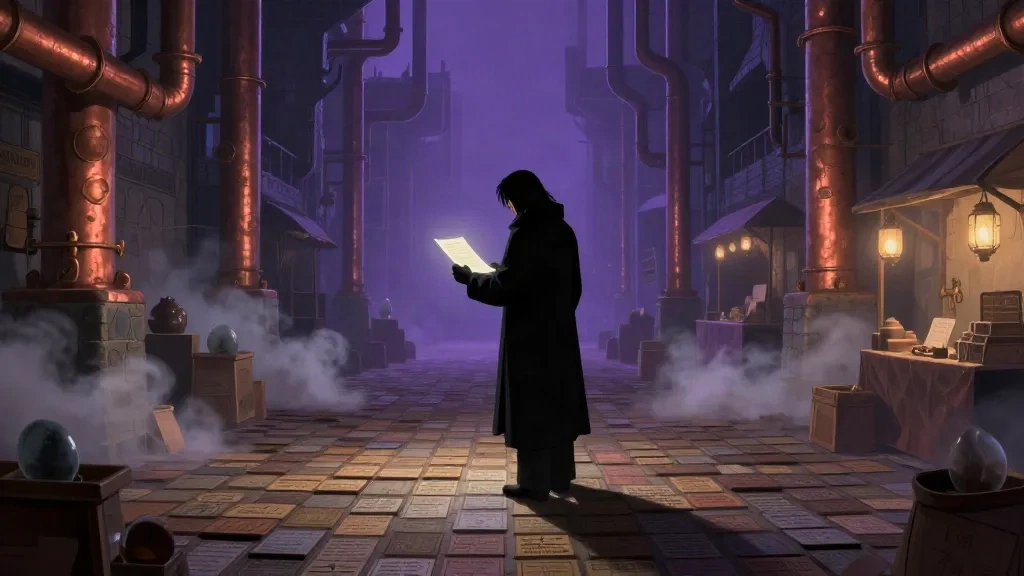
The market lay beneath the city, though no official map admitted it existed. Above it rose the blank lower walls of the first floor, copper drainage mouths, and walls of polished stone. Below it, stalls leaned together beneath a ceiling of low cloud, selling bottled thunder, salted shadows, buttons that remembered being worn, and small jars of weather harvested from rooftops.
Mara worked in the archive beneath stall nineteen. She spent her days repairing the land’s records: birth slips wrapped around pear fruit, marriage contracts folded into fishing nets, death notices pressed between bricks. The city had forbidden forgetting, then forgotten the prohibition.
The catalogue lay open on her desk. Its pages smelled of rain on hot metal. Across the top was printed: Municipal Index of Names Returned to the Ground, 2041.
Her name appeared on page 614.
Mara Venn. Restored beneath the east cistern. Witnessed by the keeper of the glass seed.
She read it twice. Then she touched the ink, and the letters warmed like a hand held over a flame.
The Shadow at the Counter
At the north gate, the city’s forgetting had taken a form.
It wore a black coat, carried a ledger, and moved through the market without displacing the people around it. Its face was smooth and violet-black. When Mara asked its name, it smiled by opening its mouth across its cheek.
“I have yours,” it said.
On the counter between them lay two objects: a glass seed clouded with violet dusk, and a wool glove missing three fingers. The glove belonged to Mara. She remembered losing it beneath the cistern stairs, years ago, when she was a child.
The shadow produced a document.
“Transfer of memory,” it said. “One name, freely given.”
Mara did not sign. The shadow dipped its pen into the inkwell. A small black hand emerged, wearing the missing wool glove, and began to forge her signature.
She struck the document with the glass seed. The page burst into orange sparks. The shadow’s borrowed hand dissolved.
“The name is not yours to keep,” she said.
“Neither is it yours to return.”
It closed the ledger. Somewhere beneath the stalls, a heavy lock answered.
What the Land Remembered
Mara descended with the seed in one hand and the torn glove in the other. The stairs passed through pipes older than the city, through chambers filled with cloud-white dust, through rooms where abandoned streets had been stored in crates.
At the bottom stood a field of stone tablets. Each bore a name worn nearly blank. The names of people who had died without witnesses, lovers separated by moving districts, children whose schools had been demolished above their own heads.
The shadow met her beside the east cistern. It had signed several documents while they climbed. With every signature, the tablets lost another letter.
“A person is a record,” the shadow said. “A record can be amended.”
Mara planted the glass seed in the nearest tablet. Violet light rose from the soil. The wool glove warmed in her hand, and she understood what it had been used for: her mother had wrapped the seed in it on the night she was born, then written Mara’s name on the cloth before the ink rubbed away.
“The land remembers what the city erases,” Mara said.
She pressed the glove against the tablet. The erased letters returned.
Across the field, names began to surface.
The Witness
The shadow lunged. Its ledger struck the ground, and black ink spread over the tablets.
Mara opened it.
Inside were thousands of transfers: names surrendered during riots, bargains made in vanished rooms, promises erased to make room for new construction. At the bottom lay an unsigned page.
She wrote her name there, but not as a surrender. She wrote it as a witness.
The market above shook. Copper pipes rang. Violet lanterns flared cloud-white.
Then every restored name spoke at once.
The shadow tore itself apart into loose pages. The east cistern opened, and clear water poured over the tablets without washing away a single mark.
By dawn, the market had vanished from the city’s lower edge. In its place stood a small field of wet stone, fenced with oxidized copper.
Mara planted the glass seed at its center. The missing fingers of the wool glove slowly filled with new wool.
Years later, children asked why her name was carved there.
She told them the land had remembered her before the city did.
That was not the whole truth. The whole truth was that memory survives wherever someone refuses to sign away its name.





