 Netwrck
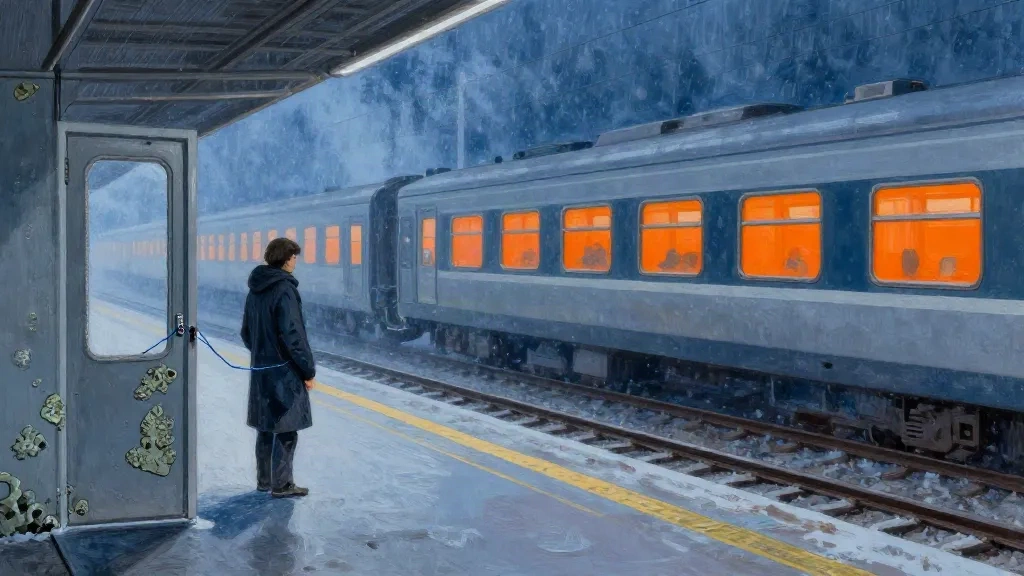
Surrealism.
The Timetable in Winter
Mara arrived at Vey Station with a suitcase of blue thread, a steel rod, and a pair of shears sharpened thin as frost. Winter had locked the platforms in iron. Frost silvered the departure board, though beneath it the destinations still shone: MARIGOLD AFTERNOON, THE LAST THURSDAY OF SUMMER, APRIL UNFINISHED.
She was a glassblower. Her trade was making windows for rooms in other worlds: a pane to watch rain from a mountain upside down, another to let in sunlight through the eyes of stone, another to show a person both roads they might have taken.
Every morning, a train arrived from nowhere and opened its doors on ordinary weather.
That morning did not arrive.
At platform eight, an unmarked door stood between the ticket booths. Lichen grew around its frame in pale green commas. A blue thread ran from its keyhole, across the platform, and into the dark beneath the tracks.
Mara followed it.
Each step untied itself behind her.
The Road That Improved with Lies
Beyond the door was a country of low hills and honest weather. Farmers stood in burnt-orange fields, calling their children by names they had never been given. Rivers ran uphill toward sourceless stones. A hound with a man’s shadow followed Mara, sniffing the air.
A brass sign read:
TRUTH OPENS THE WAY. DECEPTION CLOSES THE CLIFF.
At first, Mara trusted the sentence.
A boy stepped from the barley and asked where his mother was.
“She is waiting at home,” Mara said.
“I have never seen her.”
“You will remember her when winter ends.”
The boy nodded, satisfied. The cliff behind him folded itself into a meadow.
Then a woman asked Mara to name the town she had escaped.
“I do not remember.”
The hill ahead cracked open.
“My name is Elian,” Mara admitted, though the hound had never asked.
A tooth of stone fell from the sky and struck the road.
Mara began to understand the country’s bargain. Truth was not forbidden; truth was weight. Each fact added to the world, and the world could not bear the added weight.
So she lied to the first railwayman she met.
“My ordinary morning was stolen.”
“Stolen?”
“Yes.”
“I am not the thief.”
“You are a kind railwayman.”
He believed her. The blue thread pulled taut.
The Room Behind the Glass
It led Mara to a small station room lit by blue storm-light. A window filled one wall. Beyond it, her kitchen hovered in winter light: a chipped blue cup, a folded coat, frost feathering the inner pane. On the table lay the ordinary morning she wanted.
It smelled of toast and wet pavement. The clock had stopped at 7:12.
“You may keep it,” said a voice behind the glass, “by making the station believe it never happened.”
Mara put her hand against the cold pane. On the other side, a young version of herself hurried past, carrying a red scarf and a parcel she never opened.
“Why?” Mara asked.
“Because mornings are not allowed to belong to themselves.”
Mara reached into her case and drew out the blue thread. She tied it to the window frame, then tied another loop around the handle of the unmarked door.
“If I lie about the morning,” she said, “will you let it go?”
“A lie may open the road.”
“It will not open this window.”
Outside, the storm-light began to brighten. In the kitchen, the young Mara opened the parcel. Inside lay a second unmarked door.
What the Morning Kept
Mara did not cut the thread. She began to blow.
The glass rod glowed in the station stove. She drew a tiny flame in the blue pane, then shaped it into a window, then shaped the window into a room, then shaped the room around the morning she wanted.
The glass resisted. Each true image pulled against her breath. The blue cup was a cup. The frost was frost. Her own face was only her own face.
She exhaled lies into the pane.
“The cup is a lantern.”
The frost became wings.
“The coat is a door.”
A hidden passage opened in the window.
“The morning is a room.”
Every lie removed a wall. The kitchen expanded beyond the station, beyond the hills, beyond the country of borrowed names. Mara stepped through the new opening into the ordinary morning.
She took the parcel from her younger self. The clock moved to 7:13.
Behind her, the hound barked once. The station began to close.
At the threshold, Mara looked back. The young woman smiled and waved, already forgetting.
Then Mara cut the blue thread.
Every lie she had ever told vanished from the world at once. Vey Station reappeared: winter, unmarked door, the long tracks burning blue. Among the departing passengers, the boy with the invented mother was gone. In the distance, a hound followed a farmer’s shadow, waiting for a name.
Mara opened her palm. The thread had become a clear splinter of glass.
At platform eight, the departure board changed. One destination shone between THE LAST THURSDAY OF SUMMER and APRIL UNFINISHED.
ONE ORDINARY MORNING, AVAILABLE ONCE.
Mara boarded the train with no suitcase, no blue thread, and no door to unlock. As the winter station slid behind her, she took the parcel into her lap.
Inside, the second door was still closed.
This time, she would not open it.
This time, she would let the morning remain.





