 Netwrck
Magical Realism.
The Blue Thread
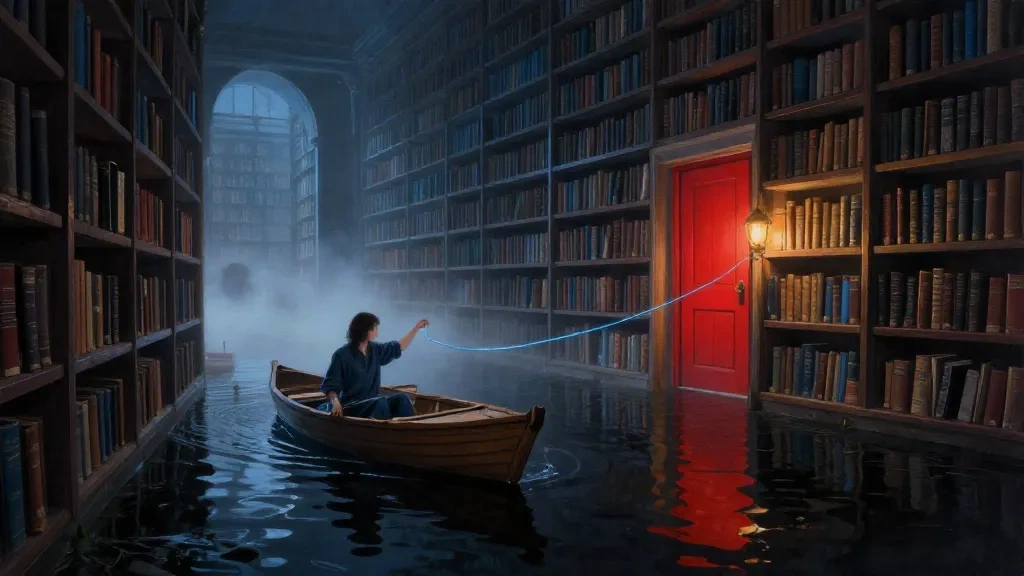
Every morning, Mara rowed beneath the archive’s high windows while the librarians called the tide. The water wore the gray of an old pearl and moved between the shelves with the patience of a clerk. She carried a leather case of glass rods, a brass mouthpipe, and the small furnace that lived in her skiff.
Her work waited above the waterline: panes for kitchens where the summer lasted eleven months, for bedrooms in countries that did not yet have names, for rooms whose owners had forgotten the shape of the sky. She shaped each window according to the light someone needed. A blue thread for longing. A thin crescent for a mother’s return. A pane with no image at all for a world tired of looking outward.
<On the seventh morning, she found a blue thread tied to the row of Unfinished Mornings.
Mara knew the catalog. It contained days that had been interrupted by wars, fevers, broken promises, and long journeys. Librarians retrieved them in corked jars. She had once rescued a morning for a drowned village: steam on blue cups, a dog beneath the table, someone laughing before the water reached the stairs.
Today the shelf was empty.
Below it floated a pale envelope. Mara caught it with her hook and read her own name.
The Price of Honesty
The thread led between shelves labeled with warnings that changed as she passed. Do not remember. Then: Remember differently. The librarians rowed carefully around her, their oars making no sound. When she asked where the missing morning had gone, the nearest woman pointed toward a red door.
The door stood on the water, unmarked except for its red paint, bright as a drop of blood on pearl.
“It is the room of departures,” the librarian said.
“What has departed?”
“The answer you gave this morning.”
Mara had not spoken to anyone. She remembered, however, the boy at the public counter asking whether a window could show a day exactly as it had been. She had told him yes. That was true when she said it.
The blue thread tightened around her wrist.
Beyond the red door, shelves stretched in every direction, each one submerged to its highest label. A narrow stair climbed from the water. On the first step lay a glass pane, perfectly clear.
“You want your morning back,” said a voice from beneath the floor.
“I want it to remain mine.”
“Then surrender one truth.”
Mara understood the bargain. The archive measured truth like a weight in a boat. Honesty made the passage heavier. Lies lightened it. She could save her morning by telling the smallest possible version of the truth.
She said, “The boy was frightened.”
The water sank half an inch.
She said, “His mother had forgotten him.”
The shelves drifted closer, their brass labels chiming.
Mara climbed. At the third step she said, “I wanted to help because I was afraid to be unable to.”
That lie sent a current beneath her feet. The red door fell away behind her.
What the Door Kept
At the top waited a room made of dawn.
Her own table stood beside the window. Blue cups. A knife beside bread. The boy’s coat, still damp from the rain. Through the glass she could see a street with carts and gulls, and the ordinary morning she had asked to protect.
Beside the table sat an old woman Mara did not recognize. She was polishing the blue thread onto a frame.
“You may have the day,” the woman said, “but not all of it.”
Mara looked closer. The old woman’s face was changing with each sentence. When she spoke honestly, its features blurred. When she lied, they sharpened.
“You cannot keep a morning that has no sacrifice,” the woman said.
Mara turned the glass rod in her hand. The room wanted a window, she realized. Not a pane to look through, but one that would let the day remain unfinished without becoming lost.
She drew the rod over her tongue and shaped a frame with no image at its center. Blue thread crossed the upper corners. Pearl-white glass filled the space. At the last breath, she opened a narrow gap in its center, no wider than a red thread.
“What do you give up?” the woman asked.
“The certainty that keeping something means keeping it unchanged.”
The truth struck the room like a bell. The water stopped.
The Ordinary Return
When Mara opened her eyes, she was beneath the archive’s shelves again. The red door had vanished. Blue thread floated around her wrist, tied to a pane that shone like a pale eye.
She rowed home slowly. At dawn, a boy climbed onto the dock and asked if she had made a window for remembering.
“No,” she said. “Only for seeing.”
That was true, and the tide did not rise.
Years later, librarians still told of the day the archive became safer. They said people had grown more honest, and kindness had spread from shelf to shore. The story was pleasant. It was also incomplete.
Mara kept the blue thread in her coat. Whenever a morning threatened to vanish, she held it over the flame and listened. Beneath the archive’s patient rowing, another sound answered: a single pane, being shaped for a room that had finally learned to open.





