 Netwrck
Surrealism.
The Windows of Other Rooms
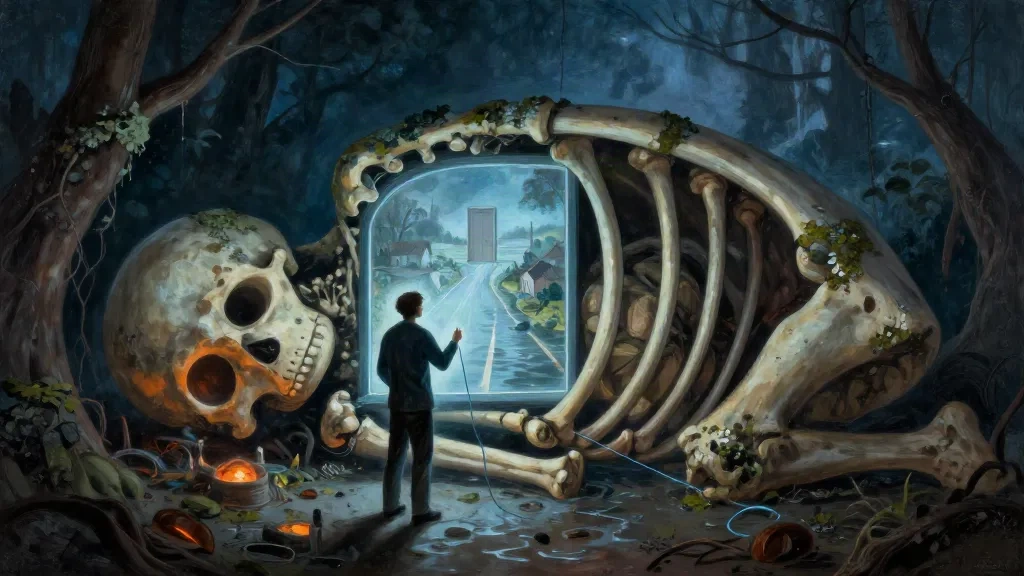
Every morning, Mara opened her workshop before the village had invented a reason to wake. The workshop stood between the seventh and eighth ribs of the sleeping giant, where the bone walls sweated rust and the roof was a thin skin of storm-lit cloud. On her table lay a blue thread, coiled beside a pair of iron tongs.
She was a glassblower. Her furnaces made windows, but not for the village. Some were panes for rooms in other worlds: a door that opened onto winter, a kitchen where the bread rose backward, a chamber containing a blue ocean with no shore. She shaped each pane by remembering the view that had escaped through it.
For years, she had made windows that gave people distant places to look toward. This morning, she wanted something less dramatic. She wanted to keep one ordinary morning from being taken away.
At dawn, the village bell rang without a clapper. Children stopped playing. Women carrying baskets turned their faces toward the same empty field. A man named Oren began speaking, though his mouth remained closed.
“The road is safe,” he said.
No one questioned him. That was the first wrongness. The road beyond the giant’s ribs had flooded last night. A woman who had seen the water climb over the bridge now said the bridge was dry. A farmer whose field had vanished beneath blue mud insisted he had never planted there.
Mara heard the lies arrive as a soft procession of insects. Each one made the village quieter. Each one made the trail outside less dangerous.
Where the Truth Goes
She found the blue thread caught on a nail beside her door. It led through the village, under washing lines, past the black cauldron where the mayor boiled turnips, and out toward the northern rib. Mara followed it. It crossed muddy ground without getting wet. It passed beneath a fallen cart, then rose into the air as though the ground beneath it had disappeared.
The farther she walked, the more details the village surrendered. The smell of smoke vanished. Rooftops lost their moss. A dog barked, then forgot why.
Near the marsh, Mara met Pell, the old woman who sold nothing but wooden spoons.
“What happened to the flood?” Mara asked.
Pell looked at the blue thread. “That question is heavy.”
“It happened.”
“It is easier to say it did not.” Pell smiled, but the expression pulled strangely across her face. “Everyone is doing so well.”
Mara understood then. The trail did not grow safer because the lies were kind. It grew safer because the lies agreed with one another. Once enough people abandoned the same fact, the road accepted that fact as the only one.
She followed the thread to an unmarked door standing alone in the marsh. It was old, narrow, and swollen with rain, yet no drop remained on its surface. The blue thread passed beneath it.
When Mara turned the handle, warm morning light spilled out. Beyond the door was her workshop, exactly as she had left it. On the table lay a finished window. Its glass showed a village waking beneath a clean sky, children laughing, water safely below the bridge.
The Room That Could Be Kept
A voice from inside said, “You can bring them through.”
Mara recognized the voice as the one that had spoken through Oren. It belonged to the giant, perhaps, or to the road itself.
“Give them the safe morning,” the voice said. “No flood. No lost field. No need to remember what hurts.”
Mara looked through the window. The false village was beautiful. It was also empty of inconvenience. No one hurried. No one argued. No one looked toward the horizon as if expecting it to change.
She thought of her mother’s hands, cracked from washing clothes in winter. Of Oren’s silent mouth. Of the child who had found a dead heron beneath the bridge and carried it home because he could not bear the sky to contain a death no one else had noticed.
Mara lifted the blue thread from the floor. It had been tied around the window’s inner edge, stitch by invisible stitch.
“This is not a morning,” she said. “It is a room with the danger removed.”
She opened the door wider. The marsh wind struck her face, carrying rain, reeds, and the distant smell of wet stone. The giant’s ribs groaned overhead. Across the village, one person began to cough. Then another. Someone shouted that the bridge was under water. Someone else said a field had disappeared.
The lies did not vanish. They fought for space, but now the truth had entered the trail and made it difficult to lie without weight.
The First Glass
At sunrise, Mara stood before her furnace. She gathered a lump of clear glass and heated it until it shone like a small sun. The blue thread remained wrapped around her wrist, wet with marsh water.
She blew into the glass. It expanded into a narrow window, not for another world, but for the village itself. She shaped its center into a road. Along the road she placed a puddle, a broken fence, and one person standing still because they had forgotten the way home.
Then she opened the furnace door.
The heat rushed out. Somewhere inside the giant, the sleeping breath shifted. A blue line of storm-light appeared beneath the clouds.
Mara set the window upright. It held the morning without hiding its cracks.





