 Netwrck
Surrealism.
The Seed's Morning
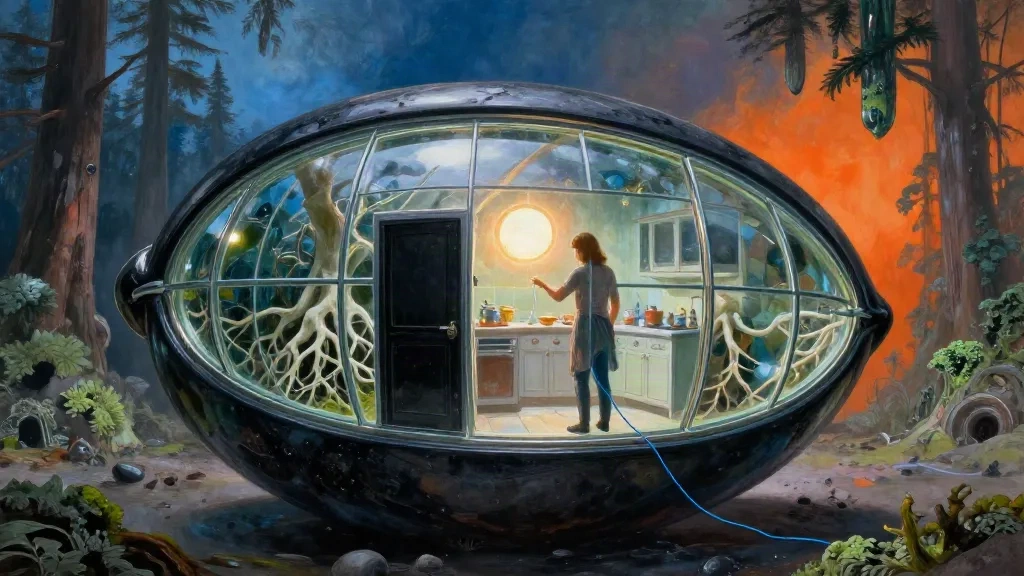
Mara shaped windows for rooms in other worlds. She worked in the crown of Seed Seven, where an orbital greenhouse curved around a black seed the size of a city. The seed remembered forests extinct for ten thousand years: cedar rain, fox-burned roots, mushrooms opening beneath a sun no living sky could imitate.
At dawn she drew blue thread through her teeth, measuring the pressure in her lungs. Each breath tightened the molten glass. Each turn of the greenhouse revealed another impossible grove pressed against the glass, leaves rustling in airless corridors.
That morning, the seed sent a pale root into Mara's unfinished pane. It curled around a bubble in the glass and made a room appear within it: a kitchen, blue cup, chipped bowl, one chair facing a square of ordinary sunlight.
She knew whose room it was. Her mother's.
Every night for nine years, Mara had received that morning through the window network. Her mother always brewed tea too strong, always left one sock missing, always said, There is no need to remember everything. The room waited on a moonless world where buildings leaned into permanent weather and grief was considered poor navigation.
Mara touched the image. The cup warmed beneath her fingertip.
Keep it,
the seed whispered through every pane. Keep this morning. Bring me a world where it still happens.
The Trail of Softer Things
A trail appeared beyond the greenhouse door, blue as lightning trapped beneath water. It led through rooms pretending to be elsewhere. One looked like her childhood kitchen, but the clock ran backward and her mother's shadow had no hands. Another opened onto a beach where footprints ended before reaching the tide.
Mara packed the unfinished window, a heat knife, and three lengths of blue thread. She tied one around her wrist. The seed tied another around its oldest root.
At the first junction, the trail forked.
My daughter makes tea every morning, Mara said.
The false kitchen shuddered. A safe stone appeared beside the path, warm and easy to reach.
She does not remember me, Mara continued. She remembers the morning, but not my face.
The stone cracked. The kitchen vanished. The trail narrowed into a blue scar between the roots.
So the rule was exact: the more she told the truth, the less safe the world became.
Farther on, the greenhouse offered a gentler corridor. On the left stood her mother's room, bright and unchanged. On the right waited an unmarked door, its surface holding neither color nor depth.
Mara chose the door.
Inside, thousands of extinct forests stood in rows, each tree breathing through a human mouth. They whispered remembered commands: Drink, sit down, nothing is lost, I am only sleeping.
Blue storm-light moved between their crowns. Under it, the seed's root had become a bridge.
What Silence Would Keep
Mara reached the far side as the greenhouse lights turned orange. The seed contracted around her. Through its skin she felt the pressure of a world bending toward hers.
Behind her, the unmarked door began shrinking.
The first lie came easily: The room is empty.
The bridge widened.
The second arrived harder: My mother is at peace.
The forests below turned their lichen faces away.
Mara stopped. The blue thread around her wrist pulled taut toward the distant kitchen. Beneath the door lay the final path, but the seed had sunk into it almost to the last pale root.
She cut through the heat knife's green flame and severed the thread.
Nothing about her softened. Her mother's room was still gone. The bridge still narrowed. Every star in the seed's black skin watched her with the patience of extinction.
So Mara told the whole truth: I wanted one ordinary morning to remain unspent. I wanted her to have made it. I wanted to go home without arriving late.
The root snapped.
Her room fell through the forest, blue cup first, sunlight square and honest on the floor.
One Square of Sun
It struck the seed's center. The bridge broke. Every window in the greenhouse rang at once.
Mara fell, then landed on a kitchen floor under blue storm-light. Her mother sat opposite her, older by nine years. The cup was empty. The sock was missing.
For one breath, anger seemed the only honest thing left.
Then her mother poured tea, too strong, and asked why Mara's hand was burned.
Outside, the extinct forests opened their mouths and released ten thousand years of rain. It fell through the orbital rooms without wetting them, carrying cedar leaves, ash, and lichen across the black seed. Where the drops touched Mara's unfinished window, morning entered.
She did not keep the whole morning. None of it could be kept. But she kept the room, the cup, the chair, and the difficult fact of being met.
When evening finally came, an unmarked door appeared beside the stove. Her mother opened it. Beyond it waited another world, another blue light, another person she had failed to say goodbye to.
Mara tied the blue thread around both their wrists.
Then they walked toward the truth together.





