 Netwrck
Folk Horror.
The Glass of Ordinary Things
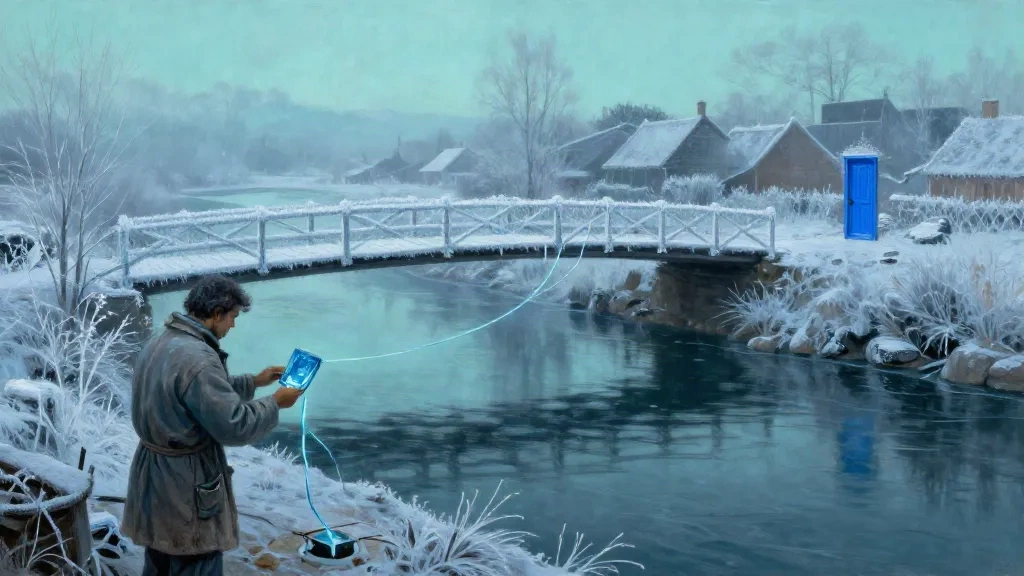
On the morning Mara Venn woke, the frost had drawn tiny bridges across every window in Bellwether. Each bridge held a pale bead of sun, trembling as if waiting for someone to cross.
In Bellwether, no bridge was merely a bridge. Every span was a promise laid between two banks, and every river was a witness. Speak softly on the water and it remembered. Lie loudly, and the current carried the lie downstream until it became difficult to tell which stones were true.
Mara shaped glass for windows in other worlds. She worked in the furnace shed behind the old customs house, where the bricks breathed warmth and the river could be heard tapping against its retaining wall. She made panes for kitchens where the bread rose before dawn, for bedrooms where children slept beneath constellations unknown here, for rooms that existed only when someone had need of them.
Her own room had no such luxury. It overlooked an alley, a broken gutter, and a blue door that had never opened.
That morning, she found a blue thread tied around her wrist. The thread began in the shed, passed beneath the furnace door, and ended at the unmarked door across the alley. Its fibers shone like ice around a flame.
Mara followed it.
The Door Without a Name
Behind the door was a kitchen she recognized from a hundred commissions. Copper kettle. Red bowl. A window facing east, its glass clear as river water. Steam rose from a pot. Bread darkened in the oven. A child coughed in the next room.
On the table lay a cup of tea, still hot.
“You came in time,” said a woman beside the stove. “If you leave, the morning goes with you.”
Mara looked through the window. Beyond the frame, the other world was visible: a pale field, a road, a row of houses beneath an impossible dawn. Soft cyan light lay over everything, neither sunrise nor moonlight. In the distance, a black bridge crossed a silver river.
“Whose morning is it?” Mara asked.
“The one you meant to have.”
On the table, beneath the tea, Mara saw a written notice. It said:
All promises made before first light are binding.
The woman smiled without warmth. “Your daughter’s school is flooded. The east road is closed. The doctor missed the night train. Nothing can be changed now.”
Mara touched the blue thread. It tightened around her wrist and led back through the doorway.
“Who made the promise?”
“You did. Yesterday, at the bridge.”
Mara remembered. She had carried a pane of blue glass across the market and stopped where the footbridge met the river. A boy asked whether the bridge would hold. She had said, “It will hold if the water remembers why we built it.”
She had meant to comfort him. The river had heard otherwise.
The Road That Improved
When Mara returned to Bellwether, the school was dry. The road was open. The doctor sat in the clinic, drinking tea and complaining about the timetable.
Her daughter came down the lane at noon, laughing, sleeves rolled to the elbows, alive.
Mara could not embrace her. Every time she opened her arms, the town seemed to loosen. A shopkeeper suddenly remembered the correct price. A constable forgot which boy had stolen the pears. Two feuding families carried tools to the same wall and began building a summerhouse.
“The river is quieter,” the shopkeeper told her. “Since the bridge opened, we hardly need to explain ourselves.”
“Because the explanations hurt,” Mara said.
She learned the pattern. When the town told the truth, the roads grew slippery. When everyone agreed to a safer version, the streets cleared. Children survived. Floodwater stayed below the steps. The dead were remembered as sleeping rather than gone.
Only the unmarked door remained visible.
It waited beside the blue thread, now stretched across the market like a small vein in the ice.
What the River Kept
Before dawn, Mara returned to the footbridge carrying an unfinished pane. She had shaped it overnight, refusing to make it transparent. Frost bloomed across its surface in a pattern of branching promises.
The river whispered the town’s newest lies.
There had been no flood. The road had never closed. Her daughter had not needed saving. All of it had been made harmless by the same clean lie: nothing was lost that morning.
Mara laid the glass against the bridge rail.
“I promise to remember what happened,” she said.
The river rose.
Water climbed the bridge pillars, carried away the painted notices, uncovered the names scratched beneath the stones. Faces appeared in the current: the doctor who had missed his train, the boy who had drowned, the woman who had died before dawn. Not ghosts. Witnesses.
The unmarked door swung open behind Mara.
Beyond it, the kitchen waited with its red bowl and hot tea. Her daughter stood in the doorway, older by ten years, carrying the blue thread in both hands.
“You can keep the ordinary morning,” she said, “but not by lying to it.”
Mara looked back at Bellwether. Frost was lifting from the roofs. Smoke rose from chimneys. Someone began to ring the school bell, and the sound crossed the river without changing.
She understood then. A promise was not a wall. It was a door left unlocked.
Mara entered the kitchen. The daughter pressed the blue thread into her palm. The window filled with the soft cyan glow of the first honest dawn.
Then Mara began to speak.
“I remember the flood. I remember the road. I remember the doctor who could not come, and the boy beneath the bridge, and the woman who died before morning. I will not make them smaller to make the world kinder.”
The river answered with every voice it had kept.
And when the sound ended, the ordinary morning began again—loss and all.





