 Netwrck
Surrealism.
Blue thread through the burnt-orange seats
Every morning I arrive at the theatre an hour before its doors admit anyone, and every morning the building smells the same way: hot glass gone slightly sour, wet wool drying on a radiator, and oranges left too long beside a furnace in the prop room. The oranges are for no one. They are there to smell like something generous, so that the rest of us can smell like something else.
In the prop room I keep my tools. Steel rods with blistered ends. Wooden paddles blackened on one face. A pipe of black iron with a mouth like a small furnace of its own. I blow windows for rooms in other worlds, though I have never stood in one. A director hands me a drawing, and the drawing is a rumour, and I make the glass that will hold the rumour up when the curtain is up. A blue pane for a drowned city. A green pane for a garden under snow. For nine years I have blown one particular pane again and again, and never once put it into a play: a kitchen window with a chip of green in the corner and, at the bottom edge, the dark run where rain has crawled down the glass and dried in streaks. My brother's name is on the docket in my ledger under that pane. I never billed anyone for it. I kept it on a high shelf behind the rods where the heat could not find it.
Our theatre presents discarded endings. This is the only repertory company in the city that admits to it. Tonight's programme lists a crown falling into a bird's mouth, a city forgetting its own name, and a man returning home to find the hallway breathing. They are performed badly on purpose, by people who have been told the truth, and the audience leaves the way people leave a dentist: grateful, light-headed, wrong-footed.
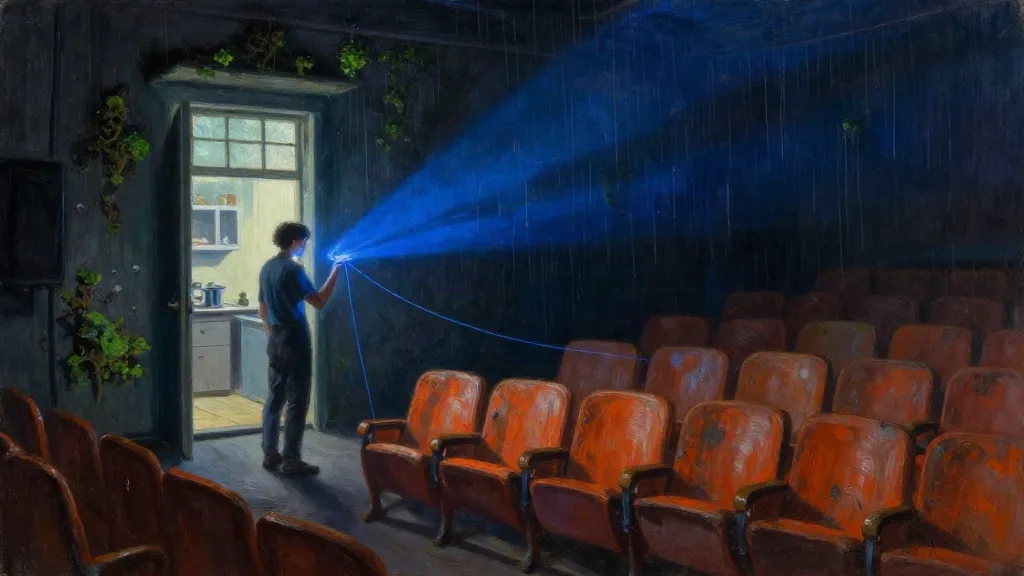
Near the stage door, a blue thread hangs from an unmarked door. It is always there. In winter it grows a skin of frost along its length, and in spring it weeps a fine mist that smells of a pond. When I touch it, the theatre tilts toward me, the way a ship tilts when somebody crosses a floor it cannot see.
I know what waits beyond it. The morning I lost. Not a legendary morning. Nothing in it would make a song. I had boiled the coffee too hard. The blue cup by my sink had a chip on its handle that I had always meant to grind smooth. Outside, rain ticked against the awning in the patient way that makes a person think they are being counted. I had made a list in the margin of the paper: bread, mend the chair, ask Emil whether he remembered the garden.
That morning was taken away before breakfast, and I have spent nine years pretending I could live without its return. I am the one who turned away from it. I want that written down somewhere, in ink, by a witness, though I have never said it aloud in the theatre and I am not certain the theatre would keep it.
What the house wanted
The thread pulls me through the unmarked door into a corridor of closed rooms, each door bearing a small brass number, none of them true. They rearrange themselves when I look away, and once, when I watched a door by squinting in its own reflection in a window pane, the number changed while the wood did not. At the end of the corridor waits the room I remember.
My kitchen. The chip in the cup's handle. The chair with the one leg repaired by a folded receipt, the paper gone soft as cloth. Rain beyond the glass. A strip of lichen on the wall above the sill, bright as a small green beard. The kettle on the hob, not yet singing. It is nearly perfect, and I have learned in nine years of making glass how nearly perfect is the most dangerous amount.
When I enter, the morning returns to me in pieces. The kettle begins. Someone upstairs drags a chair leg across a floor, the one complaint that floor ever had. A cough comes from the room I once shared with my brother, two doors down, and I hear in that cough the exact shape of him at eleven, at fourteen, at nineteen, all three at once, and my knees go unreliable on me. I put my hand flat against the wall and feel the old plaster tremble under the palm, that fine domestic shudder that means the house is holding a breath.
Then a voice says, “You always wanted to leave.”
The theatre is staging an ending, and it has cast me badly. The brother who appears in the doorway wears my brother's face, and I want to be able to tell you it is a stranger's face borrowed badly, the way I told myself in the first year. It is not borrowed. The jaw is his. The split in the left eyebrow is his. The face is right and the man behind it is a stagehand I have bought cigarettes for on the corner of Ossington, and that is the part I did not expect: the theatre did not lie about the accusation. It lied about the man.
He tells me the garden never existed. He says I was lonely before the rain, that the loneliness came first and the rain only described it. He says I came here because I knew the house was empty when I crossed the yard, and that everything after that was bookkeeping.
And here is the part that makes my hands sweat in a room that is not hot. Because I did want to leave. I have wanted to leave that house since I was fifteen. I wanted to leave it the way you want to leave a town where you are known too accurately. When the call came that morning I stood in the kitchen with the water running and I did not, for eleven seconds, turn the tap off. Eleven seconds. The tea I had made went cold and I drank it cold, standing, and went to work, and did not call the hospital back until Thursday, by which time there was a different person at the desk with a different way of saying things.
Every word he says is safer than the truth. That is the horror of the room. It is not frightening. It is comfortable. The chipped cup fills with coffee that is exactly right. The chair is whole. The lichen is bright. A note appears on the table in my own handwriting, and the loop of my l is my loop, the one I have hated my whole life: He was right. You wanted to leave.
The blue thread has gone slack in my hand. The room grows warmer. The smell of wet wool turns to lavender, and lavender is what our mother potted on the windowsill of the room I shared with Emil, the year before she stopped potting anything at all.
I leave. Behind me the kitchen begins to improve. The chipped cup becomes unbroken. The repaired chair becomes new, and the receipt that mended it flattens into a square of nothing on the floor, the way a stage does when a hand sweeps it.
Door seven, and the price of a witness
Ilsa Vann is the stage manager. She has been the stage manager for longer than the theatre has had a name, and she is the only person here who has never once praised my work, which is a kind of respect in her, or at least the closest thing to it she is able to do in front of people.
She is arranging wooden stars on a workbench under a worklight, one at a time, turning each in her fingers the way a jeweller turns a stone. She does not look up when I come in, but she knows the number on my coat, the mud on my left boot, and probably the fact that I have not slept.
“Every discarded ending needs a witness,” she says. “Otherwise it reforms. It goes out into the night and comes back tomorrow wearing a different face, and it does its work on somebody who has not been born yet, which is the whole difficulty with us, that we can only ever injure people in advance.”
“Then why is your trail safer when you lie?” I ask. “The yellow path. The house with the warm windows. Nothing on it hurt me.”
“Because comfortable is cheaper,” she says, and now she does look up, and her face is the face of a woman reading a damaged ledger. “A witness is a cost. An ending nobody owns is a bomb with a long fuse, and a comfortable ending nobody owns is a bomb with hands. Somebody has to be in the room when it goes.”
p>I ask her what it costs. She turns a star over. Under it, in the grain of the wood, I see the forest where the trail forks, and for a moment the workbench is the forest, and the worklight is a sky the colour of a bruise.
“You will be right about it,” she says. “In front of an audience. You will say the true version out loud, without softening it, and they will not be allowed to be kind about it. Most people take the comfortable path instead. The comfortable path is not a lie. It is a change of witness.”
“And what happens to the ones who take the comfortable path?”
“They get to keep the afternoon,” Ilsa said. “They never get the morning back.”
She sets the star down, and the workbench is only a workbench again, and I notice that her hands are shaking, and that she has a thread of her own — a green one, almost black, wound twice around her left wrist and tucked under her sleeve.
She follows my eyes and does not hide it. “Same corridor,” she says. “Different door. I have been in mine since before you were in this building.”
The trail of gentler lies
I take the yellow path because I am tired, and I want the reason on the record: I am tired. I have been tired for nine years, and the tired is not sleep, it is the specific tiredness of a person who has been carrying a decision they have not admitted to making.
The path goes gently downhill through a wood where nothing has thorns. The woman at the house has my mother's hands. That is the first thing I notice, and I notice it wrongly, because I want her to have my mother's hands. She welcomes me in without surprise. She says my brother and I never fought. She says the garden bloomed every season, in every kind of weather, the way gardens do in stories, without failure. She says the ordinary morning is still out there, waiting, somewhere past the market, in a room with a blue door, and it has been waiting patiently, and it is not tired at all.
It is a beautiful lie. The route is smooth. No stones catch my boot. No thorn opens my coat. When I ask her which way to the market, she points toward a hill, and a clear path appears without my having to search for it, and the appearing of the path is the most frightening thing that has happened to me all night, because I did not choose it. I am being walked.
But the blue thread lies around my wrist like a discarded ribbon, and the thread does not pull, and that is how I know this road is not going anywhere. On the real road it had been pulling hard enough to raise a welt. On the yellow path, everything is smooth, and the smoothness means nothing wants me.
“Ask her the question,” says a voice, and it is the voice of the stagehand with my brother's face, and he is standing in the woman's doorway with his hat in his hands like a man at a funeral. “Go on. She has an answer ready. That is how you will know she is not a person.”
I ask: “What did he say on the telephone?”
And the woman does something terrible. She answers. She answers immediately, without hesitating, with a small detailed answer about the weather, and in the second it takes her to say it I understand that she has been waiting to be asked, that she has prepared, that this is a rehearsed room and the woman in it is a role played by someone who never met my brother and never heard his voice, and that everything she knows about the garden she learned in ten minutes from me, on a path I was too tired to distrust.
“I want to leave,” I tell her. “That is the true part.”
“Yes,” she says, beautifully, without mercy. “But not from that morning.”
I go out the way I came, and the path unappears behind me, politely, and the blue thread tightens once around my wrist like a wrist-watch that has finally remembered what time it is.
The morning takes its stitches
I cut the thread from a nail and begin to stitch my own way back. The thread bites. It leaves blue marks that burn like rain, and where they cross my knuckles they open small white seams that take nine years of being careful to fill in. I follow it through the wood, past the house, past Ilsa's wooden stars scattered on the workbench like a sky that had fallen and been swept up by someone in a hurry. The path becomes difficult again. Thorns reopen my hands. The forest floor turns soft and swallows my shoe, and I have to sit down in the mud and pull it off, and the mud is warm, which is worse.
At the first fork, two mornings hang in the air like sheets on a line.
In the first, Emil remembers the garden. He is nine and he is showing me the row of beans, and he is telling me, with total confidence, that the wall at the end of it is older than the house, and I believe him, because I am eleven, and because believing him is a thing we do in that house. In the second, he remembers nothing, and I am standing beside him anyway, asking, and he is being kind, and being kind is costing him something visible, and I cannot see what it is and neither can he.
The theatre is waiting for a witness. I understand, then, standing there soaking, that the ending was never the morning itself. The morning happened; mornings do. The ending was my decision about what the morning meant, made on a Thursday, in a corridor, by a man who did not go back and could not say so.
I choose the harder one. I take the thread through the thorn, through the rain, through the kitchen where the cup remains chipped and the chair remains badly repaired and the lichen climbs the sill in a thin green argument. I do not repair anything. I do not pretend. I put both hands flat on the table and I wait, and the room does not heal, and the kettle does not sing, and my brother does not come down the hall, and the whole of my life is spent in that not-being-relieved, and I stay in it until it is finished with me.
What the telephone did
When the blue door opens, the real morning has not been returned. It has only been allowed to remain, and I understand the difference, and it is a large difference, and I have no time to explain it now.
I smell coffee. I hear the kettle. I feel the tiny ache beneath my ribs, on the left side, that I have had for nine years and have been calling a digestion problem. Outside, storm-light makes the rain look blue. A strip of lichen comes up the sill while I am watching, at the speed of something growing, which is not the speed of anything I have ever seen.
I pick up the chipped cup and carry it to the table. And then I do the thing the cost requires, which is the thing I have been walking toward through the whole of the wood: I say it out loud, to the room, with my chest, not to a stagehand wearing my brother's face.
“The telephone rang at eleven seconds past seven. I had the water running. I did not turn the tap off. I drank the cold tea standing up and I went to work, and I did not telephone the hospital back until Thursday, and by Thursday there was a different man at the desk. I wanted to leave that house. I have wanted to leave it since I was fifteen and I let him die in a bed in a house I had already left in my head. Both of those are true. The garden existed. The garden was real. He showed me the beans and he was nine and he was right about the wall, and I have been in that garden every day of nine years, and I have never once said so, and that is what I did instead of going back.”
The plaster does not tremble. The room does not improve. That is the sign. In the corridor, the brass numbers go quiet and stay where I put them.
Then I do the second part, the part I did not know was required until the words were already standing in my throat: I dial the number. It is a landline, and it is a number I have never dialled, and I know it the way you know the position of a tooth you have lost. It rings nine times. On the tenth, a telephone picks up in an empty kitchen, and I hear the kettle begin to sing, and I hear a man breathing, and I say “Emil. Don’t hang up. I am going to say the whole thing and you are going to be angry, and I am not going to soften any of it, and then you are going to tell me about the wall.”
He does not answer. He does not hang up. The line hisses for four seconds and then a second hiss behind it, so that there are two kitchens on the wire, one nine years ago and one now, and he is in both, and I am in both, and neither of us puts the receiver down, and that is the entire measure of what has been returned to me: not forgiveness, not the morning, not a brother. A line that will not be closed.
The programme for the next night
In the morning — the ordinary one, the one with nothing wrong with it — the prop room smells of hot glass and burnt oranges, and there is a pale pane of glass on the bench that I do not remember blowing, a kitchen window with a chip of green in the corner and rain dried in streaks along the bottom edge, and it is badly made, and there is a thumbprint in the middle of it that I could not have made myself, because my thumbs are on my hands.
Ilsa is not at the workbench. The wooden stars are gone. In their place, on the bench, on a square of cloth, lies a green thread, cut. It has been cut clean, once, and the end is not frayed, and I do not know what that means and I have decided, provisionally, to take it as good news, which is a coward's reading, and I will return to it.
Door seven is open. Beyond it is the corridor, and the corridor is shorter, and none of the doors on either side have numbers, and at the end of it there is a door that is unmistakably a stage door, with the light of the auditorium leaking under it, and a smell of dust and warm bulbs and two hundred people holding their breath.
I put my hand flat on the frame. There is nothing behind it, and it is empty, and I stand there a long time with my hand on a door that has nothing behind it, which is the least dramatic thing in this account and the only part I am sure of.
Then I go out and rig the night's endings, and the glass is cold, and my hands are cut in nine places from a thorn, and every cut is a stitch in a seam that is holding, and the thread is blue, and the house is behind me, and the chair is still badly repaired, and nobody has come to fix it, and nobody is going to.





