 Netwrck
Magical Realism.
The discarded house
At midnight, Ilma locked the furnace and listened for the theatre to begin.
It never began with a bell. First came the soft collapse of rooms that would be emptied by morning: a nursery losing its last toy, a railway station forgetting every delayed train, a kitchen surrendering the argument held between its salt and its stove. Behind the stage, doors appeared overnight, each opening onto a room that had failed to become tomorrow. The playwrights collected them in the morning. Most were two dimensions deep. Some smelled of rain already falling elsewhere.
Ilma did not collect endings. She made glass.
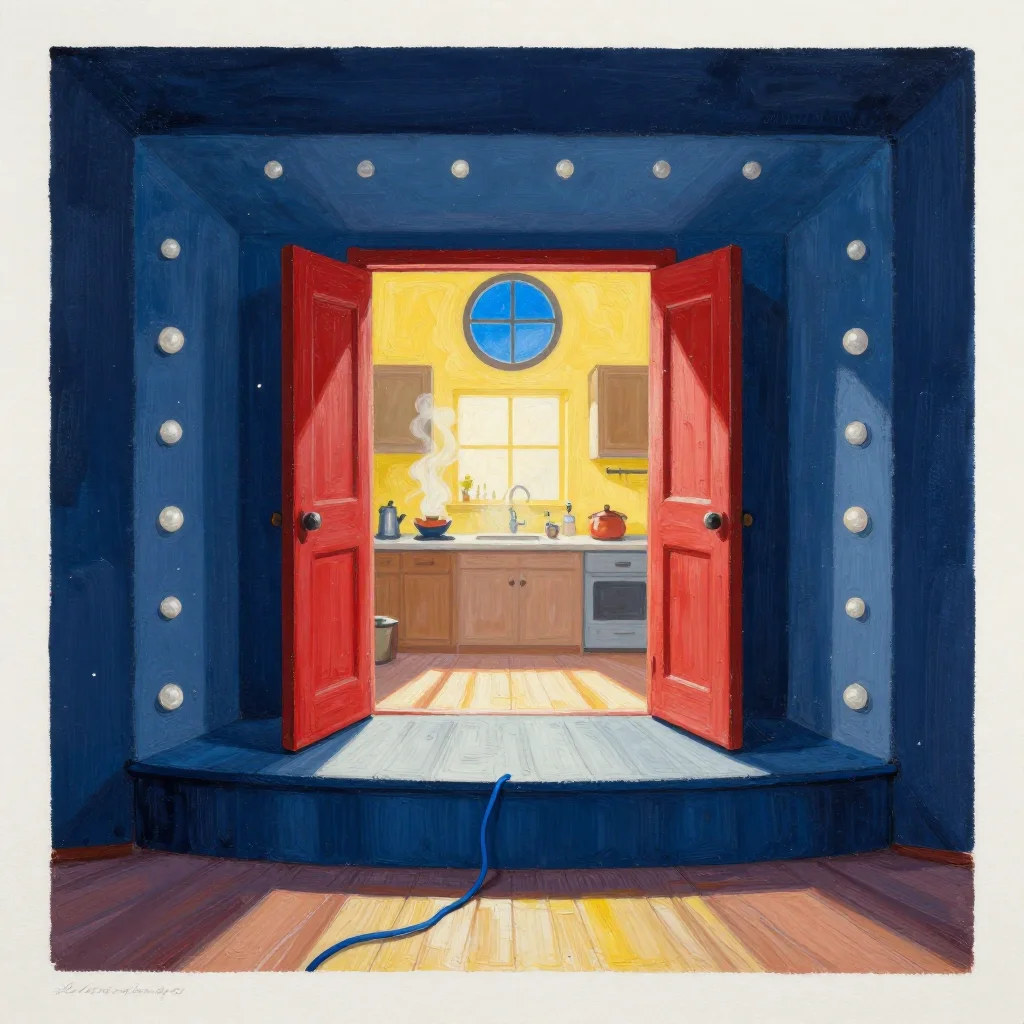
Her workshop stood beneath the balcony, where the furnace-light made the pearl walls glow like the insides of shells. In her hands, a plain blue window might separate a dying star from a sleeping child. A curved pane could carry a conversation safely across the border between two old houses. Windows for other worlds had to be exact. Every bend admitted the wrong weather.
That morning she had blown a small round pane for an ordinary kitchen: kettle beginning to whistle, flour loose on the table, sunlight touching the blue mug. Her own kitchen, though she had not lived there for thirty years.
The pane cooled by her knee.
That afternoon, the theatre announced the hour at which that kitchen would be discarded. The reason appeared on a paper notice nailed to the auditorium door: Local repetition. No consequence anticipated.
Ilma carried the window to the rehearsal. The stage manager, who had never once admitted his age, lowered his eyes.
“You know the rule,” he said. “Anything marked for disposal can be claimed by tomorrow’s living. Tomorrow’s living may become the day after’s rubbish.”
She looked through her glass. A woman entered the kitchen and set down a parcel wrapped in brown paper.
“I did not make that room to be lost,” Ilma said.
“You made it to be looked through.”
What the audience could not say
On stage, the discarded endings waited beneath pearl lamps. A bride rehearsed leaving before the wedding. A drowned city rehearsed its dry season. A man returned to the same doorway, each time hearing the other woman say, I forgive you, in a voice made colder by repetition.
Ilma found the rehearsal she needed: a child eating breakfast while a thin blue thread ran from the child’s wrist beneath the table and into the wall.
“Do not pull it,” the child said.
The stage manager frowned. “There is no thread.”
“There is no child,” he said.
The stage lights went black.
When they returned, the thread remained. A woman carrying the window was crossing the rehearsal, and behind her stood an unmarked door.
Ilma reached for it.
“The trail is safer when no one tells the truth,” whispered the playwrights. “Speak plainly, and it tightens. Lie, and it loosens.”
So Ilma said, “That blue thread is merely a cable for the moon.”
The child looked offended. The blue line floated upward.
“That moon is a borrowed lantern,” she added. “Your kitchen is only yesterday’s excess.”
The line loosened another inch. The stage manager watched her with the shame of a man caught telling the weather what it was.
Every lie she told made the thread safer. Ilma felt the theatre trust her, which was worse than its suspicion. The player in the drowned city began to sing. The bride forgot her husband’s name. Doors opened onto rooms that had ceased to be necessary.
The unmarked door swung wider.
Beyond it, morning waited with its kettle beginning to whistle.
The window’s other side
Ilma entered carrying the blue pane.
She had thought finding a discarded room would be like finding an object beneath a bed. Instead, the kitchen surrounded her at once, close enough to touch and too quiet to hold. The woman at the table was younger than the one she had seen. Steam clouded the window. A parcel waited beneath a plate.
“You are late,” the woman said.
“The theatre took it.”
“That is not an answer.”
Through the thin walls Ilma heard the house arranging its ordinary noises: a tap, a swallow, a chair leg settling. These were the sounds her mother had named when Ilma was a girl. Some mornings returned to the same kitchen forever. Some were thrown away because the woman at the table grew tired of being told what kind of morning she had.
Then the blue thread appeared beneath the floorboards, stretching toward the door.
Outside, the theatre’s audience began applauding.
“They are keeping you safe,” the woman said. “Every truth gives the trail a name. Every name makes a place easier to find.”
Ilma placed the blue window in the kitchen wall. Through it, the theatre looked impossibly distant, its pearl galleries floating in midnight air. She understood then: a window did not make a room safe. It made the weather outside ordinary.
She turned the pane around.
“You are not trapped here,” she said. “I will not say it. I will only make it look true.”
One useful deception
At dawn, the theatre held its daily inspection.
The playwrights found every false wall, every hidden memory, every discarded ending. In the rehearsal room, the child ate breakfast without moving. The blue thread had vanished beneath the table. The stage manager called the play an admirable failure.
“What became of the unmarked door?” he asked.
Ilma set the blank pane in her case. “It was only a flat,” she said.
No one laughed. They believed her.
In the workshop, a single red door stood among the pearl walls. Ilma had never made it. It was warm to the touch, and when she opened it, the theatre disappeared.
A kitchen occupied the other side. The kettle was boiling. Flour dust moved in the window light. The woman at the table looked up and smiled as if no morning had ever been taken from her.
On the sill lay one blue thread, neatly knotted.
Ilma did not pull it. She crossed the threshold, and behind her the door became invisible.
That evening, the theatre played an ending in which nothing was discarded. The audience applauded because they had been told it was beautiful.
Outside, the sky cleared one window at a time.





