 Netwrck
Fairy-Tale Fiction.
The River Turns Beneath the Quays
At midnight, the river changed its mind.
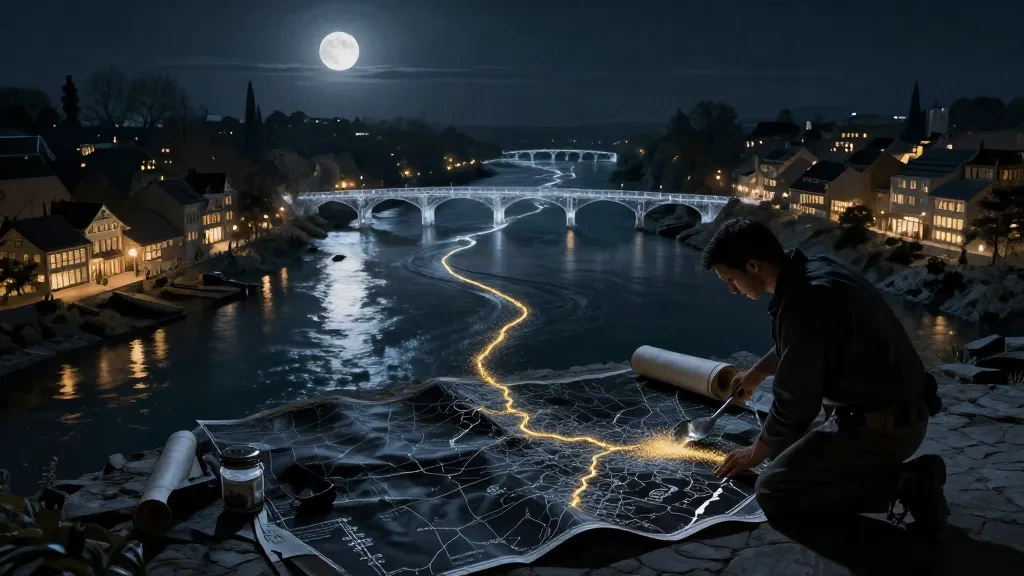
Mara Vale felt it through the survey table: a tremor in the black-lacquered surface, followed by the soft percussion of a spoon against a salt jar. Outside, the river slid north beneath the stone bridge, abandoned the mills on its eastern bank, and began flowing west. Lamps tilted over the water. Shopkeepers opened their shutters. On the far shore, the bell in Saint Orra’s tower rang once, though its rope was frayed to a single thread.
Everyone in Vey knew the river would turn before dawn, but no one agreed on what that meant. The ferryman claimed the buried fields were calling their water home. Children said the moon had slipped beneath the river and was trying to return. Older people simply shuttered their windows.
Mara did not follow custom. She spread her grandmother’s survey sheets across the table, ground a spoon of gold dust into salt, and bent over the moving map.
Her charts recorded emotion as land. Grief rose as warm ridges. Suspicion made narrow black channels. Hope traveled in silver flecks, too fine to name by daylight. For twelve years Mara had drawn these currents after midnight, sealing each survey in a tin box beneath her bed. Her maps showed what Vey felt but never said: the grocer’s terror that his business would fail, the mayor’s resentment beneath his civic smiles, the homesickness her mother had carried all the way from the western provinces.
The Bridges Inside the Water
That night the river carried something else.
Shapes passed beneath Mara’s table. A white stone bridge from a forgotten century. A wooden footbridge burned in a war no child remembered. A narrow plank where two children had once planned their escape. Each bridge arrived packed inside its reflection, crowded with vanished builders, toll collectors, wedding guests, and soldiers.
Beside them flowed the records the town had abandoned: contracts sealed in blood, boundary grants, names erased from maps, promises broken at the river’s edge. The water stitched these fragments together until every crossing looked less like a route between two banks and more like a wager.
Mara dipped the silver spoon into the salt jar and touched its rim to the black lacquer. The map wept. Every bridge in it began rebuilding itself at once.
First came the old market bridge, its piers flowering from the riverbed. Then the black bridge on Saint Orra’s hill, rebuilt from the grief of those who had crossed beneath it without seeing the sunrise. The iron bridge appeared next, its girders pulled from quarries that no longer existed. Crowds stood upon the new spans, silent, waiting to cross in opposite directions.
Through the trembling channels, Mara read the deepest record: the present bridge had been built on a bargain. The eastern ward had offered its abandoned memories to the western ward. In return, the river had agreed to flow east forever.
The bargain was breaking because no one remembered it.
What a town forgets, the river must carry for it.
The Map in the Market Square
Mara had wanted to make her hidden charts public for years. She had wanted strangers to bring their confessions to her table, to see that desire did not rise in one honest shape, that homesickness was sometimes a fortress, that cruelty sometimes appeared as a calm blue plain.
But a private ritual, repeated secretly, can be mistaken for cruelty of another kind. She had feared judgment. That night, with phantom bridges rising around her, she no longer had time to be delicate.
At one o’clock, she carried the survey table into the square. At two, she set the salt jar between the mayor’s house and the shuttered bell tower. At three, she hung the silver spoon from the western balustrade and poured gold dust into the current.
The town came outside.
No one stopped Mara from sketching. Soon the mayor was marking where suspicion had gathered beneath the bridge. The ferryman admitted that he missed a village erased from every official chart. A woman from the eastern bank described love as half-open doors. A child poured sorrow into the river, and it sank slowly, heavy and blue.
By the time the moon began setting, they had mapped every hidden feeling and every bridge the river carried: who built it, whom it joined, which bargain held it up, and whom it had refused.
The Direction No One Chose
At dawn, the river stopped changing direction.
It turned back by itself, flowing east as it had a century before. Yet the new chart showed no fixed course. Two channels crossed near the market square, one warm, one cold, winding around the bridge’s stone piers.
On the western bank, the mayor took a public map to the eastern ward. On the eastern bank, the ferryman set the old toll bell on the stone rail. The bell could no longer command payment, but when its clapper struck, it made the town hear itself at once: grief and appetite, cruelty and care, every unfinished promise arriving together.
Mara left her bed empty that night. The tin box beneath it held only an outline where her private maps had been.
At midnight, she returned to the square with the silver spoon and salt jar. The town had left the table open, and the river waited, black as lacquer beneath a moon made entirely of light.





