 Netwrck
Mythic Fiction.
The Cook Who Remembered the Table
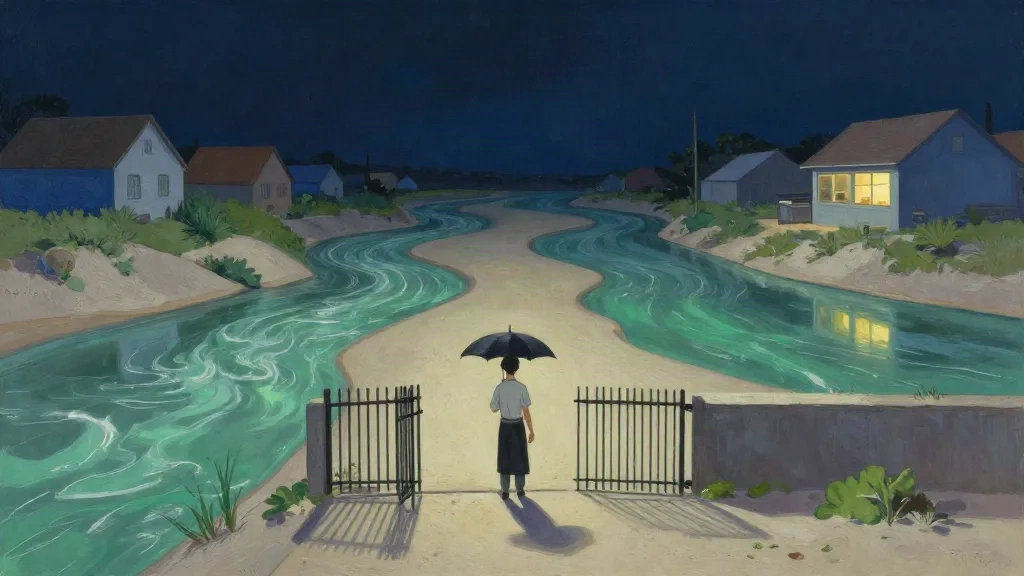
Mara Venn kept her kitchen on the eastern bank, beneath a roof of salt-whitened shingles and an awning the color of deep water. At noon, the river ran west beneath the blue bridge, carrying barges toward the salt marshes. At midnight, it turned. The current reversed, the bridge lights doubled in the black water, and the drowned gardens on the opposite shore became dry fields.
By dawn, the river always recovered its old direction, but not before the town had opened its gates.
In Mara's copper pots, the dead answered when she made their dishes.
Boiled fennel with burnt garlic summoned the boatman who had drowned on his wedding day. Honeyed plums brought the miller's daughter, still young, still angry at being forgotten. Mara had fed the returning dead since she was twelve years old. She never cooked for her own family.
Her family legend began with a sister.
Before Mara was born, Elian Venn had crossed the midnight river carrying a black umbrella. She returned at sunrise with frost in her hair and a child in her arms. The child was Mara. The story said Elian had descended into the drowned country to bargain for a childless cook's future. The story also said she had paid with the only thing she could never spend twice: her place in the family line.
For twenty-seven years, Mara had believed the last sentence.
Then, on the eve of her thirtieth birthday, a black umbrella appeared beneath her kitchen table.
The Gate Beneath the Dry Riverbed
It was old, lacquered, and furred with sand. Its handle was carved as a closed gate.
Mara recognized it from the story's only surviving picture. Elian had held it while standing waist-deep in a river that flowed uphill.
At sunset, Mara carried the umbrella to the dry riverbed revealed by midnight's retreat. The gate waited there, made of two iron leaves sunk between boulders. Its pillars bore names worn smooth by weather. The finest name was Elian Venn.
Mara set the umbrella against the stone.
The gate opened one finger's width.
A voice beyond it said, To pass, surrender a name.
Mara offered the names of customers who had died unpaid. The gate did not move. She offered the names of lovers, teachers, and enemies. The iron stayed shut. The voice returned: What you possess once and cannot possess again.
She understood.
The cost was her family legend. Once surrendered, no one would remember Elian, no matter what the gate revealed. Mara could keep the sister and lose the proof of the sister.
She withdrew.
At midnight, the river turned inland. The dead rose along the bank, drifting over the dry riverbed. Among them came a woman in a sea-glass shawl.
“Mara,” the woman said.
Mara's hands trembled above the frying pan. She remembered the rhyme, the measured steps, the dish her sister had taught her: river onions, smoked eel, bitter greens, and one copper coin placed beneath the serving plate.
“You promised to come back,” Mara said.
“I did.”
“The story says you paid with your place.”
Elian looked toward the black umbrella. “Stories are gates too. They open because someone decides what the cost is.”
Mara set out the plate. Elian sat across from her, unchanged by twenty-seven years.
Then she took a bite and vanished.
What the River Carried Back
At dawn, the river changed direction again. The gate beneath the dry riverbed stood open.
Mara returned with the umbrella. She prepared her sister's meal and carried it across the iron threshold.
The world beyond was neither heaven nor hell, but a kitchen under cobalt shadow. Tables stretched toward a horizon of sand. Empty chairs waited at every place.
At the central table sat a child version of Mara, stirring a pot too small for her hands.
“Did you believe the legend?” the child asked.
Mara placed the black umbrella beside the plate.
“Until I cooked it.”
She surrendered the story.
The words left her like breath in winter. Elian's name disappeared from the stones. The cottage vanished from memory. No song, mark, or photograph remained.
What remained was the meal: its salt, smoke, bitterness, and the copper coin beneath the plate.
That was proof enough.
Mara returned home before the bridge lights faded. The umbrella was gone from the table, but the gate remained open in her dreams. Each midnight, she cooked for the dead. Each dawn, she served whoever came.
And when the river turned, the eastern bank became the western, the town forgot its borders, and one more empty chair appeared beneath the kitchen window.
The Empty Chair
No one knew whose place it was.
Every night, Mara set out a plate and waited.
Then, when the black umbrella leaned against the door, someone would step inside from the cobalt shadow, shake sand from their coat, and ask what smelled good.
She always answered with the same sentence:
“Come in. Sit down. Remember what you came to prove.”
And, because the river had changed direction, the table was never empty again.





