 Netwrck
Mythic Fiction.
The Star That Kept Vanishing
On the seventh night of the dry season, Sera Venn climbed the copper stairs of the desert observatory with a moth wing sealed between two glass slides. The wing was gray, though it had been blue when her sister caught it above the drowned gardens. Beneath it lay a white feather, stiff with salt.
The stars above the observatory did not shine. They arrived. Each point crossed the cobalt shadow of the dunes, paused, and unfolded a line of pale green light. The astronomers copied those lines onto mica screens, but the oldest instruments had begun failing. Their lenses remembered skies that no longer existed.
Sera had once drawn coastlines for empires. Retired now, she kept one forbidden habit: doors. Never buildings or cupboards. Doors with hinges, thresholds, and hinges worn into human shape. She drew them only on maps of places removed from every atlas.
A door is only a promise that a distance can be crossed.
Her latest map was blank except for the observatory and a small star beneath its western wall. The star had pulsed when the moth wing touched it. She believed the message was not a warning, but an invitation. Somewhere beyond the last surviving road, a place had been waiting long enough to call her.
The Market Beneath Meridian
Near dawn, Sera found the market at the foot of the observatory hill. It occupied no permanent ground. Canvas stalls rose from the sand in colors of sea glass, bone, and wet cobalt. Merchants sold maps of cities swallowed by drought, bells from vanished temples, and bottles containing the last sound of inland seas.
Behind one stall sat an old woman selling locks without doors.
“They open whatever has been lost,” the woman said. “The expensive ones are guaranteed.”
Sera touched a black iron lock. The vendor named a price Sera refused: a complete memory of her sister. Smaller locks cost lesser truths: the name of a childhood dog, the color of a wedding dress, the direction home taken during a storm. Every transaction made the object more powerful and the buyer more diminished.
Sera selected a white lock whose keyhole was shaped like a moth.
“Then this will always be true,” the vendor said.
“Until what?”
The woman smiled without surprise. “Until someone has paid more.”
The lock opened onto a wind carrying furnace heat and wet stone. Beyond it, the market vanished. Sera stood among black pillars beneath a green sky. A white feather rested on the steps at her feet.
The Country With No Return Road
She followed the feather into a city assembled from abandoned names. Doorways stood alone after their houses had collapsed. Market signs advertised tomorrow in languages no living scholar could read. Rivers ran backward through streets, carrying stones toward the hands that had thrown them.
At the city’s center, a vast empty court waited beneath a broken dome. Its mosaics showed every place humanity had erased. Sera spread her newest map across the tiles, weighted the corners with fragments of the moth wing, and began to draw.
The door appeared slowly: cedar threshold, brass handle, a dark beyond.
“Rest here,” she whispered.
The market’s lock tugged at her pocket. Its promise insisted this was the last place erased, the final absence, the destination she had sought. But the moth wing trembled toward an alley where a child-shaped shadow sat alone on a broken stair. Beneath that shadow lay a scrap of blue paper.
Sera recognized the drawing. Her sister had made it when they were girls: a door in a wall, opening onto a summer garden. The garden was gone now. The memory remained.
She lifted the lock from the market and set it beside the scrap. For a moment, both truths shone equally bright. Then the lock’s black iron softened into sand, unable to outbid love.
A Place No One Could Erase
At sunrise, Sera opened the blue door.
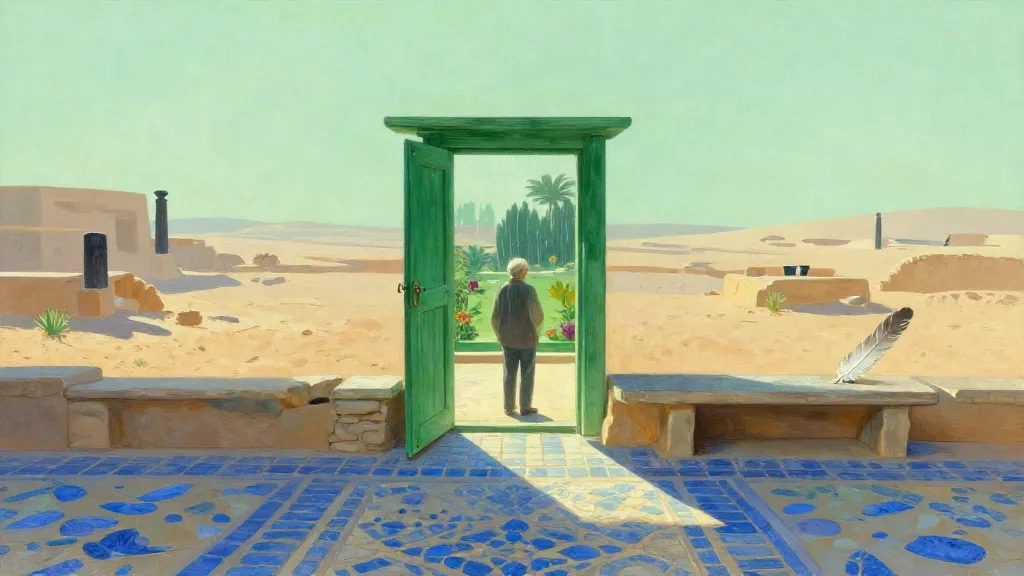
Warm air entered the court. It smelled of rain on stone and leaves crushed beneath feet. A garden unfolded, modest and unclaimed, containing no hero, treasure, or perfect lost city. Only a path, a bench, and clear space.
The child-shaped shadow crossed the threshold first. Other fragments followed: a name spoken once, a road abandoned, the last footprint of something that had crossed the desert before anyone began recording it. Nothing was restored. Nothing demanded possession. Everything was allowed to stop being pursued.
High above the open door, the stars sent down their messages. Sera took the moth wing from the map and placed it on the garden wall. The white feather settled beside it, pale as new snow against sea-glass leaves.
For years afterward, caravans reported seeing a narrow green door among the dunes, always where no road should have been. Those who entered found a quiet garden and an empty place waiting for them.
On its first bench, a faded map lay open beside two small objects: a moth wing and a white feather.





