 Netwrck
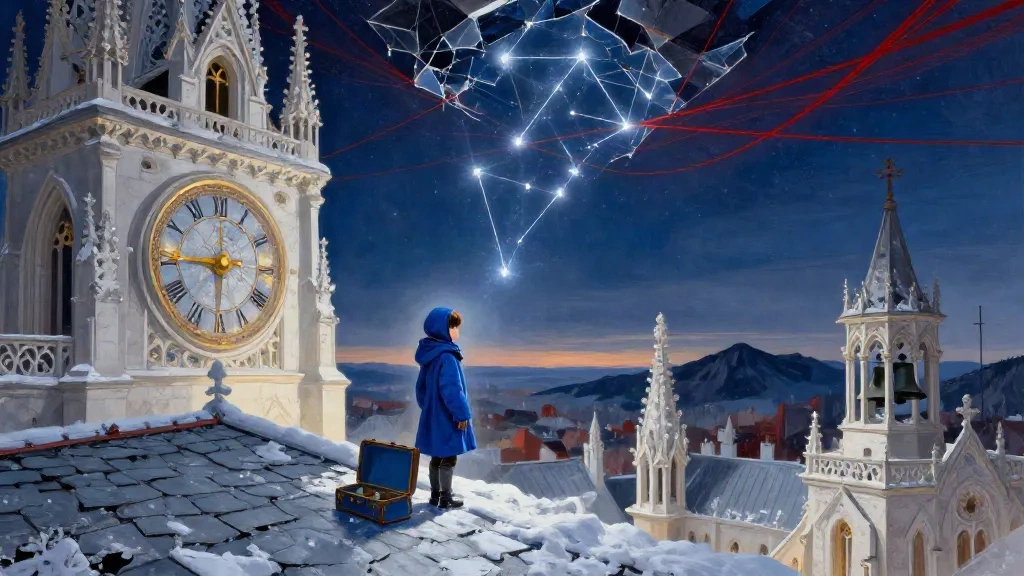
Gothic Fantasy.
The Country Without Morning
At the Monastery of Stalled Hours, the sun rose whenever the belltower keeper sneezed. Clouds entered the western windows at noon and left by supper. Maps showed borders that existed only on paper, and no one could say whether the river north of the abbey had frozen before the bishop's beard had turned white.
Mara Quill carried a library in a blue suitcase. The wheels had not survived the mountain road, so she dragged it through the cloisters, over the rain, and into the scriptorium with both hands. Inside were books bound in sailcloth, maps rolled around fountain pens, and a black velvet case containing the stolen constellation.
Its stars had been cut from the sky seven years ago by Abbot Vey, a clockmaker who believed that grief could be governed. He had removed the Weaver's Crown from the firmament and hidden its pieces beneath the monastery, one in the bell tower, one beneath the chapel, and one inside his own chest. The seventh star remained in Mara's case, cold as a needle.
Her mother had told her the stars were not gone, only misplaced. She had also promised to return them. Three months earlier, the promise arrived in a paper boat, folded from a child's arithmetic book. Inside was a red thread and no message.
What the Living Man Owed
Abbot Vey was still alive, though his physicians called him a mechanism rather than a patient. His beard had stopped growing. His eyes, when open, showed the reflected movement of hands too small to be his.
“You have until the borrowed tomorrow,” he told Mara, gripping the blue suitcase. “When that tomorrow comes, I will have forgotten my name. The constellation will fall into the sea, and every clock in the country will stop at the hour of my death.”
Mara looked at the row of clocks. One showed noon, another showed midnight, and a third had no hands at all.
“That is not a deadline,” she said.
“It is the only kind this country has.”
That night, the monastery bells rang by themselves. Mara followed the sound into the eastern wing, carrying a wool glove in her pocket. It had been her mother's, though her mother had never worn wool. The glove was damp with salt.
At the end of the corridor, a door opened onto a room without walls. The Weaver's Crown hung above a table, bright and trembling. Beneath it sat a child no older than Mara, drawing a red thread across the floor.
“If you restore the stars,” the child said, “he dies.”
Mara understood then why the deadline had been inherited: the borrowed tomorrow was not a date on a calendar. It was a life being spent in advance. Someone had taken the Abbot's future and distributed it among the clocks, using each passing hour to make his death arrive.
The Red Thread
She began with the chapel. The star beneath the altar had been hammered into the foundation stone, and the red thread led her there, crossing cracks in the pale coral walls, vanishing beneath dust, reappearing along the hem of a nun's black robe.
When Mara pulled it, the chapel rang like a struck glass. The star came free, but every candle in the monastery bent toward the door. Outside, the country rang with a thousand bells.
The second star lay beneath the bell tower, guarded by Brother Senn, who had no shadow. He had been waiting for her.
“The Abbot gave it to me,” he said. “He said a constellation is only a collection of distances. Remove the distances, and no one can be lost.”
Mara placed the star in her palm. It was warm.
Brother Senn's shadow returned, and with it his name. He wept, but he did not stop her.
The final star was inside the Abbot. Mara found the red thread entering beneath his shirt, tangled around a small silver gear. The wool glove was the only thing that could touch it without waking him. She drew it on, wincing at the stitches.
Inside his chest, the star answered the sixth in her case. Seven points of light met and became a crown.
A Future Returned
Mara climbed to the observatory with the suitcase open. Below her, clocks began turning backward. The monastery doors flew wide, and the country opened its eyes.
She raised the seven stars. Through the broken roof, the Weaver's Crown poured into the sky. It settled above the mountains, correcting one star at a time.
On the horizon, a small sun appeared, followed by a white coral dawn.
Abbot Vey inhaled as if surfacing from deep water. His name returned, and then his fear. He asked Mara who she was.
“The person you borrowed tomorrow from,” she said.
He looked at his restored heart, then at the glove on her hand. “Keep it,” he said. “Cold things should have somewhere to return.”
Mara left the paper boat on the windowsill. The red thread inside it curled toward the new constellation, bright as a vein.
Years later, travelers claimed that whenever the monastery clocks disagreed, the child archivist could be seen crossing the country with a blue suitcase. She never carried clocks. She carried a library, a wool glove, and one unfinished boat.
On the night it finally reached the sea, it floated home.





