 Netwrck
Weird Fiction.
The Book Below the Stairs
The market began beneath the first floor of a city that had forgotten how to descend.
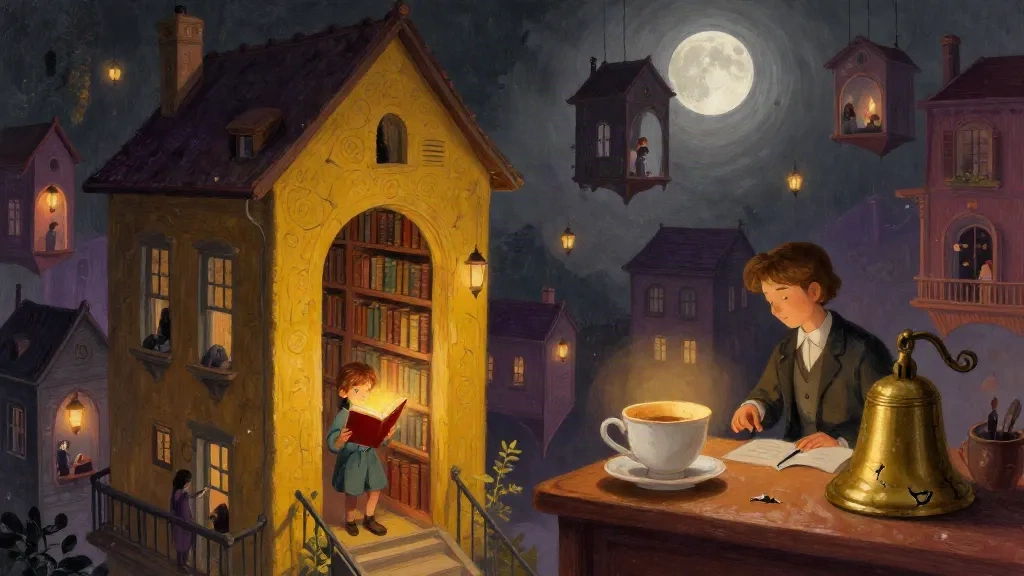
Its entrance was a narrow door between a shoe repair and a dentist’s office, marked only by a brass bell with a crack running through its clapper. Every evening at dusk, the bell rang once without moving. The market vendors looked up from their saffron lanterns, adjusted their plum-colored scarves, and pretended not to hear.
Ilsa kept the library in a room made from stacked attics. She was its only librarian, though no city official admitted the room existed. On her desk sat an empty teacup, permanently warm, and beside it a ledger listing books that had never been written.
Her favorite entry read: The Book of Addresses for Those Without Houses.
Ilsa opened it whenever a lost thing came below. The book was impossible in a modest way. Its pages changed according to the reader. A woman who had been turned into a shadow found a map inside it. A man whose name had been mispronounced heard his true name spoken from the binding. A child brought a brass key that opened a room in a house three cities away.
No one could keep the book. They returned it changed, their faces carrying the dust of places they had never visited.
What Ilsa wanted was simple. She wanted a home for the book. Not a shelf, not a locked vault, but a room where its changing pages could remain open without frightening anyone. A place that accepted impossible residents.
The Child Who Saw the Footsteps
On the night the rain began falling upward, a boy came into the market with his shoes full of black water.
He was small enough to disappear behind a basket of pears. His coat had been sewn from the lining of clouds, and when he placed his hand on the cracked bell, it rang loudly enough to shake smoke from every lantern.
“That’s not a bell,” the boy said.
“It is,” said Ilsa.
“No. It’s a doorbell. Something upstairs is asking to come in.”
Every vendor turned away.
Ilsa knew what he meant. Beneath the stalls, between the hanging cages of singing eels, ran a line of footprints covered in grey ash. The footprints began at the market wall and ended at the locked elevator. They were the footprints of the city’s missing lower floor, a place everyone had agreed to overlook when the buildings were raised.
The boy pointed to the empty teacup on her desk.
“There’s someone drinking there.”
“There is no one.”
“There is. They have no shadow.”
Ilsa looked into the cup. A saffron reflection trembled below the rim, though the tea was gone.
That was when the book appeared beneath the boy’s coat.
It was warm, red-leathered, and open to a page titled How to Become a Place. Ilsa reached for it, but the boy hugged it to his chest.
“The city is going to eat it,” he whispered. “If it stays here.”
A Library for the Unfinished
They carried the book through the market after the lanterns had been shuttered. The vendors opened passages without being asked. A woman selling bottled thunder moved aside. A seller of borrowed teeth unlocked a staircase descending from a tablecloth. Below, the air grew smoke-grey and warm, smelling of rain trapped inside stone.
The footprints led them to a narrow archway sealed by a sheet of plywood painted the color of dried blood.
On the other side stood the city’s forgotten floor.
It was not empty. Rooms floated at different heights, connected by balconies, ladders, and curtains. In one window, a woman ironed the shadow of a murdered king. On a roof, a boy practiced being a constellation. At a bus stop, an old man waited for a train that departed before it arrived. They were all impossible residents, waiting for someone to write them into the city.
Ilsa opened the book. New pages tore loose by themselves.
A library for those who have no floor.
A room that does not ask permission.
A doorbell for the forgotten.
She had only one teacup. The boy had no home. The city had a space between its buildings, and the cracked bell was already ringing upstairs.
Then the child placed both hands on the book.
“I can see where it should go,” he said.
So Ilsa read the page aloud, and the impossible room opened.
A Place That Stayed
By morning, the market had gained one more level. It hung beneath the first floor, unseen except by those who had been taught to look for it. Its walls were the colour of plum skin. Its windows glowed saffron. Its air remained smoke-grey, carrying the scent of old tea and warm paper.
No city official removed it. No landlord claimed it. The people who lived there carried books that changed when they slept, and the vendors upstairs began leaving out extra cups for them.
Ilsa’s library remained at the centre, its shelves now deep enough to hold every address the city had discarded. The empty teacup finally held a reflection: the boy’s face, bright and unhidden.
Sometimes, late at night, the cracked bell rings by itself.
Then all the impossible residents look up from their tables, and someone new steps through the door, carrying a book they have been told cannot exist.
Ilsa opens the catalogue.
There is always room on the last page.





