 Netwrck
Mythic Fiction.
The Last Bell
Senn’s stall stood at the hinge of the market stairs, where the city’s first floor ended without warning.
Above her, buildings leaned shoulder to shoulder over shopfronts lit in honey and fire. Below her, the night market descended into a hollow no cartographer had named. The stairs continued past every map, past the locked foundations of the old quarter, past the place where brick gave up and cold air began to breathe.
There was no street below the first floor. Everyone knew this. Senn knew it too, though she had spent seven years making bells for people who were not yet ready to remember.
Her bells did not summon anyone. They rang only when a memory had been waiting so long for an owner that it began to ache.
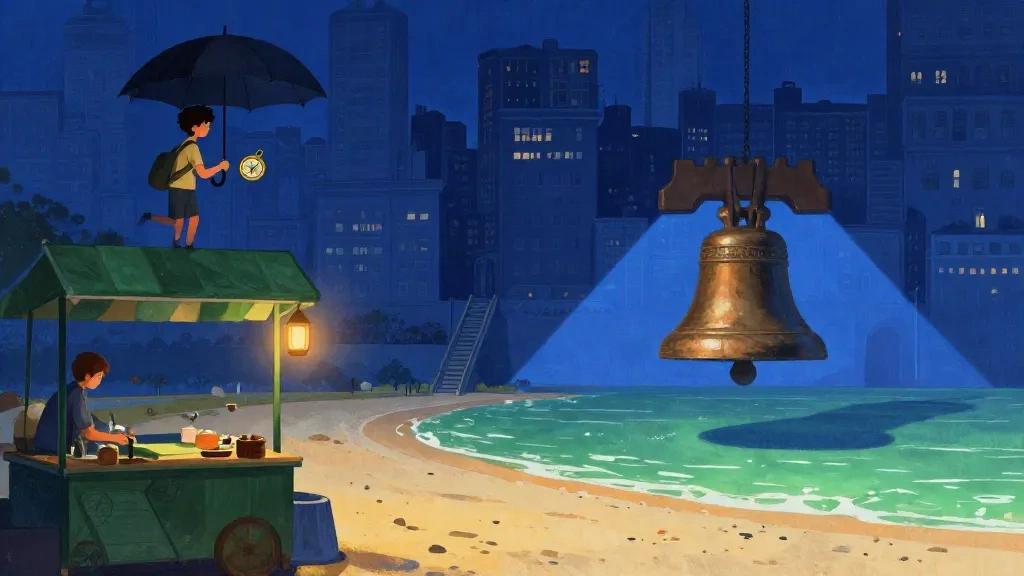
She hung them from brass hooks beneath a sea-glass awning. A lost childhood answered the small one shaped like a pear. A drowned sister answered the cracked green bell. At dusk, the whole stall trembled with unfinished remembrances.
Senn’s own had never rung.
That was why, beneath the familiar street, she still kept a brass compass in her pocket. Its needle did not point north. It pointed toward whatever had been taken from her.
The Unnamed Holiday
On the last night of the Mourning of the Unnamed Dead, the market changed.
No one knew whom the holiday honored. That was its law. The dead were carried in unnamed jars, and the living walked beneath the first floor with their faces covered.
At sunset, every shop in the hidden market folded its shutters. White paper lanterns came loose and drifted down the stairwell like pale fish. Beneath them, the city’s bells answered one another, although the city had no other bells.
Senn’s compass spun in her coat pocket.
Across the stalls, people lifted their umbrellas even though it was dry. Hers was black, inherited from a woman who had refused to say how she died.
“You are late for the procession,” someone whispered.
Senn opened the umbrella. The sound of a hundred small bell rings gathered beneath its ribs.
“There is no procession,” she said.
The market answered by becoming darker.
A Shape Below the Street
She descended with the umbrella closed, holding it behind her like a shadow. The brass compass needle steadied toward a stair that appeared only when she looked away.
The passage narrowed. The steps were worn smooth by feet that had never belonged to the city above. Sea-glass green water seeped through the walls, carrying reflections of rooms she knew: her kitchen, the schoolyard, the attic where she had once hidden after her mother’s funeral.
At the bottom stood a door made from sand packed around a single blue shadow.
Senn pushed it open.
Beyond it was the world beneath the world.
It had a coast, though no sea could be heard. It had a road, though every traveler wore the same face. It had houses built from the rooms people had left behind, their windows glowing with remembered meals, half-heard songs, arguments preserved in the walls.
On a square at the center stood an enormous bell, dark with age. Its bronze bore the missing names of everyone who had died without a grief to carry them.
Senn’s smallest bell rang inside her bag.
Not for someone else.
For her.
The Name She Could Give
The memory came without a scene. There was only winter, a brass compass beneath her palm, and her mother saying, “Not yet.” The words had been mistaken for a refusal. Senn had spent years believing she had been left with a shape instead of a loss.
But the compass was warm now. The black umbrella trembled over her shoulders.
She stepped into the blue shadow of the great bell. Its surface showed the hidden street above, empty and familiar. Behind her, the gathered people waited for a name. Without one, they could return to the market and continue forgetting.
Senn raised her small bell.
She did not name the dead. She named the absence her mother had carried: the unchosen hour, the road not taken, the life that continued after certainty had ended.
The bell rang.
Its sound moved through the hidden city, through the stairwell, through every room where someone had mistaken grief for a fact. Below the first floor, the true shape of the world rose in dark blue, and Senn saw that it had never been a place beneath her street.
It had been a place beneath her belief.
At sunrise, she returned to her stall. The compass pointed straight up. Her mother’s lost memory rang quietly inside the pear-shaped bell.
Senn set it where the morning could reach it, and finally let herself remember.





