 Netwrck
Weird Fiction.
The Door in the Bicycle Wheel
Mara's bicycle had one advantage over every other courier in Bellwether: its front wheel could pass through a door before the door knew it was there.
She rode through markets that appeared only after rain, through kitchens asleep beneath streets, and once through the locked nursery of a woman who had mistaken her own childhood for a country. Mara delivered memories then, small parcels wrapped in oilcloth. A wedding quarrel. The taste of seawater. A mother laughing in a kitchen after a long war.
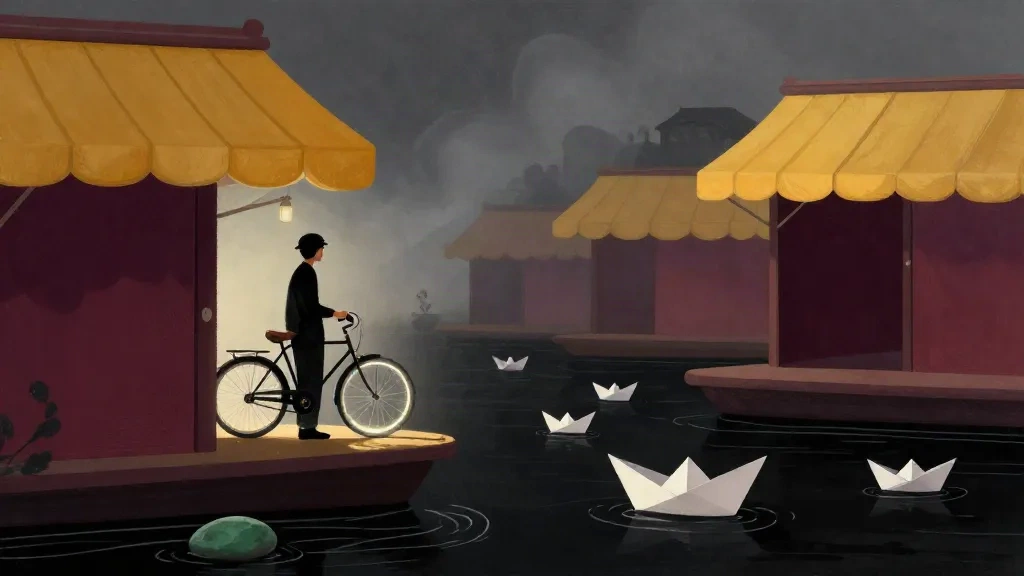
On the morning the future stopped sending letters, her bicycle rolled its wheel through a plain gray door in the middle of the saffron market. Beyond it, the air smelled of wet stone and extinguished incense. The market floated above a black, unmoving river, its stalls lashed together with rope and copper wire. Hanging from the awnings were jars of forgotten faces, each face turned toward the smoke-grey sky.
Mara dismounted. In her satchel rested a paper boat folded from an undelivered letter. Its ink had run, leaving a green stain shaped like a stone. She had been carrying it for six days, waiting for the future to remember how to send.
Letters With No Destination
The ownerless memories whispered behind the stalls.
“A bell heard once,” said a memory in a blue bottle.
“A hand on a shoulder,” whispered another.
Mara walked between them, asking the merchants what had happened to the future. They looked at her bicycle wheel, then at the paper boat, and became suddenly busy.
At the far end of the market sat a stall marked with a green wedge. A long-nosed clerk named Oren arranged sealed envelopes beneath a glass dome. The seals bore dates that had not happened yet.
“No deliveries can cross the boundary,” he said. “The future has not withdrawn its post. It has been intercepted.”
By whom?
Oren pointed below the floating market. Beneath its wooden floor, roots descended into the dark river. They pulsed with a slow saffron light. “By the land,” he said. “Under the Treaty of Borrowed Ears.”
The Treaty Listens
Mara knew the treaty only as an old phrase carved into courthouse doors: The land may hear what its people choose not to say. It had been signed to stop landlords from claiming private grief. The land had been granted ears.
Now the land had kept listening.
It had heard every future promise. It had heard the first letter that nobody sent, the first train that never departed, the first child who would eventually learn the names of the stars. When the future became too crowded with explanations, the treaty required the land to collect them. A silence was legally indistinguishable from a theft.
Oren unlocked the stall beneath the market. Inside lay a green stone, smooth and wet, with a channel cut through its middle. The paper boat in Mara's satchel began to tremble.
“The stone is the treaty’s seal,” he said. “Break it, and every listening thing is released.”
“And if I break it?”
“The land will hear the future whether it consents or not.”
Below them, the river flexed. Thousands of ownerless memories turned their blank faces upward. A crowd gathered without footsteps. Their expressions were all the same: expectation.
The Future’s Return Address
Mara placed the paper boat on the green stone. The ink stain spread, filling the channel.
She understood then. The future had not stopped writing. The future had stopped sending because it had no address. Every prediction had been sealed inside a memory too painful to surrender, and the treaty had taught the land to mistake silence for a legal claim.
“Can the land return a letter?” she asked.
“Only if someone gives it an address,” Oren said.
Mara drew the bicycle wheel through the wall. The door opened onto her own kitchen, years behind her, where a boy was folding a paper boat beneath a table. She remembered the afternoon. She had not remembered that he had asked for the boat afterward.
She wrote one line on the blank side: I remember you.
Then she placed the letter in the paper boat and set it on the river.
The saffron water lifted it. The green stone cracked cleanly down its middle. Across the market, every jar began to sing.
Mara opened the bicycle’s wheel-door and stepped through. Behind her, the future resumed its deliveries, each envelope carrying a memory that knew where to go.





