 Netwrck
Adventure.
The Door in the Empty Square
On the night the observatory received a message in a dead man’s handwriting, retired cartographer Sera Vale walked into the desert carrying a blank sheet of black cherry paper.
The stars above had been sending messages for eleven years: a wheel with one missing tooth, a river drawn backward, a child naming the sun. The observatory recorded every arrival in pale stone notebooks. Sera did not. She had spent forty years drawing coastlines, vanished rivers, and the borders of kingdoms swallowed by drought. Since retiring, she had learned a narrower craft: doors for places that no longer existed.
Her latest commission had been simple. Find a resting place for lost things. Socks. Keys. The left glove from a railway platform. A childhood home whose owner still set a place at the table.
The message contained an address.
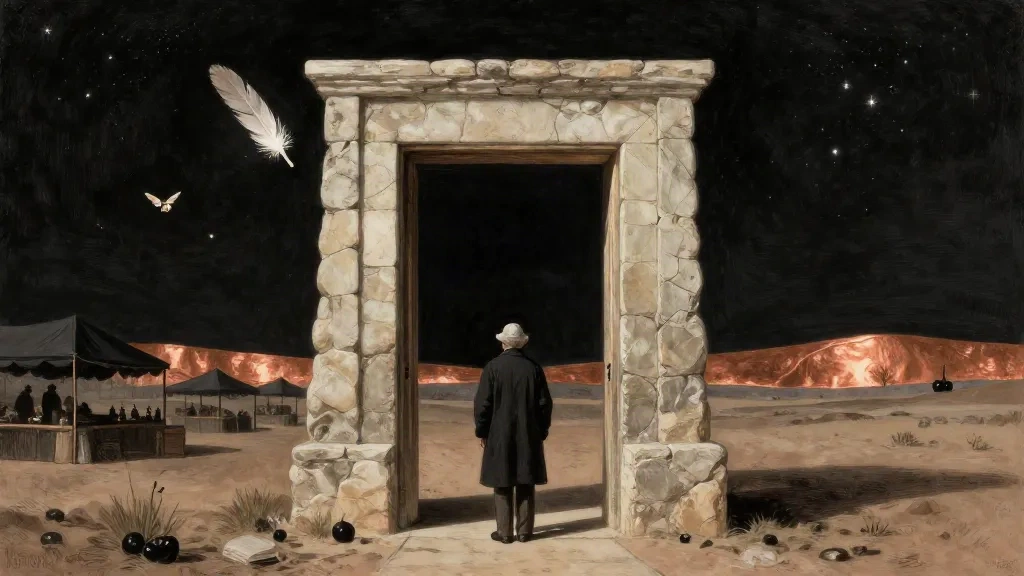
It led to an empty square in the copper-colored desert. There, beside a well filled with wind, a door stood upright without walls. Sera unfolded her map. The door appeared in pale stone ink, hinged toward a darkness filled with stars.
The Market of Certain Things
Beyond the door lay a market under a copper horizon. Stalls stood beneath black cherry awnings, their lamps burning without smoke. Merchants sold ordinary things: a brass compass, a jar of summer rain, a child’s tooth tied with red thread.
Sera soon understood the market’s rule. The cheapest objects were merely likely. The expensive things were always true.
A silver moth wing promised to find any lost road, but only if its owner abandoned the memory of where she had been. A white feather promised to reveal a person’s last unspoken word. Both lay on the central stall, guarded by a merchant with eyes like polished coal.
“You cannot buy a place for everything,” he said. “Places are heavy.”
Sera pointed to the feather. “How heavy is a truth?”
“Heavy enough to change the map.”
She had already seen the map beneath the city. A black lake marked the lost town of Orison, where the desert had once been. A thin white road led from the lake to the observatory. On the map, Orison was not gone. It had been removed by an act no cartographer recorded: a city-wide agreement to forget it.
The market sold the means to restore it. Sera’s door, drawn from memory, was the only object that could open the way.
“The feather tells me who erased the town,” she said. “The moth wing finds the road home.”
“Together, they cost a memory.”
The Price of Returning
For three days Sera followed the market’s winding lanes. She traded brass for maps, maps for names, names for hours borrowed from a sleeping watchman. Each bargain narrowed her past. Her first home vanished. The smell of her mother’s kitchen dissolved. The face of her daughter, lost at sea forty years earlier, became a pale blur behind closed eyes.
At sunset, the black lake appeared.
Orison rose from the desert in pieces. Roof tiles returned first, then staircases, gardens, bells, a bakery with its oven still warm. People stepped from the shadows carrying suitcases and leading dogs that had forgotten their owners. A woman stood beneath a broken clock, screaming a name into the wind.
The observatory’s message repeated across the sky: DO NOT LET THEM RETURN WHAT WAS TAKEN.
Sera understood then that the town had not been forgotten by accident. Its inhabitants had chosen disappearance to preserve something living. The city beneath the lake was a refuge, and the stars were warning every keeper of maps that some absences were made by the people inside them.
She climbed to the copper ridge with the white feather in one hand and the moth wing in the other. The market watched without vendors.
“Choose,” the merchant called.
Sera drew the map of her own life. The rooms opened, each one containing a person she could no longer name. She placed the feather on the page. It whispered the truth of Orison: the town had erased itself so its children could be found by a future that had not yet been born.
Then she placed the moth wing beside it. Together they formed a door.
Not to Orison. To the lost places scattered through the world.
Sera opened it. From its darkness came the first lost key, then a glove, a raincoat, a blue cup, a suitcase, a red book. They landed around her as gently as sleeping birds.
A Rest for the Missing
By dawn, a shelter stood where the empty square had been: low walls of pale stone, a roof painted black cherry, windows facing the copper horizon. There was no gate, no fee, and no map marking its exact location. Only those carrying something that had lost its way could find it.
Sera hung the white feather above the entrance. It remained white, though its single black bar had faded. She kept the moth wing in a jar on her desk. It no longer flew; still, it trembled whenever someone approached carrying an unanswered question.
The observatory sent one final message after the old cartographer fell asleep.
It was not written in a dead man’s hand. It was written in hers, from a future where every lost thing had a place, and every place remembered the way home.
On the pale stone above the door, Sera carved no name. Some destinations are better recognized by returning than by inscription.





