 Netwrck
Adventure.
The First Shadow
By the time Mara Venn reached Aurren, the resort had three shadows for every guest. They pooled beneath the black cherry trees, lengthened across the pale stone terraces, and waited beneath the copper-colored horizon.
She had come for one final commission. The town council wanted a map of a pass that had collapsed before her grandmother was born. The work would be easy: draw a road where the mountain no longer agreed to stand.
Instead, a shadow detached itself from the hotel and bowed to her.
It wore the shape of a woman holding a glass jar. Inside the jar, something flickered pale and quick.
“You are late,” said the shadow.
Mara closed her portfolio. She had spent forty-three years drawing coastlines that shifted and borders that lied politely. She knew how to make a place appear on paper. She did not know how to make one exist anywhere else.
That was why she had come.
Her wish was modest: a place where lost things could rest. A thimble found in a demolished house. A name scratched beneath a school desk. The first snowflake to fall on a warm country.
The shadow touched the jar. “We have been looking for an architect.”
What the Market Sold
Aurren’s market opened beneath the northern slopes, where the snow lay untouched even at noon. Stalls occupied the shadows’ spaces, their tables covered in objects that seemed ordinary until someone looked twice.
A brass key. A child’s red mitten. A ticket with a departure date from next year.
The merchants did not offer memories, exactly. They offered proofs.
A woman bought the sound of her sister laughing. A boy traded away the last lie his father had told. An old man paid in silver for the exact temperature of a summer afternoon.
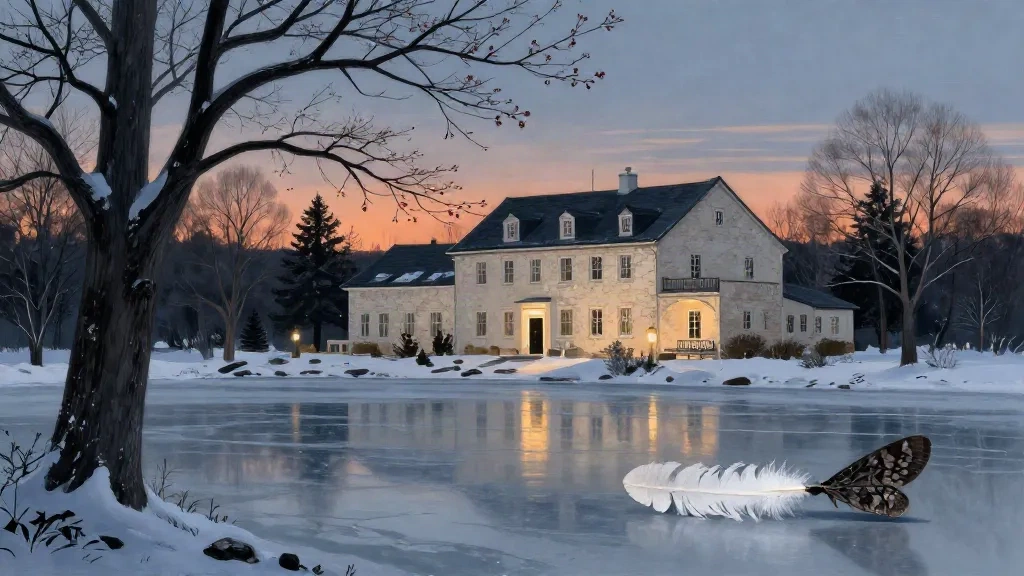
At the final stall sat a merchant with a face hidden beneath a white feather.
“Here,” the merchant said, sliding a moth wing across the counter, “everything is true. That is what makes it valuable.”
Mara examined the wing. It was black cherry in color, though no cherry tree grew this high. Its scales caught the copper light along the horizon.
“How much?”
“A memory you have been using to avoid living.”
Mara gave him the memory of her daughter’s last summer. The market swallowed it without noise.
In return, the merchant placed a rolled map on the table.
It showed a room beneath the frozen lake, furnished with shelves, low lamps, and a door that opened onto a place no living person could name.
“Your refuge,” said the merchant. “The expensive things are always true.”
Mara looked again. The room was real. She could smell wet stone and hear pages turning beneath the ice.
The Price of Shelter
The map demanded three materials.
A door from a house erased by floodwater. A name surrendered by someone still breathing. And the white feather from the merchant’s cloak.
Mara found the door in the hotel’s oldest wing, hanging in a wall where no wall remained. She copied its hinges onto paper, careful to preserve the grain of the wood. The door accepted the drawing with a cold click.
The name was harder.
At dusk, a boy sat beside the frozen lake, holding the red mitten from the market. He had stolen it because it had belonged to his missing sister. He would surrender anything, he said, if she came back.
Mara could not make the sister return. But she could give the lost thing rest.
She drew a small room on the map and placed the mitten inside. The boy watched the paper brighten.
“She was kind,” he said.
“Then she can rest without being forgotten.”
At midnight, the market vanished. Its stalls folded into the snow, and the expensive truths walked home carrying their borrowed grief.
Only the white feather remained, stuck in the black cherry tree beside Mara’s hotel.
She reached for it.
The shadow in the glass jar knocked against the world behind the page. “If you open that room,” it said, “you must decide what belongs inside it. Some lost things are lost because they were harmful.”
Mara understood then. A refuge was not an excuse to preserve every wound, every monster, every mistake.
A Door for the Missing
She returned to the merchant before dawn.
He waited beneath the copper horizon, his face still hidden by the feather. “You have your door,” he said. “Why hesitate?”
“Because I am tired of drawing places that only exist because someone refuses to let them go.”
She took the feather and placed it over the map.
Its barbs divided into pale lines, showing hidden paths: a drowned village, a vanished railway platform, the unnamed room beneath the lake. Each loss had been recorded. None had been given a destination.
“Build it carefully,” the merchant said.
Mara drew a narrow corridor. She gave it windows, though the corridor lay underground. She made the walls pale stone and the floor black cherry, polished smooth by the footsteps of things that had nowhere else to go.
She did not draw a room for every lost thing. She left the spaces between them open.
Some things needed shelter. Others needed to become stories. A few needed only to be released.
When she finished, the map rose from the table.
The white feather became a compass. The moth wing trembled, then flew through the paper and vanished into the cold.
Far below, a door opened in the ice.
Out came the girl’s mitten. Out came a sailor’s compass, a vanished song, the smell of a kitchen demolished decades ago. They passed through the corridor and into the world, changed but not surrendered.
Mara stood at the entrance as the shadows of Aurren gathered behind her. For the first time, they did not arrive ahead of anyone. They followed.
She had drawn a place for the lost, not to keep them, but to let them choose.
Then she walked home beneath the copper horizon, carrying an empty map and the quiet knowledge that every true thing eventually asks for a door.





