 Netwrck
Romance.
The Last Dish Before Midnight
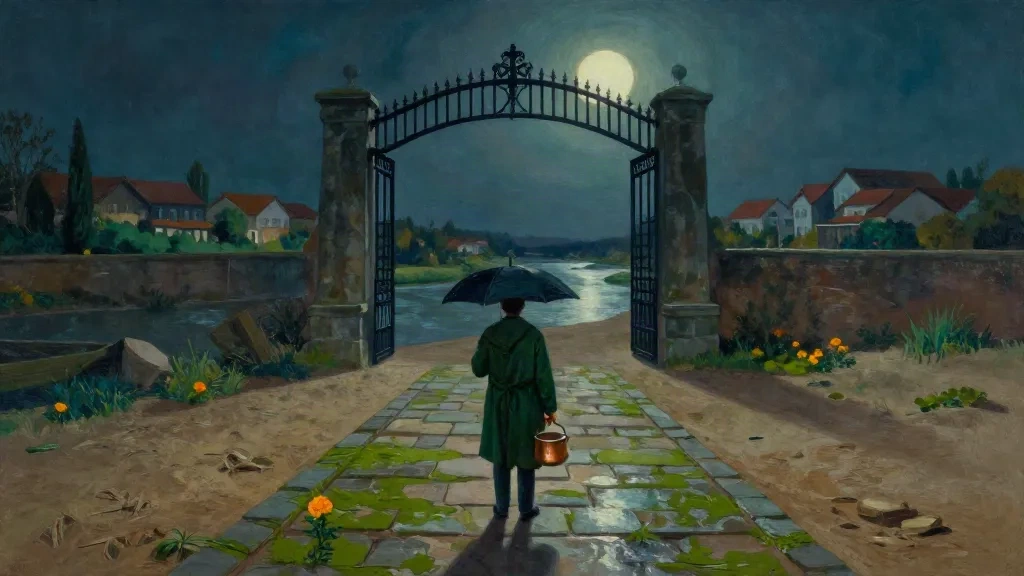
The river divided Vey and Ordan along a seam of moss green, but the border was easiest to see when the water changed direction. For one hour before midnight, it withdrew into its eastern channel, exposing the dry riverbed: pale stone, stranded bicycles, bottles silvered with silt. At midnight, it reversed without a sound. The crossing bell rang, and the current struck the western bank like a returning blade.
Mira stood above the bed with a black umbrella hooked over her shoulder and a copper pot in her hands. She had inherited the umbrella from her grandmother, along with her recipes and the family legend. Each dish summoned the ghost of someone who had eaten in that kitchen. Whiskered customers from the year of the blue tin. Her mother at fifteen, stealing bread from the pot. Once, briefly, a boy with rain in his hair who had sat opposite Mira at a midsummer table and kissed her while the candles guttered.
Her grandmother had warned that food made the dead hungry for the living. The gate beneath Ordan’s old tollhouse opened for anyone willing to give up a true name. Once opened, the gate took one name forever. It would not accept the same sacrifice twice.
Mira had not come to summon that boy. She had come to prove her grandmother’s last claim: their ancestor, Ilyra, had crossed the reversing river to return a stolen treaty and saved the town from war. Family legends were maps worn smooth by repetition. Mira wanted the border.
A Table Set for the Missing
At the tollhouse she found a man waiting beneath a broken weather vane.
He introduced himself as Ansel. His coat smelled of wet wool and woodsmoke. “You brought the ladle,” he said.
It had been part of the pot, handle bent into a small silver hook.
“My name is Mira,” she said, testing whether the gate would hear.
Nothing moved. She ladle clear water into a bowl, added salt in the shape of a doorway, and crumbled marigold petals over the surface. The recipe had no written name. Her hands remembered it: broth for those who had nowhere else to go.
Steam rose. The empty bowl filled with the smell of fennel and wood ash. In the tollhouse doorway, a woman appeared carrying a child. Then an old man. Then a line of the vanished, each repeating the gesture of the last person who had shared their table.
Ansel watched them pass. “Ilyra crossed here,” he said.
“So my grandmother said.”
“Your grandmother said Ilyra came back.”
“That’s not the same.”
“No,” he said. “It is if the river remembers.”
The Price Beneath the Bell
They went down beneath the tollhouse, where the stones sweated with groundwater. The gate was black iron set in a circular arch. Its opening bore the shape of a key, but no keyhole. Only a shallow bowl.
“A name,” Mira said.
“The name by which someone you love calls you.”
Ansel looked toward the empty doorway. Before she came, he had already surrendered his own name to cross the border. His had opened the road between the banks. The gate would not take it again. He could watch her use hers, or turn her away.
Mira thought of her mother saying Mira in every doorway, through fevers, over debts, on the morning no reply came. She thought of the boy who had whispered her name beneath the table.
Then the river turned.
The black iron shuddered. Marigold light raced across the stones. The dry riverbed filled from the far end, water climbing toward the tollhouse in a smooth, impossible wall. Ansel seized the umbrella and held it over them as the gate spoke in the voices of everyone who had ever crossed.
Give me the name. Give me the name. Give me the name.
“I have proof,” Mira said. She recited the treaty’s first line, the seal erased from the archive, the song her grandmother taught her. “Ilyra returned it.”
“The river keeps what it takes.”
“Then show me.”
The gate opened. Inside stood a woman in a green coat, older than any portrait, holding a roll of seals in one hand and a black umbrella in the other.
What the River Returned
It was Ilyra. Mira recognized the crook of her thumb from the kitchen carving. The ancestor had crossed, but she had not returned. For a hundred years, the river had held her on its changing current, unable to enter the town because the gate demanded a name and she had surrendered the one by which her daughter called her.
“You came for the treaty,” Ilyra said.
Mira held out her hand. The wet stone trembled beneath their feet. “I came for the truth.”
“Truth is a debt. It costs its reader too.”
“What must I pay?”
Ilyra lifted the black umbrella. Beneath it, her face was not the fierce face in the legend but the face of Mira’s mother: tired, frightened, alive with the memory of waiting.
“Not my name,” Mira said. “Not hers.”
“A memory,” Ilyra said. “The memory of eating at your table.”
Mira understood. Once given, it would vanish. Her mother would still be her mother. The boy would remain a kiss on a forgotten summer. But the table where they had loved her would be empty forever.
She placed the silver ladle in the bowl. The gate took the memory.
At once, warmth left the room. Every meal, every shared silence, every hand that had steadied her cup, went with it.
Ilyra stepped through. The river struck the gate behind her and withdrew.
At dawn, Ansel asked what she had forgotten. Mira looked at the copper pot, the black umbrella, and the newly mended bridge. “Something worth keeping,” she said.
She took his hand. The water beneath them was changing direction again, carrying the past toward the town instead of away from it. Mira did not know which way they would return.
It did not matter. For the first time, she knew they were coming home.





