 Netwrck
Romance.
The Season That Would Not Close
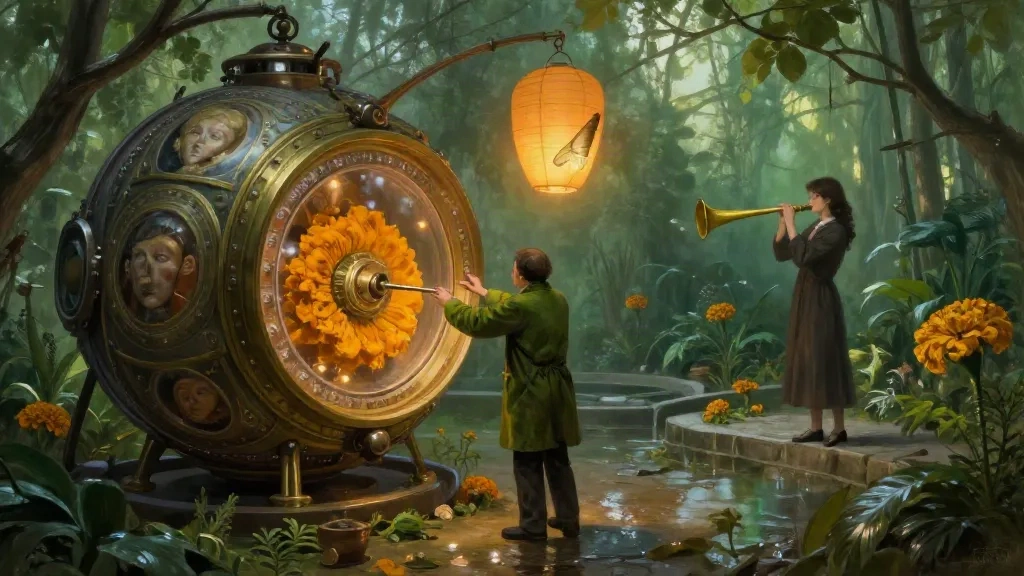
Iona Vey made clocks for seasons rather than hours. Her workshop hung beneath the orbital greenhouse’s northern dome, where condensation beaded on old stone ribs and moss climbed the pipes in patient green. Inside, damp clocks breathed against the walls. One opened its brass petals for spring. Another released a slow violet frost. The smallest chimed whenever the seed’s stored sunlight changed by a fraction.
Iona did not make them to tell anyone the time. She made them to prove that a year could be missed without being lost.
Her father, Arun, had believed this. Before his last flight to the seed’s lower heart, he had made a key from marigold brass. It opened no lock. Wound into it was a single minute in which winter yielded to spring, preserved perfectly despite the seed’s damaged orbit. Then Arun had gone below and returned unable to remember Iona.
She found him’s paper lantern in the choir chamber. It was a small wrinkled sun, burned during the repair of his suit, its wick blackened. Inside, instead of a flame, lay one silver moth wing.
The wing was a message. The greenhouse choir understood that immediately.
Every Voice Remembered Differently
“He hid the key,” said the deep voice of the ventilation.
“He gave it to her,” whispered the voice of seedling roots.
“He broke it,” complained the voice of a hundred leaves turning at once.
They were not ghosts. They were memories encoded in the seed: Arun’s memories, the people’s memories of Arun, and Arun’s memories of the people who remembered him. When Iona had been a child, she and Arun had brought this chamber food during storms. They had sung badly beneath the paper lantern. He had promised that when she built her first seasonal clock, he would dance beneath the summer stars.
He had not. The memory of the promise remained exact, though Arun himself had lost it.
Now Iona climbed to the choir with Mara Quell, the greenhouse’s acoustician. Mara carried no lantern. She had brought a blue listening horn, and she kept the uppermost brass tuning pipes warm with her hands.
“They will use me against you,” she said.
“They already do.”
In the listening horn, Iona heard her father laugh. Not the father who forgot her. The father who once caught her on a ladder and called her his dangerous little solstice. Beside the laugh stood another voice. Iona had heard it once before, in a memory she had never lived.
Mara’s voice said, Keep the minute. Lose the man. That way belongs to us.
Iona lowered the horn. Mara watched her.
“That wasn’t me,” Mara said.
“No.”
For the first time, Iona wondered whether love was history offered as shelter, or a blade disguised as an inheritance.
What the Moth Had Seen
The moth wing resolved when Mara tuned the horn to the frequency of burning paper. The memory opened onto the night Arun descended below the greenhouse.
The marigold key was in his hand. Another figure waited in the wet stone corridor: a woman with wet hair, no face, and a flight suit patched with wings.
“If you preserve that minute,” the figure said, “the orbit stabilizes. If you leave it, this place keeps growing.”
Arun asked, “And us?”
“There is no us in this choice.”
Then he put the key into the choir. The wing burned into the lantern, leaving the minute trapped among contradictory memories. The greenhouse had split time around him: spring continued beneath the roots while the woman remained stranded in a winter no one else could enter. In the morning, Arun had forgotten every promise except the one he could no longer keep.
“He chose the garden,” Iona whispered.
“He chose everyone,” Mara said. “That may be worse.”
They descended through the wet stone. Behind them, the choir split. Some voices begged forgiveness. Some condemned Arun for mistaking survival for love. One small voice, buried deepest, sang the tune he had taught Iona.
At the heart of the seed, the marigold key waited inside a cage of frozen sap. A second lantern stood beside it, unburned.
Mara reached for it.
“If I take the wing, the choir loses its oldest memory.”
Iona understood. The first lantern had held Arun’s side of the choice. A moth wing could hold the other: his face, his hands, the mark above his heart. Returned to him, it would restore the whole memory—and with it, grief.
She looked at Mara.
“I can give him the whole minute back,” Iona said, “but not only the spring.”
Mara’s fingers closed around the wing. “And me?”
The choir waited in a hundred conflicting throats. Iona took Mara’s hand.
“Come with me.”
A Minute Large Enough for Two
Arun waited in the observation garden, older than memory and younger than grief. Iona placed the lantern in his lap. He saw the moth wing. Then he saw her.
“Iona,” he said. It was not restoration. It was choice.
She took out the marigold key.
The minute wanted to escape. She felt the greenhouse draw breath, roots tightening around the seed, leaves turning toward a spring that had waited years to finish itself. Mara stood beside her, listening horn raised. The stranger trapped in winter sang through it, furious and afraid.
“Call her home,” Mara said.
So Iona did not open the key.
She made a clock.
The mechanism was simple: two hands, no face, a space between them. Iona set the marigold brass for the exact second he had forgotten her, and the silver wing for the instant he caught her on the ladder. Then she added Mara’s hand, warm from the tuning pipes, and the wing of the stranger who had believed there was no use in love.
The clock opened.
Its minute held spring, winter, a failed promise, a kept one, and a name no choir could own. The greenhouse shook. Above them, moss brightened along the pipes. Far below, a door opened in the frozen corridor.
Arun wept. “I left her.”
“Yes,” Iona said.
He looked at Mara, then at his daughter. “And you brought someone to help you bring me back.”
Outside the dome, the seed turned toward its star. Green moved through the branches in patient waves. One flash of marigold crossed the wet stone.
That night, Iona built another seasonal clock, this one with room for two. At midnight, it opened without being wound.
Mara stood beneath it and asked, “What season is this?”
“Ours,” Iona said, and took her hand before the bells could change.





