 Netwrck
Romance.
The Clock Beneath the Stacks
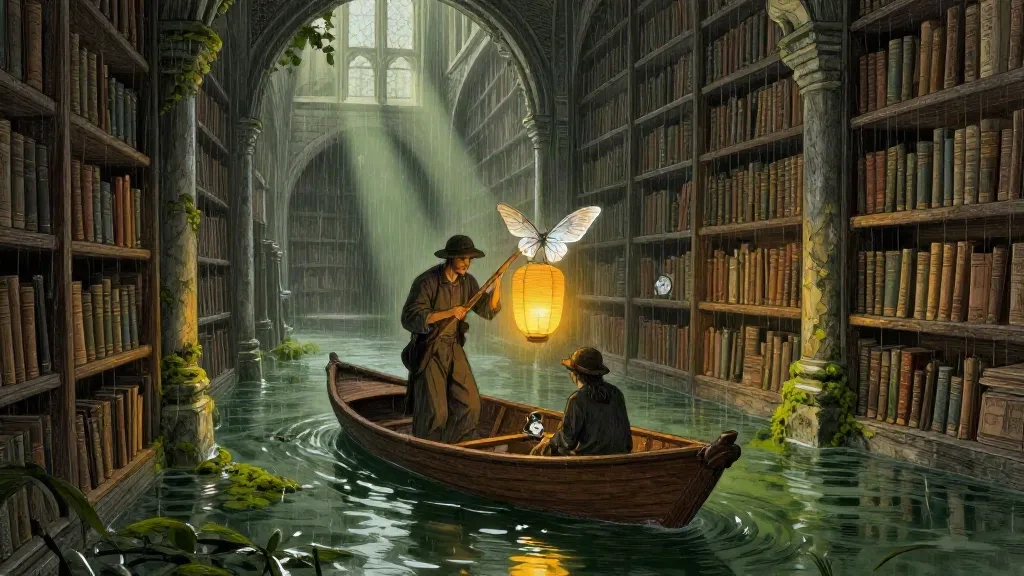
Mara rowed her narrow boat through the drowned archive, poling between shelves that rose from the water like roofless cathedrals. Moss softened the wet stone. Marigold floated on the surface wherever the lanterns had burned through the night.
In her coat pocket lay a season-clock with no hour-hand and only one spring on its silver dial. Mara had made it seventeen winters ago for Ione, the archivist who taught her that time was a promise rather than a measurement. Then came the flood, the quarrel neither of them had survived, and the long official silence in which the missing remained missing.
That morning, the clock spoke.
Not chimed. Spoke.
Bring me the lantern with the torn wing.
Mara closed her hand around the paper lantern hanging from her bow. Inside it, a moth wing lay folded against the flame, one side translucent as old window glass. She had found the lantern in the drowned map room, empty then. Now the wing moved whenever she turned toward the choir shelves.
Voices That Disagreed
The choir began without breath or accompaniment.
Its first voice was Ione's.
It told her the lantern was bait, that the archives were trying to use her longing as a key. The second voice belonged to the missing librarian and called her thief. A third insisted there had never been an Ione, only a nameless archivist who stole winter clocks from the eastern shelves. They overlapped until the water trembled around the boats and drowned lamps.
Mara rowed toward the old reading room, though no such room remained. The choir followed through the open doors of the stacks, borrowing mouths from clerks who had drowned centuries ago.
“I built this clock for him,” she said.
“Built it for whom?” demanded the nameless voice.
“For the person I loved before I became afraid he would leave.”
The Ione in the choir softened, but the others grew louder. One memory held an April morning: Ione laughing in the clockroom, soot on his cheek, while they pressed their foreheads together beside a workbench. Another held the evacuation, his hand slipping from hers beneath the falling water. A third showed him standing on dry land three days later, saying her name in a stranger's voice. She could not tell which had belonged to him.
The paper lantern hissed. Its moth wing turned black at the edges.
What the Spring Remembered
At last they reached the round chamber where the oldest calendars floated on their backs. The season-clock fitted into an empty pedestal shaped like an open hand. Mara understood then why the choir feared her. Once returned, it would release the spring Ione had sealed away before the flood, along with every memory bound to it.
Some voices wanted that spring restored. Others believed a dead man had made his own death inevitable by trying to preserve a single perfect hour. The nameless voice shouted that love had been used as a lock and should be used again.
Mara lit the lantern. The moth wing cast a marigold flash across the wet stone.
“Then let him answer for himself,” she said.
She set the clock in the pedestal and opened its glass face. The choir collapsed into a single low note. Out of it stepped Ione, salt-dark and shivering, no older than the man she had mourned. Mara wanted to touch his face. Instead, she held out the lantern.
“You made the wing,” she said. “Or used it to make me bring you back. Either way, you owe me the truth.”
Ione looked not at the lantern but at her.
“I was not taken by the flood,” he said. “I left because I knew what the choir would do when it found my memories. It wanted my spring, and spring never ends without taking something.”
The Minute That Belonged to Them
The confession could have been another trick. Mara listened to his voice stumble, searched his face for the polished grief she had constructed from fragments, and found no place for her invented version to hide.
She placed the moth wing against the clock's spring. Its silver hand advanced one marigold-bright minute.
The choir divided. Some voices praised forgiveness. Others cursed it for weakening them. Ione stepped into the boat without asking her forgiveness. He took one oar, leaving Mara the other, and together they rowed away as the shelves closed behind them.
“Where are we going?” she asked.
“Wherever this minute takes us.”
At the archive's last arch, the lantern went dark. Its wing remained whole. Ione's hand covered Mara's on the oar, warm, neither absent nor made of memory.
Behind them, the old choir sang every version at once. Ahead, the floodwater widened toward open sky.





