 Netwrck
Romance.
The Market Below the Tide
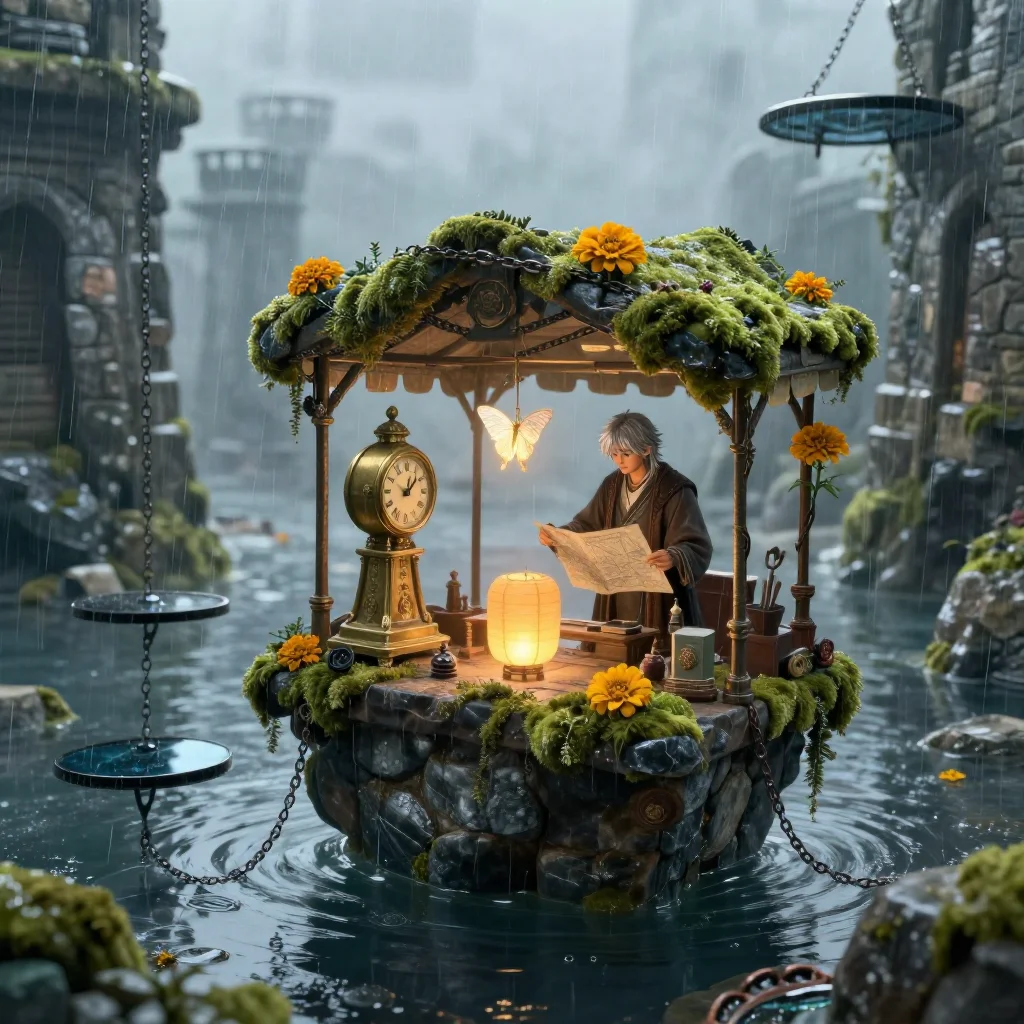
By dusk, the market had risen above the drowned city, its stalls floating on chains of kelp and black glass. Lanterns swayed beneath the walkways, each containing a memory with no one left to remember it. Shopkeepers sold rain from vanished summers, arguments repeated by empty doorways, and the names of children who had grown old in another country.
Mara kept her stall at the western edge, where the wind carried a smell of wet stone. He arranged tiny brass clocks in rings around a cracked hourglass. His clocks counted seasons: the slow green thaw, the long amber fall, winter's blue hush, and the brief fierce spring that made every market blossom with moss.
He made them for people who had lost something they could not name. A widow wanted the exact spring in which her husband had laughed. A sailor sought the winter before he came home. Mara built the mechanism, but the memory chose what it would keep.
That evening, a paper lantern drifted against his table. It was small, damp, and painted with a marigold at its center. A single moth wing had been stitched inside the paper seam.
Beside it lay a black iron key.
Mara recognized the key before he touched it. Its teeth were cut like the months of a season, and its bow bore the tiny mark of a broken compass needle. He had made it twenty-three years earlier for Elian Venn, a mapmaker who had promised to chart the market before it moved again.
“You found my key,” said a voice behind him.
The Choir of Borrowed Voices
Elian stood beneath the awning, silver hair bright against the storm-colored sky. He had aged in places Mara remembered and in places he had not. A scar crossed his eyebrow. His left hand was missing two fingers. When he smiled, Mara felt the old ache in her chest move like a key turning.
“The market gave it back,” he said.
“The market gave it to me.”
Before he could answer, the lantern flared. From inside it came a chorus.
One voice was Elian's, young and fiercely certain: Return the key to the maker. She will know what I could not say. Another was Mara's own, roughened by grief: Keep it. He left you waiting, and waiting is not love. A third whispered through the paper walls: Neither. Let the tide decide.
The voices multiplied. Some begged for the key. Some demanded it be melted. Some remembered a different Elian entirely: cruel, laughing, afraid of water, kneeling beside a broken boat while the city sank beneath them.
“They are conflicting interests,” Elian said. His face had gone pale. “Every memory wants a different ending.”
Mara picked up the lantern. The moth wing brushed her thumb, dry and impossibly delicate. She remembered Elian leaving with the key in his coat pocket. She remembered finding an empty room. She remembered hating him for a year, then missing him for nineteen.
“I want to return this to the person who made it,” she said. “That was always the work.”
A Season With No Hour
Elian took her hand. His missing fingers left a small, permanent gap against her palm.
“I did not come to claim it,” he said. “I came to ask whether you would let me remember the truth with you.”
“Which truth?”
“The one no one has kept.”
They set the key in the center of Mara's largest clock. Its hands began turning backward. The market rose higher, and the drowned streets below turned like gray seams in a garment.
Memories poured from the lantern. Elian as a boy carving weather symbols into a roof beam. Mara meeting him beside a spring tide, both pretending the meeting was accidental. His boat foundering in a fog that had erased the shore. Her own hands sealing the key into the clock after he vanished.
The choir became one voice, then many, then a single note. The clock struck once.
When the light cleared, the key had become a new shape: two joined rings, one made of brass, one of green glass.
What the Morning Kept
“You made this?” Elian asked.
“We did,” Mara said.
He fastened the rings to the chain around her neck. Below, spring broke over the floating market. Moss brightened on every stall. The paper lantern lifted, carrying the moth wing into the marigold dawn.
Mara watched the boy go, then kept the market's small red wheel in her own hand. The dead did not vanish. The past did not forgive. Neither did love. They simply became a room with two chairs, where someone could return, sit down, and begin again without pretending the first ending had never happened.
Some things are returned. Some things are remade. The maker must know which.





