 Netwrck
Romance.
The Door That Bloomed in March
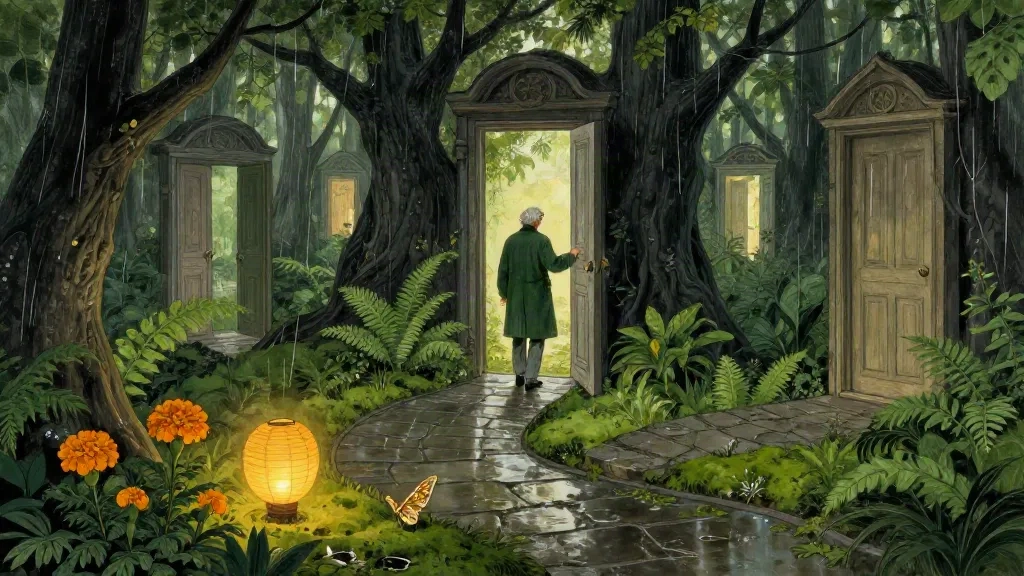
Mara kept the season clocks beneath the eastern arbor, where rain ticked from the leaves and the paths shone wet-stone dark. Her workshop occupied a glasshouse built around the garden’s oldest tree, a vast black trunk from whose branches grew doors. Some opened onto spring rain, some onto rooms in other cities, and one opened upon the white winter held inside an amber lantern.
She had made that lantern when she was twenty-three, folding paper over a brass frame and painting a single marigold at its heart. Beside it lay a moth wing, translucent and veined with gold. The wing had belonged to her brother, Tomas, who disappeared nine winters ago during the garden’s unremembered night.
Her clocks did not measure hours. The smallest marked the turn from frost to thaw; the largest divided a century into its four unruly seasons. People brought them broken and asked for repairs, though what they usually wanted was permission to remember correctly.
“You should let it go,” said the tree one morning.
Mara tightened the spring inside a clock shaped like a green bell. “It is not yours to return.”
“Everything in my branches returns somewhere.”
The Choir That Remembered Differently
The lantern had begun sounding at dusk. Its paper shell breathed warm against the glass, and the moth wing trembled in its box.
When Mara opened the door to the garden, the choir was waiting beneath the moss-green canopy. The voices had no bodies. Some belonged to visitors who had wandered through the tree and returned changed. Some were the memories of places themselves: the old greenhouse, the locked nursery, the path where Tomas used to race her toward the pond.
They sang his name in seven different keys.
One voice said he had left willingly. Another said he had died on the winter path. A third insisted he remained inside the lantern, folded between the paper seams.
“Which of you remembers him?” Mara asked.
The choir divided. The memories strained against one another, each certain that its version was the kindest. The garden trembled. Along the branches, doors opened and slammed open, showing rooms full of snow.
“You know what happened,” said a small voice from beneath the moss.
It was Mara’s own, younger and untouched by nine years of waiting. Mara covered her ears, but the choir sang louder.
The paper lantern flared. Inside it, a figure appeared: Tomas at the window, waving for her to come inside.
A Door Requires Two Hands
“He is calling you,” the lantern whispered.
Mara lifted the lantern toward the nearest door. The marigold brightened, and she could smell pine smoke, hear Tomas laughing in the next room, feel the old thrill of being chosen by someone she loved.
Then the moth wing flashed. It was not gold but green, the color of a wing crushed beneath a careless hand.
“That is not him,” Mara said.
“You do not know that,” said the choir.
“I know he would not ask me to forget the door home.”
The false Tomas vanished. The lantern dimmed, and the garden returned to its rain and green shadows.
At the foot of the tree, Mara found a low door she had never noticed before, its wood covered in moss. It required two hands to open. One seam bore the impression of her palm. The other held a tiny bite from a brass gear.
She fit her own missing gear into the lock.
Behind the door was Tomas—not alive, not a ghost, but a preserved summer, warm and golden as the inside of a bell. He looked exactly as she remembered him, except for the sorrow in his eyes.
“I made you forget,” he said.
“I know.”
“I asked the garden to keep the worst night out of you.”
“I asked it to keep you.”
The choir rushed toward the door, each memory shouting a different destination. Summer. Winter. The nursery. The pond. The room where they had promised to meet after the blossoms fell.
Mara placed both hands on the wood. This time she did not choose the memory that comforted her. She opened the door all the way, letting every season enter the garden at once.
The Hour She Had Lost
The clocks rang together, not in agreement but in answer. Their bells measured the grief, the mercy, and the years that had passed without either of them.
Tomas stepped through. He was no longer golden. Frost silvered his hair, and rain darkened his coat, but Mara knew him. The man before her had survived the life she had tried to keep sealed.
“I wanted to return the lantern to the person who made it,” she said.
“You made it for me.”
“I made it because you were leaving.”
He touched the paper crease where her hand had once trembled. “Then it returned.”
Behind them, the choir fell silent. The false versions of Tomas dissolved into rain, but the true memories remained: the nursery, the pond, the winter path. None had won. All had been allowed to stay.
Mara took the moth wing from her pocket and placed it beneath the lantern’s glass. The wing lifted itself, carrying a bar of marigold light toward the black tree.
One of its doors opened. Beyond it, the garden’s first spring morning shone with wet stone and bright leaves.
Tomas held her hand.
“What hour is it?” he asked.
Mara looked at the clocks, all moving at once.
“The hour we begin again,” she said.
They stepped through together, leaving the lantern open behind them. It glowed among the moss like a small sun, and its paper walls filled with the warm, mingled breath of every season.





