 Netwrck
Fantasy.
The Season Door
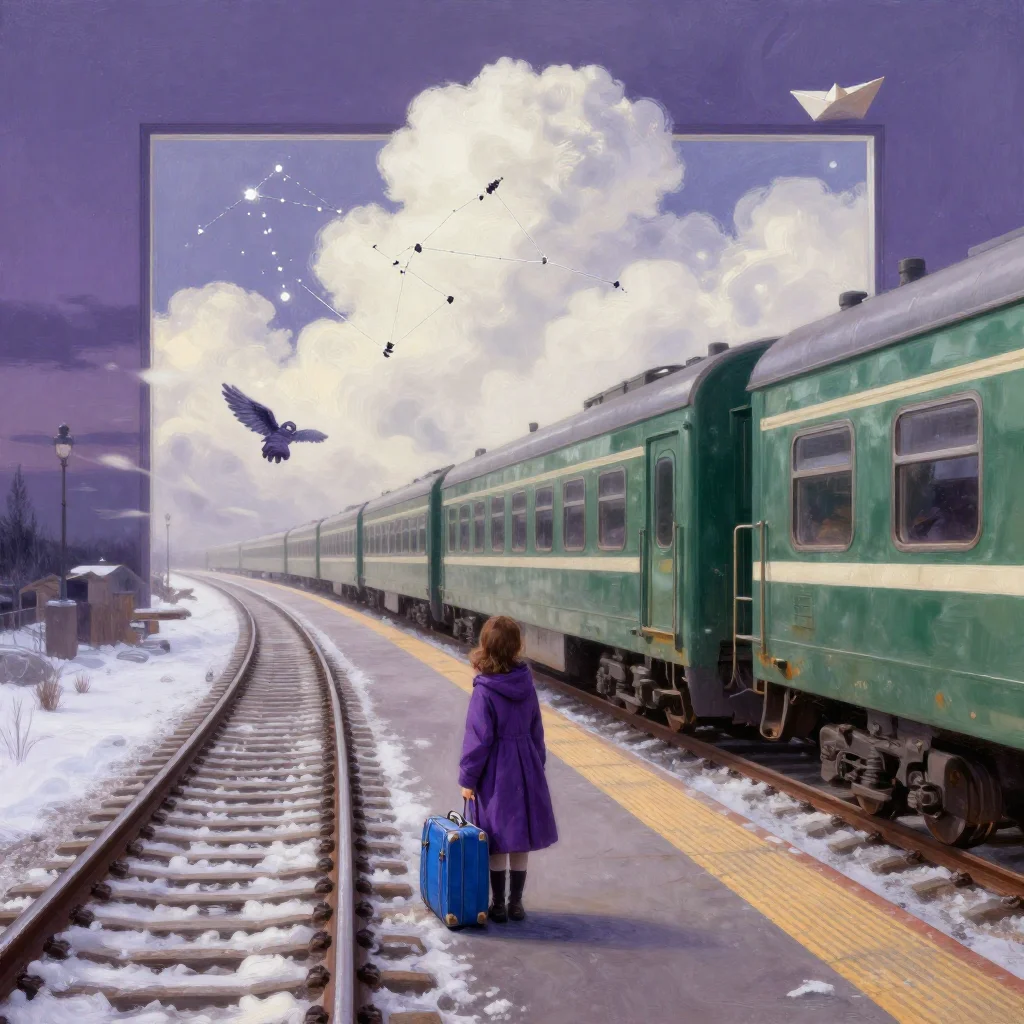
Violet dusk settled over the station while snow rested on the rails like clipped feathers. The departure board clicked through impossible destinations: THAW, LATE SUMMER, THE YEAR AFTER RAIN. Each platform held a different temperature, and each train breathed a different weather against the glass.
Mara stood beneath the board with a blue suitcase clasped beneath both hands. Inside it travelled her library: forty-three shelves of catalogued weather, pressed flowers, forgotten songs, and one empty drawer marked Heron, the Broken Wing.
Her father had left the suitcase at her bedside without explanation. On its handle he had tied a wool glove, thumb missing, and inside the pocket a paper boat folded from a page of star charts.
“You are late,” said the stationmaster.
He was arranging copper tickets into a circle. Their edges had oxidized green, and each bore the name of a destination that no longer existed.
“The train to the Upper Sky leaves when the living deadline expires,” Mara said.
The stationmaster glanced at the tracks. “Then you have until your father remembers how to die.”
She opened the blue suitcase. The empty drawer breathed cold air across her wrists.
The Winter Passenger
At Platform Three, a train waited beneath a cloud-white sky even though night pressed against the station roof. Its windows were mirrors. In them Mara saw the constellation Heron, pinned above a mountain of cloud, with one wing broken and seven stars missing.
The conductor wore a coat the color of oxidized copper. He offered Mara a ticket marked SEVEN STARS.
“Your father bought passage for you,” he said.
“He said nothing.”
“Dead men are poor correspondents.”
He nodded toward the wool glove hanging from her handle.
Mara unfolded the paper boat. Its sail bore a single line: When the north bell rings, ask the winter passenger.
Behind the train, a bell began to toll beneath the snow. The station clock jumped backward one minute.
“What did my father inherit?” she asked.
“A promise,” said the conductor. “He was born with seven years left in his lungs. Every year he delayed, the constellation lost another star.”
Mara looked at the empty drawer. The missing stars had been waiting inside it, patient as seeds.
Her father was alive in the city below, sleeping beneath a rented roof. She had seen him that morning. He had asked her to bring home the blue suitcase.
The wool glove tightened around her fingers, though no hand moved.
Across the Borrowed Sky
The train departed without a whistle. Mara sat in a compartment full of winter passengers: a woman carrying snow in her pockets, a boy with icicles for eyelashes, an old man holding a dead moth in both hands. Outside, the station collapsed into a violet spark.
At the third stop, the conductor opened the door. Snow streamed sideways. A white fox stood on the rails, carrying the missing stars in its teeth.
“Give me the glove,” it said.
Mara understood then. The glove had not been left by accident. It belonged to the person who had torn Heron from the sky and hidden the pieces in the living world. Her father had not inherited the promise. He had inherited the debt.
“He is not dead yet,” Mara said.
“That is why the train is here.”
The fox dropped the stars into her palm. They burned there, cold and bright.
She placed them in the paper boat and returned the glove to the blue suitcase. The library shuddered. Books flew open, their pages filling with the names of vanished places.
When the north bell rang again, the conductor told her to throw the boat from the moving window.
“The sky is below us,” he said. “For now.”
A Constellation Returned
Mara leaned into the violet dark. The station was gone. Beneath the train lay an ocean of cloud, and beyond it the mountain where Heron hung incomplete.
She released the paper boat.
Wind took it. The stars rose from its folds, one by one, joining the bright shape in the sky. The broken wing bent upward. The seven lights held.
The wool glove opened by itself. A scrap of paper fell from its palm, written in her father’s hand: Forgive me. I thought a sky could be carried safely in a child’s hands.
At dawn, Mara returned to the winter station. The train behind her had vanished. Her father stood on Platform Three, older and thinner, with the same blue suitcase beside him.
He asked what she had done.
“Returned it,” she said.
He looked up. Heron burned above the station, white as a lamp seen through snow. Then he took her hand, and together they walked into the falling season.





