 Netwrck
Mythic Fiction.
The Bell That Remembered Tomorrow
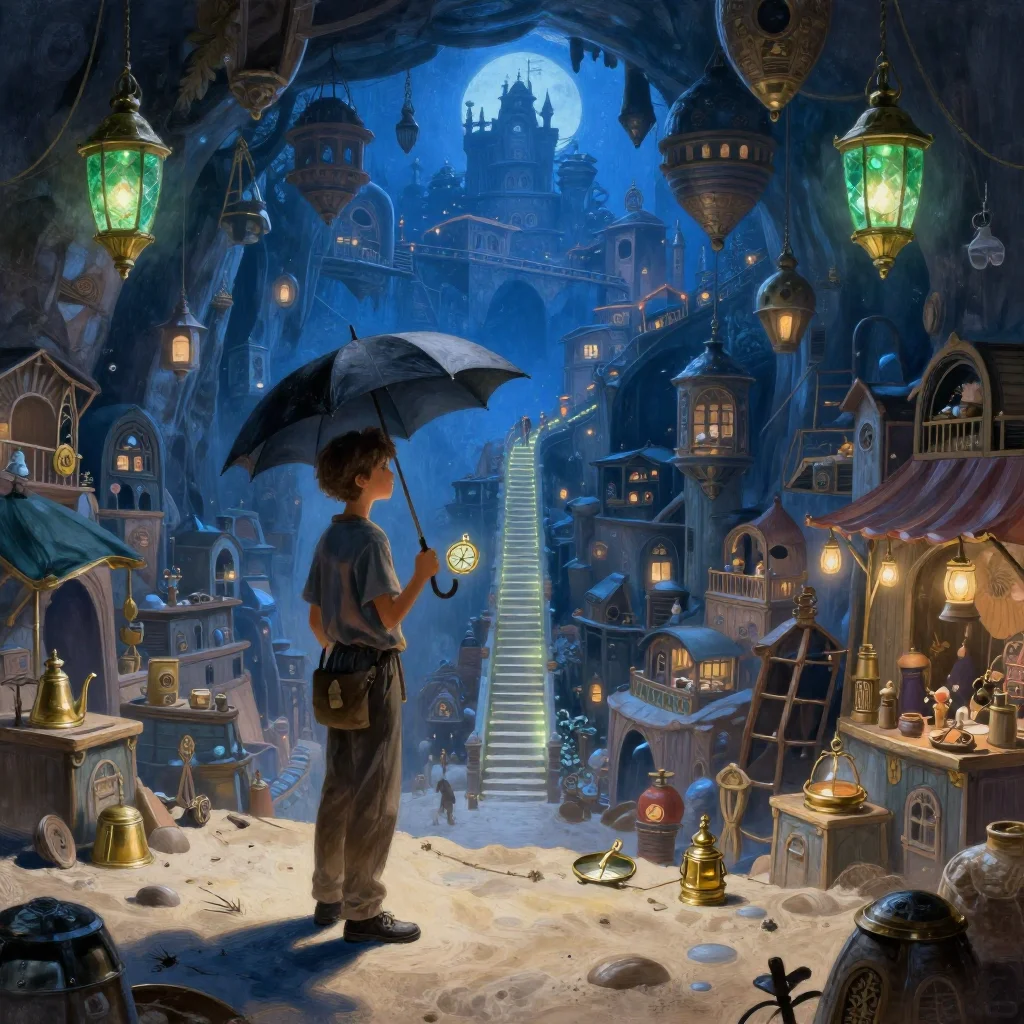
Mara Vale made bells beneath the first floor of Saint Orra, where the city’s houses stood on iron legs and the night market unfolded in the hollow beneath them. Above her stall, boots crossed floors that had no street below. Below, among fish blue with cold light, brass pots, sea-glass combs, and cakes dusted with grey sand, her hammers rang.
Her bells were small enough to close around one hand. Each had a clapper shaped from a different metal, and each rang for a memory its owner had not yet owned.
“A bell for your wedding,” a customer would say, and the bell would answer with the sound of a door slamming in a house that no longer existed.
Mara never explained this. Customers preferred possibility to certainty.
Her own bells had begun ringing in the mornings, before she woke. They sounded of stairs descending. At night, they answered one another from beneath the market, always from deeper below.
She wanted to know the true shape of the world beneath Bellwether Lane. Everyone in the upper city used that name for the avenue, though its oldest stones had been cut with marks belonging to no alphabet Mara could read.
On the eve of the Nameless Wake, the market changed.
What the Holiday Required
The holiday began when the lamps were lowered and the stalls were covered. No bell marked its arrival. Instead, the sea-glass lamps turned cobalt, and the crowd opened a corridor through its center.
The Nameless Wake honored a grief that had never received a name. People brought objects wrapped in cloth: a child’s shoe, a cracked cup, a ticket, a ring. They carried them to the market and left them beside the empty stall where Mara’s mother used to sell black umbrellas.
The objects were not buried. They were placed beneath the paving, and the city remembered forgetting them.
Mara’s mother had vanished during the previous Wake. She had carried a black umbrella and a brass compass, and she had told Mara never to follow the sound of a bell below the first floor.
Then she had gone down to sell an umbrella that could not get wet.
That night, Mara found an umbrella resting across her workbench. Its canopy was black as a hole in the lamps. Beside it lay the brass compass, its needle turning toward the hollow beneath the market.
She recognized both objects immediately.
When she touched the compass, every bell in her stall rang at once.
Buy nothing, and the road will show you what you left behind.
The words came from below, spoken in her mother’s voice. The market had been silent. Now every object in it trembled faintly: knives in their trays, shells in paper cones, teeth set on black cloth.
Mara took the umbrella and compass. She did not take her bells.
The City Under Bellwether
Behind the market, where the city’s support beams vanished into darkness, Mara found a stair.
It had no railing. Its steps were narrow and wet, descending through layers of packed earth. Each landing held a different street.
There was a lane of blue doors. There was a market where three moons hung beneath the floor. There was a garden filled with glass trees, and beneath the trees lay the bones of buildings that had never been built.
The brass compass pointed down, though Mara had tied the needle shut with thread.
“You are late,” said a voice.
An old woman sat beneath a streetlamp that cast no light. She wore a sand-colored shawl and held a black umbrella over a puddle shaped like a sleeping child.
“My mother came here,” Mara said.
“Everyone comes here carrying the thing they cannot name.”
The old woman pointed beneath the puddle. Below its surface, a woman walked through a city of drowned rooms. She carried an umbrella, though no rain fell. Her compass pointed toward a doorway.
Mara knelt. The water was warm and smelled of iron.
“The Wake is closing,” the old woman said. “Whatever has no name will be taken away before dawn.”
“Then I will give it one.”
The old woman studied her. “A name is not a key.”
Mara opened her palm. The black umbrella sprang open, casting a broad shadow over the puddle. Inside the shadow, the drowned city rose until its walls pressed against the stairwell.
Beyond them stood the street Mara knew. Bellwether Lane, with its crooked shops and the first-floor houses suspended above the market. Only one thing was different. A little girl stood beneath the awning of a closed clock shop, holding a brass bell.
Mara saw herself.
The Name She Would Not Keep
The girl beneath the awning looked up. Behind her, the street opened into a black square. The Nameless Wake waited there, surrounded by people holding their wrapped losses.
“If you name it,” the old woman said, “the city will remember. If the city remembers, you must carry it.”
Mara understood.
Her mother had not been lost because she had forgotten the way back. She had been carrying the grief of an entire city. Every unnamed loss had gathered inside her compass, and every Wake demanded she surrender one.
Mara reached into the black square.
She felt grief passing through her hands: a city lifted from its foundations, a door closed on a laughing voice, a whole district erased from maps, a mother who had come home to an empty room. The grief was not one feeling. It was a crowd pressing its faces against the dark.
She could give it her mother’s name. Then it would be easy, heavy, and finished.
Instead, she spoke the first bell she had ever made.
The sound was thin and imperfect. It rang through the drowned city, the stairwell, the market, and the crowded floors above. It did not announce an answer.
It made room.
One by one, the unnamed griefs found a voice. They became a whistle in an abandoned tunnel, a chair scraping across a lost ballroom, a child counting steps under a vanished bridge. None belonged to Mara. None was hers to carry alone.
The black square opened into daylight.
The Shape Below the Street
Dawn reached the market through the underside of the city. It entered blue and gold, fell across the closed stalls, and illuminated the place beneath Bellwether Lane: not a basement, not a hidden kingdom, but a field of roots and rooms where the upper city had planted its forgotten foundations.
Mara climbed the stair with the brass compass in her hand. Its needle now pointed north, then south, then toward her own chest.
She no longer needed it.
On the final step, she found her mother waiting beneath a streetlamp. The black umbrella rested over one shoulder. The compass lay open on her palm.
“Did you name it?” her mother asked.
“No,” Mara said. “I gave it something to do.”
Her mother smiled, not sadly, but with the tired relief of someone setting down a burden.
They climbed into the waking market. Above them, the city’s first-floor doors opened. People descended for bread, salt, and the small blue fish sold only after a storm.
None of them knew what lay below the familiar street. Mara did too, and did not. She knew only that the world had no bottom because grief had made paths through it.
That evening, she made a new bell. It was brass, sea-glass green, and warm from the forge. It rang when someone remembered what they had lost—and, a moment later, when they remembered they were still loved.





