 Netwrck
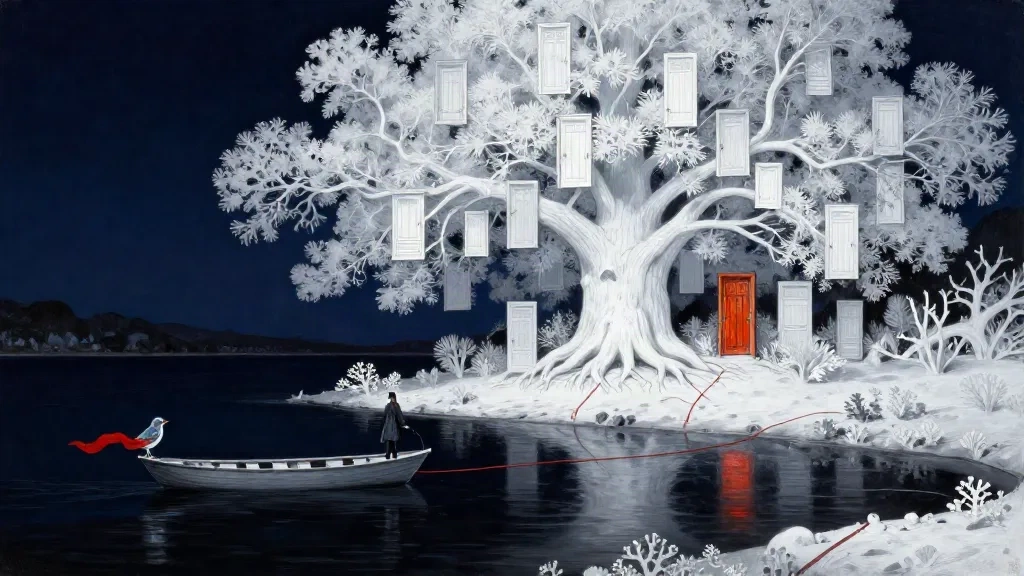
Gothic Fantasy.
The Tide That Kept Its Own Time
The lake appeared only when the moon forgot itself below the horizon. By dawn, the ferryman lowered his narrow boat into a valley of dry grass, and the water gathered beneath its keel like a dark animal waking.
He lived in a white coral house at the waterline. Its windows were barred with ink-black wood, and a red scarf hung from the eastern door, fraying one thread at a time in the salt wind. Every winter he crossed the lake toward the botanical garden, though the garden stood on the opposite side only during low tide.
The garden had been built around one tree. Its trunk was pale as bone, and its branches carried doors: blue nursery doors, narrow pantry doors, doors made of rust, doors with no walls behind them. When the wind moved through them, the garden smelled of wet leaves and rooms no one had entered for a century.
At the tree's center stood Marrow, the first gardener. She had disappeared before the ferryman was born, leaving behind a glass bird with a red thread tied around its neck.
His desire was simple. He wanted to find the one person who remembered the original version of the world.
The Map Against the Hand
He carried the map Marrow had drawn. It showed the lake as a blue eye, the garden as a green thorn, and the far shore as a narrow place where the first sunrise had landed. He kept it inside his coat, away from dishonest fingers.
At the first landing, he unfolded it. The route he had crossed lay beneath the lake. The shore he needed lay where his house stood.
He tried again, holding the map flat against the boat. White coral replaced the ink, red thread stitched across the coast, and a small door appeared beneath his feet.
Every honest attempt altered it. The map feared a fixed direction. When he asked strangers for the old road, it drew their lies as roads. When he followed it, the map erased the road behind him.
By noon he had crossed a marsh of black water, a field of white coral, and a garden growing upside down beneath the soil. At its lowest gate waited the glass bird. It stood on one crystal leg, its beak dipped in ink, and the red thread around its neck shone like a wound.
He lifted the bird. Every door in the garden slammed shut.
What the Tree Refused
Behind the trunk, something knocked from the other side.
The tree opened a low door of damp wood. Beyond it waited a woman in a boatman's coat, black-haired and motionless. The lake moved around her feet, though she stood in a room with no horizon.
“You remember me,” he said.
“I remember the world before the map learned to lie.”
Her name was Orra. She had been the first person to cross the low-tide lake, carrying seeds from the garden. When she returned, the world had altered itself around her. Mountains moved inland. Names changed. Every map began correcting her memory.
“Marrow is not lost,” Orra said. “She is the door that will not open.”
He unwrapped the map. The red thread had sewn its edges together. He understood then that the map was not guiding him toward her. It was keeping her in the version of the world that had erased her.
He tore the map along the thread.
The garden screamed in white coral and ink. Every door opened at once. Behind them stood rooms the world had lost: a blue morning, a city under snow, a childhood bedroom, a shoreline with two moons.
Orra crossed the threshold. The ferryman followed.
The First Shape of Water
They emerged on the dry valley floor as dawn filled the sky. The lake was shrinking around them, its surface becoming a sheet of glass set into the earth. The map lay in his hands, blank except for one red line running from the garden tree to the horizon.
He tied the glass bird's thread to his boat. Orra watched him.
“Now,” she said, “the map will have to begin again.”
He pushed off across the remaining water. Behind him, the botanical garden rose in white coral branches, every door standing open to a different world. Ahead, the empty route shimmered under the sun.
The ferryman did not know which shore he would reach. For once, he did not need to know. The original world had no map; it had only the patient red thread, crossing every surface by hand.





