 Netwrck
Mystery.
The Courtyard With No Door
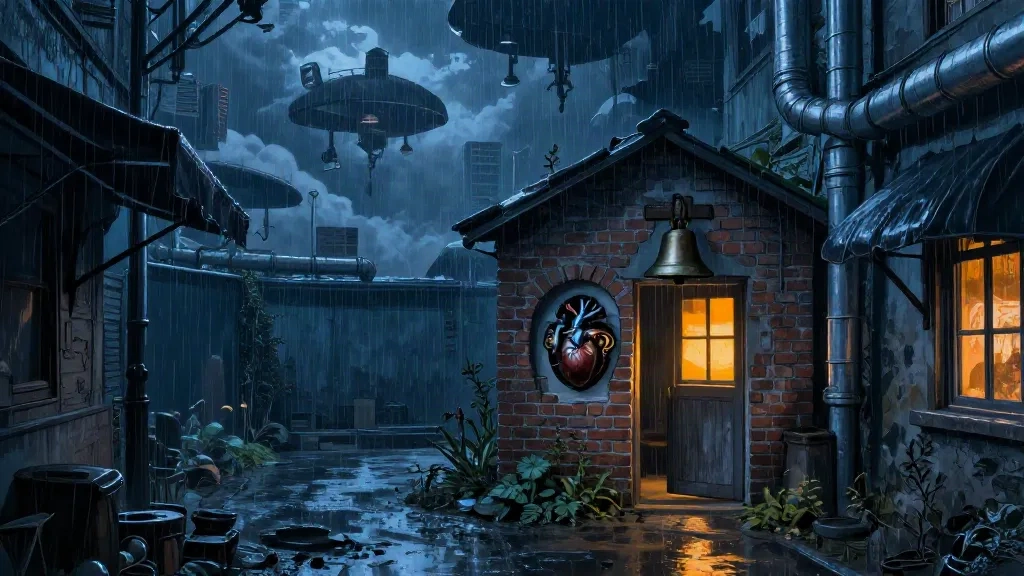
Rain silvered the underside of the night market, beading on black pipes hung between buildings whose first floors faced the clouds. Above them, shoes struck awnings and the city coughed through its ventilation shafts. Below, sellers unfolded stalls on wheels, their lamps making pools of amber in the ink-blue lane.
Ila kept the last courtyard before the market’s northern drain. The walls were blank, the weeds ambitious. She touched a rusted watering pipe and spoke her mother’s account of leaving the city with six children and no room large enough for them.
Her mother had always spoken of a lodging house: brass key beneath a cracked bell, shelter granted to anyone who had lost the right to sleep somewhere safe. The story ended there. Ila had spent seven years trying to grow the missing ending from its seed.
That night a key appeared beneath the drain, and a bell hung in the empty air beside it.
The Machine Against Conviction
The bell could not ring. Its fracture divided it nearly in two, though the two halves still shivered. When Ila raised the brass key, a panel opened in the courtyard wall. Inside waited a machine of black glass, porcelain rollers, and a narrow copper mouth.
A label said: FAMILY SHELTERING ENGINE. ONE TRUE STORY REQUIRED.
Ila fed it her mother’s story. The rollers turned, printing nowhere. She tried the details her family remembered: six children, one borrowed blanket, the smell of boiled onions. Still nothing. The machine made the small, contemptuous click of a judge refusing a plea.
Then a market lantern drifted into the courtyard, illuminating it. A woman carrying radishes stopped. Two children peered from beneath a cart. Before long, eight strangers stood among the weeds, looking at the machine and giving the obvious question.
“What is that?”
“Can it shelter us?”
“What if it is real?”
The copper mouth snapped shut.
What the Doubt Built
That night Ila understood the rule. Belief had been entering the machine through them. Every convinced mind tightened the walls around the impossible object until it vanished.
So she opened the streets to strangers and gave them work. She asked the radish seller to trim the walls with soot. She placed the children among the weeds and told them their roots must not be pulled. She showed doubters the cracked halves of the bell and invited them to say both were worthless.
By dawn, doubt had become labor. Skeptics held the key because no one could agree it opened anything. Children carried the bell, taking turns insisting it could not ring. The sellers argued over whether the machine existed while the machine printed shelter deeds onto strips of rain-dark paper.
Each deed granted only what its holder believed. One promised a dry corner but no safety. Another gave warmth but refused to remember a name. The black glass produced paper after paper, honest in its impossibilities.
At midday the courtyard had six walls, a roof, six bunks, and no machine.
Word spread that the room came from a lie. Most stayed away. The desperate came.
A Shelter Not Believed Away
Her mother arrived last, leaning on a stranger’s arm. She looked at the copper key in Ila’s palm, the bell hanging uselessly from a rusted hook, and the narrow shelter crowded with people she had not recognized.
“You finished it,” she said.
“I believed I could.”
The answer was incomplete, but the shelter accepted it. Bells have no audience requirement for grief, only somewhere to break.
Months later, the bell remained cracked. The key fit no ordinary lock. The market sellers still argued over the night the engine disappeared, even as the courtyard sheltered hundreds.
No one there agreed it was where it was.
That was how it kept its doors open.





