 Netwrck
Mystery.
The Courtyard Without a Door
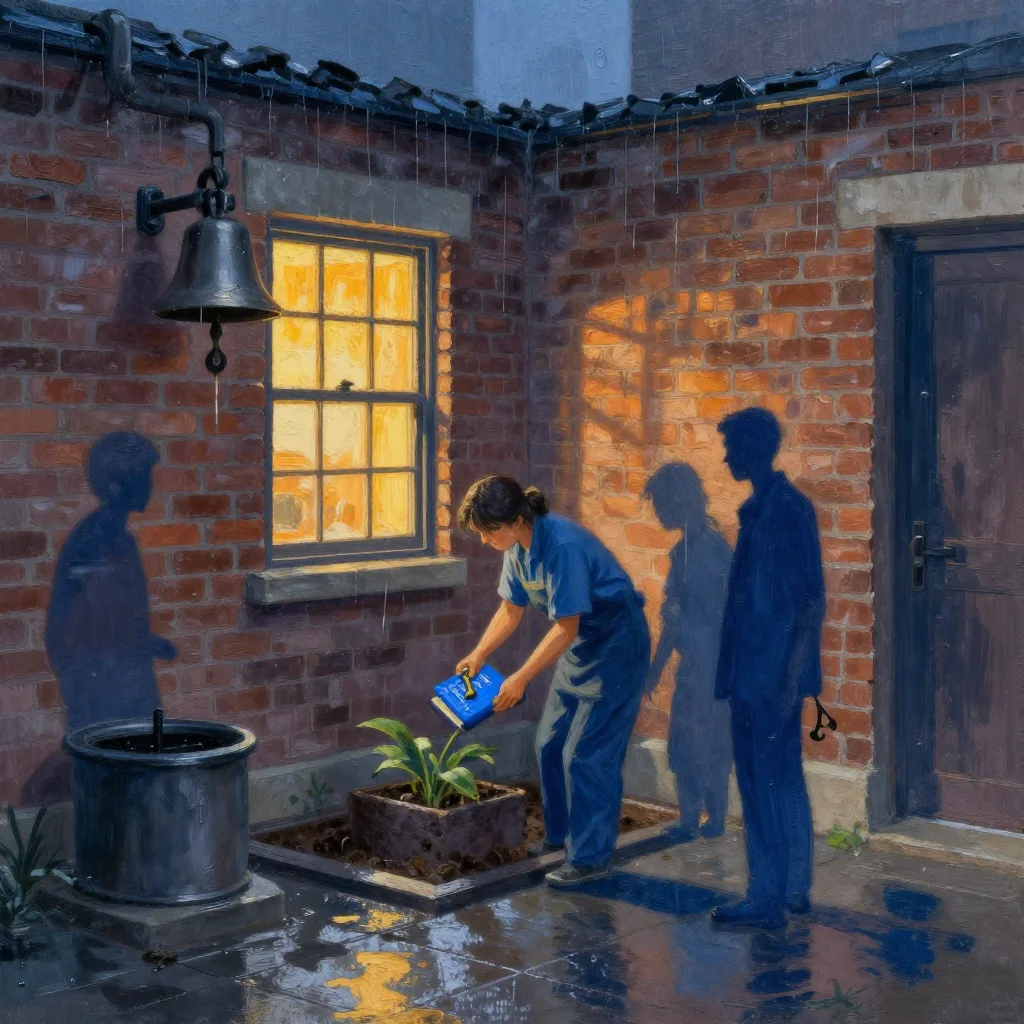
Mara Venn pruned the courtyard of shadows beneath Bellweather Crescent at ten minutes past midnight, when the rain turned the city to quicksilver. Her municipal shears whispered through shapes that hurried past her: narrow bishops, broad dogs, old women carrying invisible suitcases. Each cast its human owner beside it, and each made the same little turn toward the warm amber window of the tram depot.
The courtyard belonged to nobody. Its walls leaned inward above a bed of black soil, and its gate had vanished during a census correction forty years earlier. Mara knew this because she had planted the deed in the municipal archive, wrapped in ivy, where records were permitted to dream.
She knelt beside three stones marked only by initials: E.M., T.M., and a third worn smooth. The stones were not there at noon.
At dawn, a woman named Sera arrived carrying a canvas bag and the expression of someone who had mistaken a closed door for a grave. She pointed to the courtyard.
“My mother lived here,” she said. “Not inside. Beside it. She said this was where the city kept its spare rooms.”
Mara’s hands tightened around the shears. She had served this neglected courtyard for seven years, planting stories in neglected courtyards, but she had never been asked to finish one.
“What did she call the room?”
“The room where people could stay after they had nowhere to be.”
That was the desire, precise and awkward: turn a family story into a shelter for strangers.
The Machine in the Cistern
Below the courtyard, beneath a hatch hidden by rain moss, they found a brass machine with three dials and a keyhole shaped like an ear. A cracked bell hung above it from a chain that passed through the wall and climbed toward the clouds.
A maintenance plate bore a notice:
Do not test this apparatus in the presence of belief. Belief is the operator’s hand. Doubt is the machine’s absence. Permit the absence, and the absence will build.
“Belief is the operator’s hand,” Mara said.
Sera pointed to the bell. “And this?”
“The warning.”
Mara’s mother had told her the cracked bell in the courtyard sounded every time someone was about to be forgotten. Her mother had also claimed that the brass key could open any door belonging to a person who had never existed. Mara had treated both statements as inherited weather: true in feeling, unreliable in fact.
She inserted the key.
Nothing happened.
So she turned it again and said, with complete conviction, “I don’t think this can make a shelter.”
The machine coughed. Under the soil, something unfolded.
Walls rose without dust. A roof assembled itself from a thousand small shadows, each one stepping into place at the same time. Windows appeared along the courtyard’s northern side, dark as unlit rooms. The cracked bell gave a single iron cough.
Sera’s face went white. “It worked.”
“It objected,” Mara said.
They had built a shelter by disbelieving it. The discovery delighted them until a stranger stepped through the gate.
The stranger had no shadow.
He carried a ticket stamped with a destination that no longer existed. Behind him waited a queue of people whose outlines blurred whenever the rain touched them. They had come because the shelter was visibly open, which meant it was visibly possible, and possibility had made them afraid.
“If we admit them,” Mara said, “we admit what the machine creates.”
“If we don’t,” Sera said, “the room is only a story.”
The brass key turned in the lock by itself.
The Census of Shadows
By noon, the courtyard had become impossible to govern. Citizens declared that the walls belonged to them because their shadows cast new ones there. The municipal gardener received six complaints, two poems, and an anonymous threat from the Department of Civic Belonging. Every person who claimed the shelter changed it by one detail: an extra window, a crooked door, a chimney that exhaled weather from another district.
Mara found Sera’s mother’s missing story in the soil.
It was a small blue book, swollen with rain, containing a single account: a child named Ada arrived in the city with a red umbrella and no family; the residents of Bellweather Crescent gave her bread, dry socks, and a key to the courtyard; the key opened a room in the wall where the child slept until dawn. Each morning the room vanished, but the bread remained.
Sera read the account twice.
“That’s all?” she asked.
“That’s enough.”
“No. It isn’t.” She turned the pages. “She never learned what happened to the room.”
At the end of the book, a pressed amber leaf marked the missing answer.
The shelter contracted. One of its windows slammed shut. On the street, the no-shadow visitor began to fade, and the people behind him forgot why they had come.
Mara understood then that the machine built from denial had no foundation. It required a fact no one was willing to speak: the room had existed because strangers had once sheltered one another, and the story survived only by refusing to admit that it was valuable.
She took the brass key and climbed the roof.
A Window Left Warm
At dusk, Mara rang the cracked bell.
The sound did not summon belief. It shook belief out of the courtyard, loose as black snow. Shadows separated from their citizens and drifted toward the walls, carrying their hidden hours: the soldier asleep in a bakery, the child waiting behind a locked ward, the old man who fed pigeons but never named them.
Mara planted the blue book beneath the amber window.
“We believe this,” she said, and the machine sank beneath the ground.
“We believe a family story can become a shelter for strangers.”
Sera knelt beside her. “A room can open without erasing the people who need it.”
The walls held.
They did not become grand. They remained crooked, damp, and difficult to insure. Rain silvered the roof. The municipal gardeners replaced the missing gate with a bench. Above the courtyard, the cracked bell continued to shiver whenever someone was forgotten, but now the sound carried farther than the forgetting.
Years later, strangers arrived carrying small histories and larger losses. They slept beneath the blue book’s window. In the morning, they left food on the bench and took a brass key from the hook.
The key opened different doors for each of them. None was outside.
On the last night before Mara retired, she saw her own shadow enter the courtyard ahead of her. It bowed to the warm amber window, then sat down beside Sera’s shadow as though they had been waiting years for a place in the story.
Mara did not tell it where to go.
Somewhere below the city, a brass machine opened and closed its empty hand.





