 Netwrck
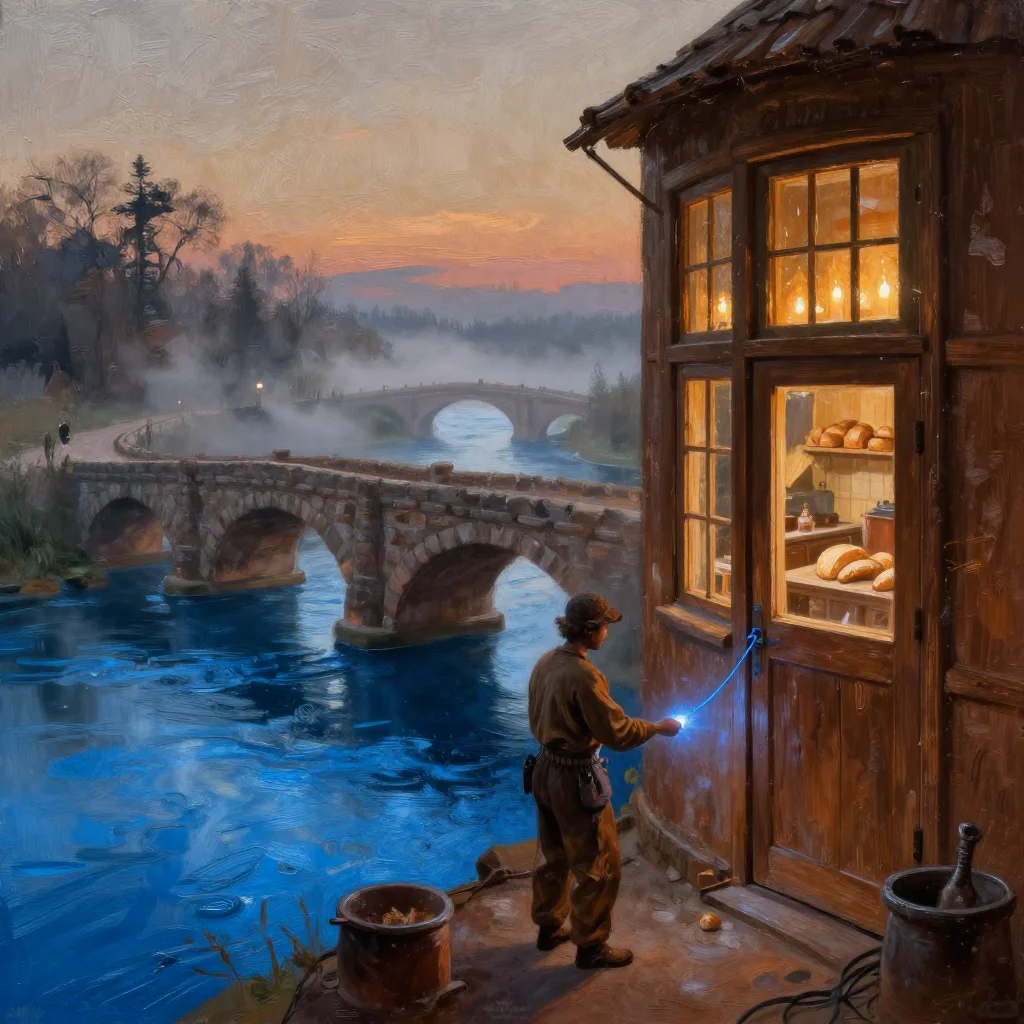
Historical Fantasy.
The Door Behind the Furnace
On the first cold morning of autumn, Mara Venn found an unmarked door in the wall of her glass furnace.
It stood between the ash drawer and the river-facing wall, its wood the color of tobacco, without hinges, handle, or threshold. Heat moved beneath it in slow pulses, though the bricks beyond were cold. Mara had shaped windows for forty years: panes for bankers, priests, kitchens, and a child who insisted every room required a different shape of moon. Other worlds sent their requests through her furnace, folded as sparks, and she answered in glass.
That morning, the glass had brought her no worlds. It had brought the door.
Through its center she could see a kitchen, ordinary and perfectly lit. A kettle sang on a black stove. Bread rose beneath a blue cloth. At a table, an old man buttered a roll while a girl recited the days of the week. Beyond them, pale morning rested on a row of chimneys.
Mara pressed her palm to the wood. The girl looked up.
“If you open it,” the girl said, “they will notice the light.”
Then the door vanished, leaving only a cold rectangle in the brick.
What the River Held
Veyr was built across seven bridges, and every bridge was a promise. The western span had been built so a widow could cross without mourning. The eastern bridge carried a treaty signed by three kingdoms. The smallest, over a drain-brown canal, had never needed a promise and was therefore considered unlucky.
The river was their witness. It kept these bargains in its current, and the town kept them in habits: never boast of a bridge you had not crossed, never thank a river aloud, never promise to return before sunset.
At noon, Mara met Tobias Vale, the bridge warden, beside the western span. A blue thread hung from his coat, bright against the steel of the rail.
“The trail began at the furnace,” he said. “It reaches every bridge. It grows safer whenever people stop telling the truth.”
Mara looked toward the canal. The blue thread trembled in the wind, though there was no breeze.
“What kind of safer?”
“Nothing can be taken from us.”
He showed her a notice nailed to the bridge: All departures suspended until the weather improves. The wording changed before Mara finished reading it. First it promised no one would leave. Then it promised no one would arrive. Finally it said only that the road was being repaired.
Downstream, a crowd stood in a queue at the smallest bridge. Each person carried a suitcase, a bundle, or a sealed letter. They had stopped speaking. Their silence made the water smooth. Under the hush, the blue thread lengthened by a handspan.
The Price of Quiet
Mara returned to the furnace and shaped a small blue window. The glass gathered candlelight, then reflected the door into being. The kitchen was still there.
The girl shook her head. “We tried telling everyone. The truth made the road dangerous.”
“Your morning is being carried there,” Mara said.
“Ours?” The old man looked down at his breakfast. “You mean the morning after tomorrow.”
Mara understood then. The town was not losing a day. It was trading one for another, and the quiet made the exchange irresistible. Every truth insisted that this morning belonged to those living in it. Every lie loosened the boundary.
She heated her tools and cut a circle of blue thread from the workshop spool. Through the pane, the kitchen brightened.
“If I bind the door to a true memory,” she said, “the river must accept it.”
The girl smiled for the first time. “Will you stay?”
Mara looked at the furnace, where unfinished windows clouded the fire. She wanted nothing grander than to keep this morning ordinary: bread cooling in the kitchen, the kettle settling, the old man learning the girl’s name again. She wanted her own hands to stop trembling before noon.
“I will make the town speak,” she said.
The Seventh Promise
At sunset, Mara stood on the seventh bridge with the blue thread tied to its rail. She had spent the day passing through doors, opening windows, and telling one truth at a time. The baker admitted he had been stealing flour. The mayor confessed the eastern bridge was failing. Children named those they had abandoned.
With each truth, the road grew difficult. But the river remained clear, and the thread held.
“A promise needs a witness,” Tobias said.
Mara tied the thread around her wrist. The river reflected candlelight, tobacco-brown water, and the narrow strip of steel-blue evening above it. Somewhere beyond the bridges, the unmarked door opened.
The girl stepped through. The old man followed, carrying the blue cloth from the bread.
Mara released the thread.
In the furnace, every unfinished window rang at once.
By morning, the town had forgotten the door. It remembered only that the western bridge had been repaired, the baker had paid for his flour, and a girl with bread under one arm had come home before the river changed color.
Mara opened her own shutters. Candlelight trembled across the glass, then settled into a clear pane. Beyond it, the ordinary morning remained where she had left it.





