 Netwrck
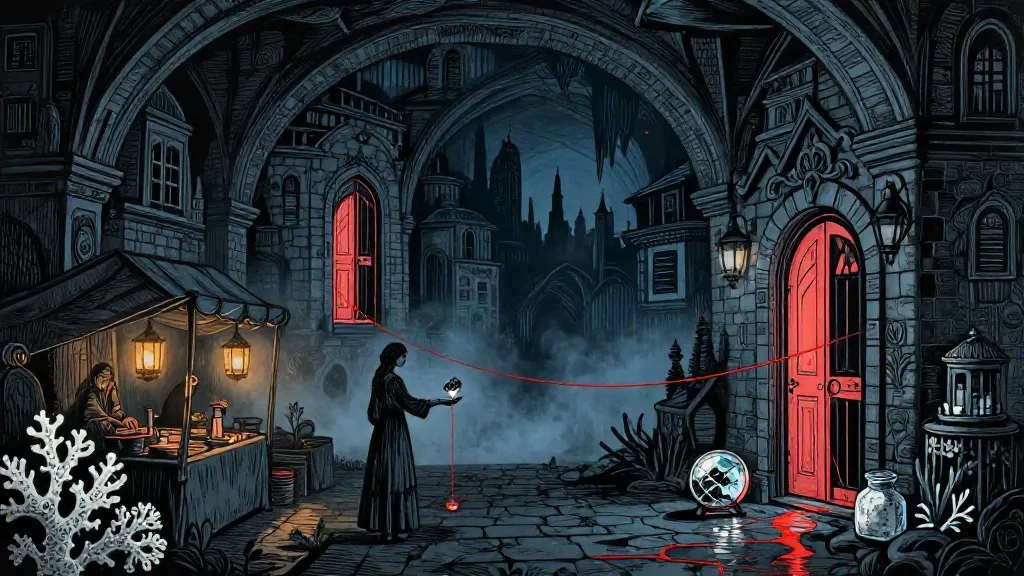
Gothic Fantasy.
Below the First Floor
The city had no street below the first floor, though it possessed a market there. Every night after the last bell, the people of Marrow House descended through a hatch behind the apothecary and found themselves among stalls roofed by black tarpaulin. Lanterns hung at uneven heights, their flames the color of old paper. White coral lay in glass bowls beside salt jars, black buttons, and bundles of red thread wound around the sellers’ fingers.
There the seamstress Sable repaired what distance had torn. She could take two people’s sleeves, overlap the fabric, and sew them into a temporary closeness. A mother stitched her cuff to her son’s. A bride fastened a loose thread at her husband’s wrist. A boy once tied his sleeve to a girl standing on the opposite side of a river, and for one hour neither could walk away.
Sable had one wish. She wanted a door between the living city and the drowned quarter beneath it, a door that opened only when both sides consented. The market’s hidden rooms had been sealed since the Flood, and without passage no one could return the stolen things kept there.
The Agreement in Red
The door waited in a cellar beneath the bone stalls. Sable found it behind a curtain of red thread, its frame made from two white coral pillars joined by a single black beam. There was no handle. Across the beam, instead of a lock, hung a strip of skin.
The writing on it was neither ink nor letters. Sable recognized the forms from funeral cloths, where the dead supposedly read the names of those who would follow them. Every stroke bent downward, carrying its own shadow. When she touched it, the letters warmed.
“You cannot open a covenant with a living hand,” whispered a vendor of salt. He had no face, only a smooth oval beneath his hood. “The village below agreed to stay closed. The city above agreed to forget.”
Sable drew out her needle. “Then who consented?”
The vendor pointed to a small glass seed resting in his palm. Inside it, a white coral branch grew without soil. “They consented once. The terms were witnessed by those who no longer lived.”
She took the seed. The salt vendor smiled, though his mouth remained a seam.
What the Dead Required
Sable read the agreement by placing her palm over the writing. A dead language entered her through the fingertips, cold and precise. It stated that the drowned quarter had surrendered its doors, its roads, and its right to remembrance. In return, the living had surrendered the dead.
That was the complication. The city had not simply abandoned the lower quarter; it had made an agreement with the dead to forget the people who died there. Their names were still spoken, but never beneath the first floor. Every year, more of them vanished from the city’s memory.
At midnight, Sable climbed onto the black beam and began sewing the door shut. She used red thread for consent, white coral for protection, and ink for refusal. A crack opened in the wood. Behind it, hundreds of voices whispered at once.
“Only the living may consent,” they said. “The dead cannot choose.”
Sable drew the needle through the final stitch. The glass seed split. Inside it, the coral branch bent toward a narrow face with salt-white hair.
Both Sides of the Door
The child on the other side reached through the crack and offered her a handful of black buttons. Sable could mend the distance between herself and the child, but she could not mend the agreement. A door could not be made honest by stitching shut the mouths that had been prevented from speaking.
So she cut the red thread.
The market went silent. Salt fell from every bowl. The dead language tore itself from the skin on the door, leaving one pale line.
“I consent to your opening,” Sable said.
Beyond the wood, the drowned quarter answered with a thousand voices. “We consent to yours.”
The door opened inward. Wind rose from the streets of the missing city, carrying the smell of rain, iron, and coral. No one passed through. Sable built no passage for the forgotten. She built a threshold, and on it she placed the glass seed, empty now, holding a single red thread.
By morning, the market above had a new hatch. The dead no longer spoke only in the agreement. They spoke through open doors, one word at a time, asking the living to listen. Sable kept her needle by the frame. Distance remained dangerous, but it was no longer a wall without a handle.





