 Netwrck
Folk Horror.
The Blue Suitcase
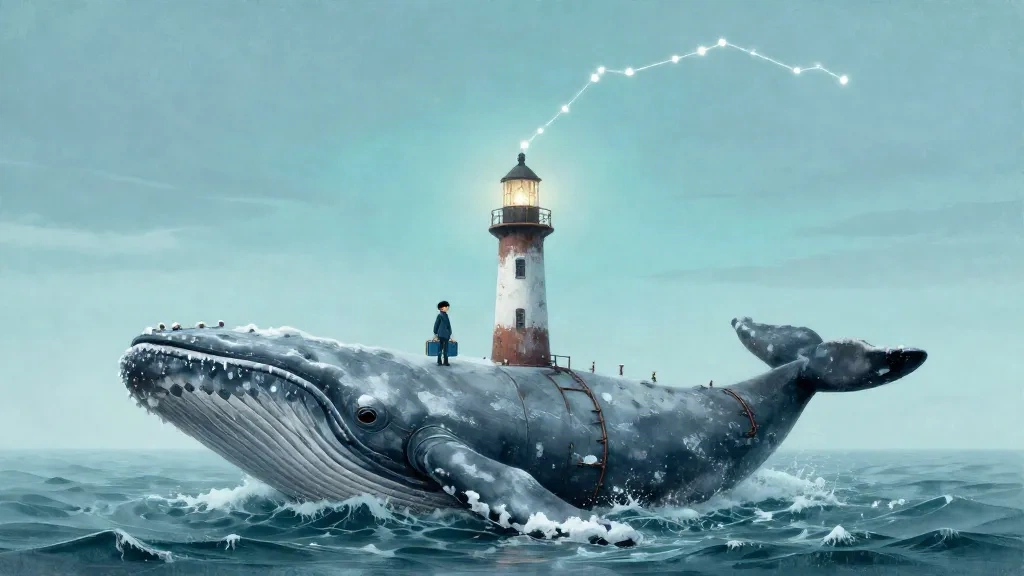
On the back of a sleeping mechanical whale, Mara kept a lighthouse.
The whale lay beneath the sea like a hill beneath a blanket. Iron plates showed through the water, green at the seams, and barnacles grew along the hinges of its ribs. Above its spine stood the lighthouse, crooked and narrow, with a lantern room like a cracked tooth. Frost silvered the brass railings. Even before dawn, the sky held the soft cyan of an impossible morning.
Mara was twelve. She carried a blue suitcase packed with the sea’s smallest library: tide tables in salt-proof cases, drowned parish registers, three books of names, and one empty jar. The books trembled whenever the whale breathed.
In the bottom lay a paper boat. In her coat pocket was one wool glove, its thumb patched with blue thread.
She had come to return the Sleeper’s Eye, a constellation stolen from the winter sky. The old keeper had told her where to find it. Not the stars themselves, but the name that bound them together, cut from the sky and hidden in the whale’s lantern.
The name was a small cold thing. Once spoken, it would let the constellation go home.
The Woman Who Had Not Died
The trouble waited in the lighthouse kitchen.
On the table lay a brass chronometer ticking backward. Beside it, a note written in an adult hand:
You have until the first bell after the whale wakes. Bring the sky home, or I remain dead.
The note was signed by Mara’s mother.
She was alive in the village above the cliffs, waiting for a train that had not arrived. Mara had been told she was dead because a storm had taken her, though her mother’s body had never been found. Now the chronometer showed four minutes and eleven seconds.
“You cannot be dead,” Mara said.
The chronometer lost a second.
In the lantern room, the stolen constellation appeared as a smear of frost across the glass. Five stars. A crooked line. A dark gap where the sky had been cut.
When Mara climbed, the wool glove in her pocket began to itch. She took it out. A scrap of grey wool clung to the glass, then tore free and vanished into the mechanism.
Below, the whale’s engine started.
The Bell Under the Ice
The lighthouse had three bells.
One rang when ships returned. One rang when storms began. The third had no clapper, and the old keeper had forbidden sounding it.
Mara found it beneath the floorboards, packed in ice that held the shape of a hand. The paper boat from her suitcase floated in the lock beside it, though she had left the suitcase downstairs.
She picked up the boat. Inside was a tiny strip of night sky, folded once.
“You kept the pieces separate,” she said.
The empty jar answered with a soft click.
She placed the paper boat in the jar, the wool glove beside it, and the library books around the bell. The frost began to leave the glass. The constellation brightened, but its missing name remained hidden in the lighthouse.
Mara opened the chronometer.
Inside, instead of gears, she saw a sleeping woman beneath a blue blanket.
Her mother opened her eyes. “If you call me back, the whale will wake,” she whispered. “If you send the stars back, I will have to die again.”
“That is not a deadline. That is a trap.”
“It is what the coast gives us.”
The whale exhaled. The lighthouse leaned. Far beneath the floor, something enormous turned over.
The Name in the Lantern
Mara climbed into the lantern room.
The missing name was cut into the brass housing, hidden beneath years of lampblack. She scraped it clean with the patched wool glove. The wool unraveled, leaving only a blue thread in her hand.
Outside, the sky brightened.
She opened the jar. The paper boat rose into the wind, carrying its strip of night. The five stars separated, then climbed above the whale’s back.
The name burned in the brass.
Mara spoke it.
The constellation returned to the winter sky in one white fracture.
At the same moment, the whale’s eye opened beneath the water.
Mara’s mother vanished from the chronometer. On the cliff road, a train began to whistle. Somewhere in the village, a living woman coughed and opened her eyes.
The paper boat landed in Mara’s palm. It was dry now, warm, and folded around a single fresh star.
Mara put it in the blue suitcase. The lighthouse settled. In the kitchen, the paper note had changed.
Thank you. Next time, bring the whole sky.
She looked through the lantern glass. Above the sleeping whale, the stars had made a new shape: a hand, a boat, and a narrow road leading home.





