 Netwrck
Historical Fantasy.
The Whale Below the Sea
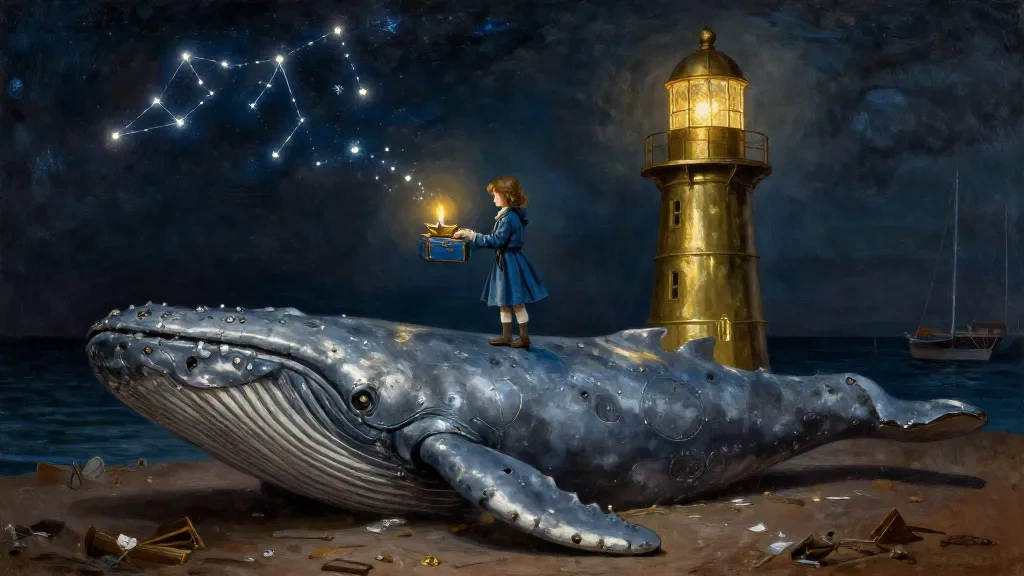
On the back of a sleeping mechanical whale, a lighthouse kept watch over the western sea. The whale had been built in the winter of 1841 by engineers who feared the new machines would make men obsolete. Instead, they made a vessel of iron, salt, and sleeping intention. Its ribs rose beneath the island like the hull of an upside-down ship, and at its highest point stood the lantern house, where a small girl named Mara catalogued the sky.
She carried a library in a blue suitcase. Not books, but papers: star charts, harbor ledgers, tide tables, and fragments of ceremonies copied from places that no longer existed. Her mother had called it a portable inheritance. Her father had called it evidence.
That morning, Mara found a blank square in the heavens above the whale's nose. She knew it at once. The Square of Returning Light had been taken from the sky sixty years earlier and hidden beneath the lighthouse, where a naval cartographer had folded it into brass and called it a navigation error.
She opened the brass case. Inside, the constellation pulsed with cold, imprisoned light. Seven stars, joined by a crooked thread of fire. Mara wanted to return it before sunset. She wanted the sky to have its proper shape before the fishing fleet came home.
Three Things the Father Gave Her
The difficulty arrived with a letter.
Mara's father was not dead. He lived in the eastern city, where he repaired clocks and refused to speak of the sea. But he had sent her a folded note, and the note carried a deadline written in his precise hand: at the thirteenth bell, the borrowed constellation must touch the sea again, or its stars would become part of the whale's dream.
He had inherited that deadline from his mother, who had inherited it from the lighthouse's first keeper. The family had carried it without dying for three generations. A deadline, Mara thought, should at least be allowed to become old. This one was still waiting for a living man to die.
He had also given her two things. One was a wool glove, gray at the fingertips, smelling faintly of smoke. The other was a paper boat folded from a page of the stolen constellation's chart.
At noon, Mara climbed the whale's back and set the glove beside the lantern. The wind pulled at its empty fingers. Below, the mechanical ribs breathed through their brass joints, each exhale raising the island a few inches and lowering it again.
She placed the paper boat in the glove and launched it across a trough of rainwater. It sailed toward the western railing, stopped, and turned north.
That was not possible. Paper boats did not turn north.
The Keeper Who Had Not Died
At the base of the lighthouse, an old woman was waiting beside the whale's great eye. She wore a coat of tobacco-brown wool and held a lantern no larger than a thimble.
You have brought back a piece of the sky, she said.
Mara tightened her grip on the blue suitcase. The constellation was not in it. The brass case was in the suitcase, and the suitcase was against her ribs, but she felt the stars lifting through the canvas.
The old woman introduced herself as the keeper's successor. She had been appointed when the previous keeper retired, though no record named him. She said the lighthouse did not need a living keeper. It needed someone who could keep a promise before its owner was dead.
Mara asked why the stars had been stolen.
Because the sea was afraid of the dark, the woman said. A lighthouse cannot make the whole sky bright. It can only promise that one beam will return.
Mara looked at the wool glove. One star, barely a white ember, clung to its fingertip.
Then the whale began to wake.
The Thirteenth Bell
Its eyes opened first. Light swept the deck, extinguished the old woman's lantern, and found the paper boat spinning in the rainwater. Mara ran with it, her shoes striking the whale's iron skin. The constellation tore loose from the brass case and scattered across the sea in seven burning lines.
She caught the wool glove and threw it into the air. The empty fingers opened. The paper boat struck the glove, and for an instant the wool and paper became wings.
They carried Mara above the lighthouse, past the whale's ribs, into the blank square. She placed the seven stars back in their places. Each one burned with the color of remembered windows.
Below, the thirteenth bell sounded in the eastern city, where her father looked up from his workbench. Mara felt the deadline pass through her suitcase and return to the hands that had first written it.
The glove fell into the lantern. The paper boat landed on the water. The old woman was gone, but the lighthouse burned steadily, and the whale slept beneath the restored sky.
Mara opened her blue suitcase. Every catalogue was blank except for one new entry in her father's hand: Constellation returned. Promise inherited. Keeper still needed.





